
Remember me








/https://tf-cmsv2-smithsonianmag-media.s3.amazonaws.com/accounts/headshot/ChristianThorsberg_Headshot.png)
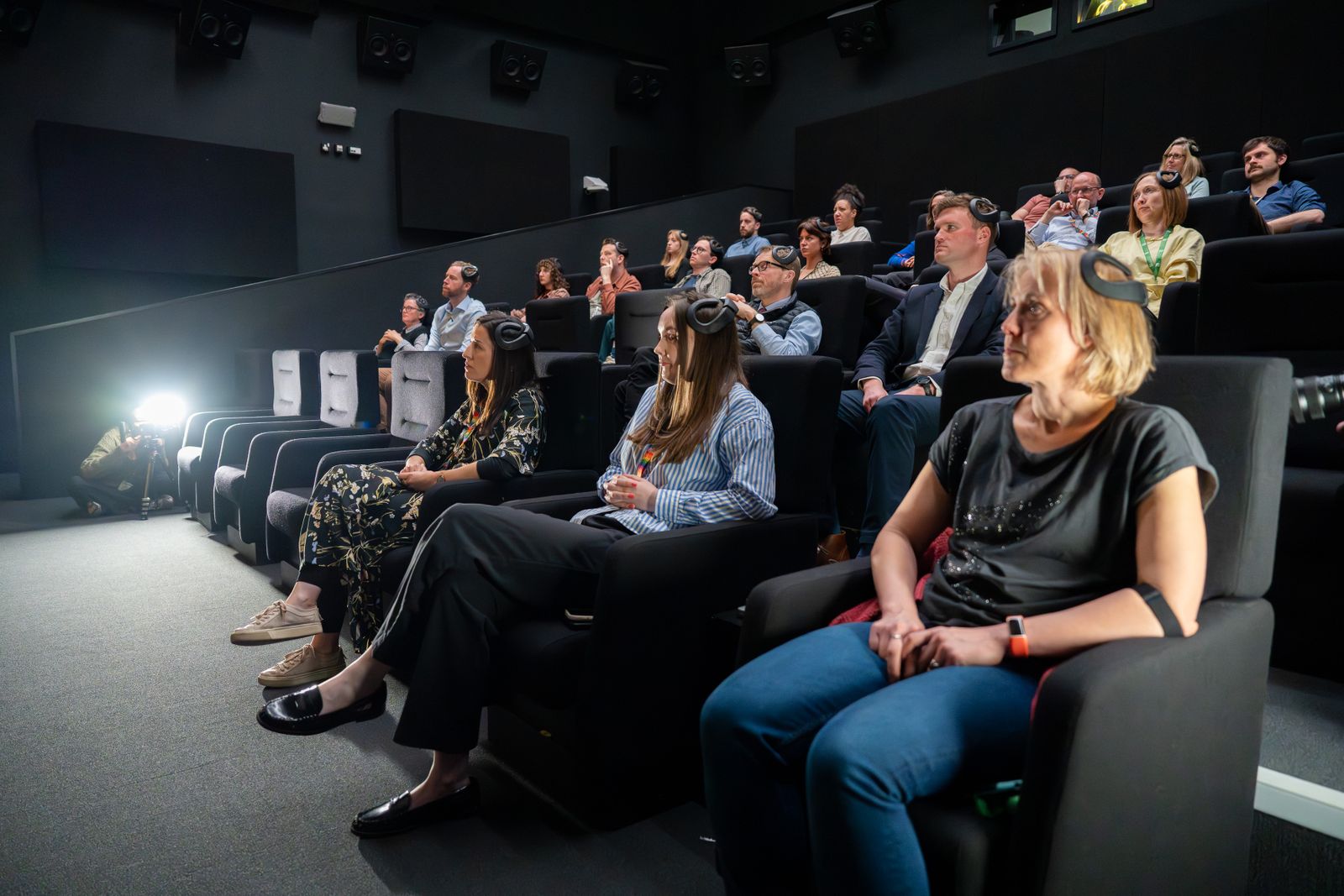
:focal(1750x1167:1751x1168)/https://tf-cmsv2-smithsonianmag-media.s3.amazonaws.com/filer_public/23/d5/23d59582-792e-4521-9c30-401ffb5ab688/smart_cinema_-_audience_2.jpg) The new Smart Cinema theater collects biometric data to track in-the-moment reactions to on-screen action.
University of Bristol
The new Smart Cinema theater collects biometric data to track in-the-moment reactions to on-screen action.
University of Bristol
For decades, movie studios have relied on advance screenings to gauge how audiences respond to in-development films, with viewer reactions informing edits, re-shoots and even changed endings.
Studios typically collect qualitative feedback from written or verbal comments after films end—if audiences in the attention-strapped streaming-age even finish watching. But researchers at the University of Bristol in England now seek to modernize this method with a first-of-its-kind “smart” movie theater that measures viewers’ instantaneous physical reactions with high-tech equipment.
Located on the institution’s new campus, the 35-seat Smart Cinema theater pairs the familiar high-resolution laser projector and Dolby surround-sound speakers with technologies foreign to most movie houses: heart rate monitors, EEG headsets and infrared cameras. By monitoring viewers’ pulses, brain waves, body heat, skin responses and eye movements, researchers say they can more accurately capture in-the-moment, knee-jerk reactions that may be lost or forgotten after the credits roll.
“Those [older] methods have their value, but they always rely on memory,” Iain Gilchrist, a neuropsychologist at the University of Bristol, tells the Times of London’s Will Humphries. “With this smart cinema technology and with these methods, you don’t have to take the risk of releasing something and hoping it works. You can actually get real audience insight, moment by moment, into how they’re responding and then make changes before release. And we think that could bring real value.”
Gilchrist was the co-author of a study published in October in the Journal of Cognitive Neuroscience that applied those methods. Researchers showed 40 people ten short TV clips of varying genres while collecting biometric data. The researchers found that viewer focus and emotional engagement were associated with heart rate and gaze “synchrony,” but their narrative understanding was not.
“Despite the importance and ubiquity of storytelling, relatively little is known about the neurocognitive mechanisms by which narrative media capture and sustain our attention,” the researchers wrote.
/https://tf-cmsv2-smithsonianmag-media.s3.amazonaws.com/filer_public/ca/52/ca527ad3-8c4c-4fb7-b1a7-8f1bc36ee30e/smart_cinema_-_audience_member_wearing_crown.jpg) An audience member wears a “crown” that collects brain wave data.
University of Bristol
An audience member wears a “crown” that collects brain wave data.
University of Bristol
A short science fiction drama called RENO became the Smart Cinema’s inaugural film this week, playing to roughly 200 viewers. Fittingly, the film explores the relationship between humans and artificial intelligence and was produced on an experimental stage at the university that harnesses virtual reality technology.
“As a director, having the opportunity to audience test RENO in the Smart Cinema is truly invaluable,” Rob Hifle, the film’s director, says in a statement. “It’s not just about refining the film; it’s also about connecting with viewers, understanding their reactions, and ensuring that our story resonates deeply. This experience will undoubtedly shape the final cut in ways I can’t yet imagine.”
Fun fact: Alternate endings Test audiences have informed some memorable Hollywood flicks. Nicholas Barber reported for BBC News in 2022 that viewer screening reactions saved the freeway musical sequence in La La Land, changed the fate of Glenn Close’s character at the end of Fatal Attraction and led Steven Spielberg to extend a scene in Jaws to better scare the audience./https://tf-cmsv2-smithsonianmag-media.s3.amazonaws.com/filer_public/e5/01/e50106a4-7c56-438d-b1dd-5451a0f99e4e/smart_cinema_-_audience_member_wearing_arm_band.jpg) Arm bands track biometric data, helping researchers and directors discern physical reactions.
University of Bristol
Arm bands track biometric data, helping researchers and directors discern physical reactions.
University of Bristol
Despite the new theater’s buzz, not everyone carries optimism that it will have a groundbreaking effect on cinema.
“Original storytelling prioritizes craft and story, not a formula of ‘50 percent of tested audience members want X,’” Amanda Lotz, a media scholar at Queensland University of Technology in Australia, tells the Guardian’s Linda Geddes.
Still, creators of other types of media might want in on the high-tech action. Bristol researchers say that the new cinema’s technology could also test live music or advertising.
Get the latest stories in your inbox every weekday.
Comments (0)