
Remember me



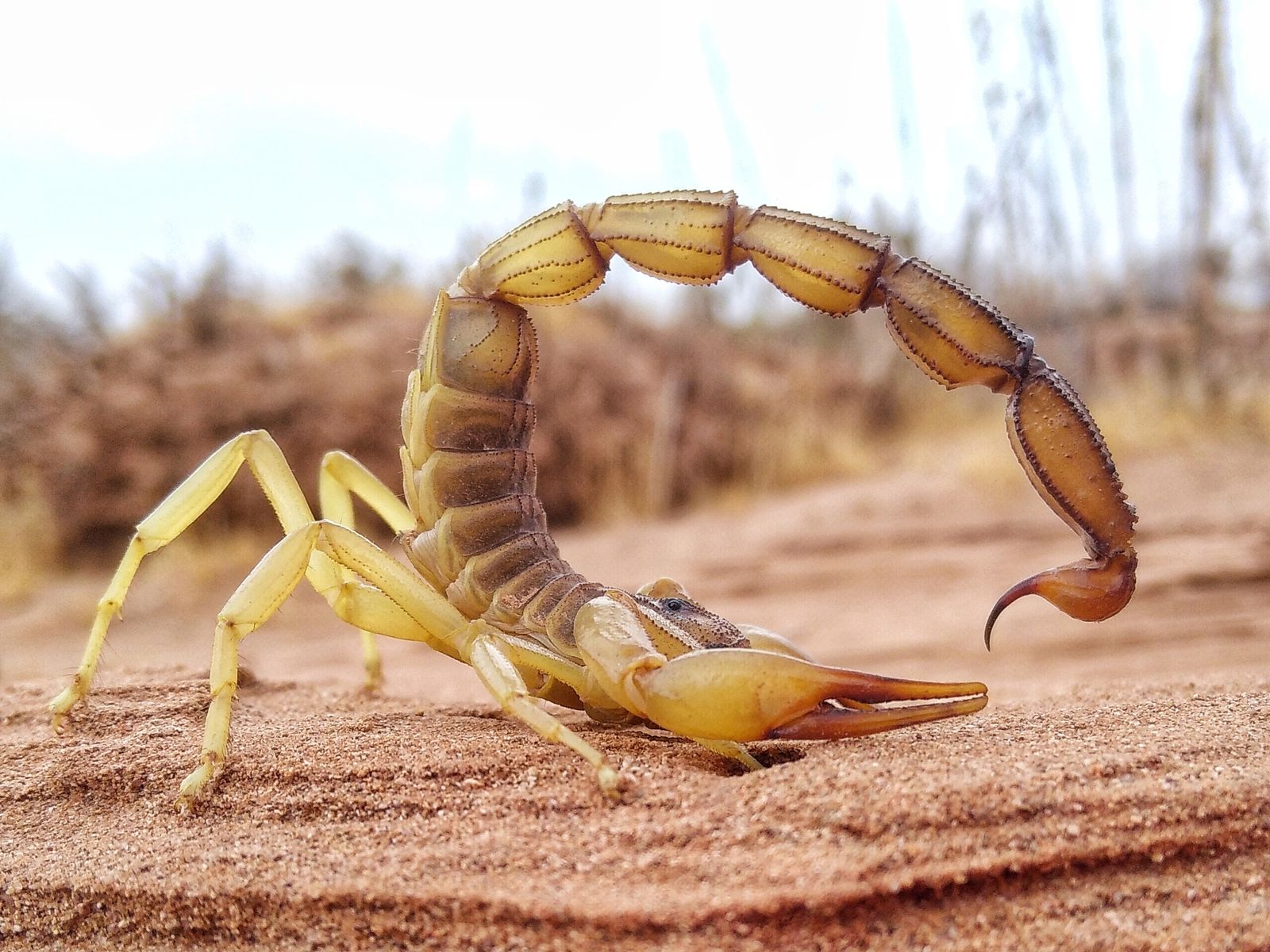


:focal(1024x770:1025x771)/https://tf-cmsv2-smithsonianmag-media.s3.amazonaws.com/filer_public/86/71/86717296-de0f-486d-a5db-0170eeb7f2c1/buthidae_1.jpeg) African fattail scorpion (Androctonus amoreuxi)
Mohamed Mousaid, some rights reserved (CC BY-NC)
African fattail scorpion (Androctonus amoreuxi)
Mohamed Mousaid, some rights reserved (CC BY-NC)
Scorpions have eight legs like a spider, claws like a lobster and an upward curling tail ending in a venomous spur like seemingly no other creature. Within their exoskeletons is another intriguing characteristic: Like tiny cyborgs, the predators’ stingers and claws are bolstered with metals.
Most of a scorpion’s exoskeleton is made of chitin, a complex sugar that forms a tough protective covering for the animal’s body. But their claws and stingers, which face strong impact forces as they grasp and stab, must be extra sturdy—especially because adult scorpions can’t repair any lost body parts. “If something gets damaged or broken, that’s just what they’re stuck with for life,” says scorpion biologist Lauren Esposito.
Scientists knew that some scorpions’ stingers and pincers are enriched with metals, but they weren’t sure how these elements were organized in the weapons—or how their concentration varied between species. With thousands of scorpion species worldwide, and so few having been studied in detail for their metals, researchers had lots of questions.
“Scorpions are incredible hunters,” Sam Campbell, a biologist and former graduate student fellow at the Smithsonian’s National Museum of Natural History, says in a statement. He wanted to find out “whether this metal enrichment relates to how they hunt.”
/https://tf-cmsv2-smithsonianmag-media.s3.amazonaws.com/filer_public/72/2e/722ec8c6-1b16-4906-b6e6-775d70a7356f/buthidae_2_adobe_express.jpg) Sergent's fat-tailed scorpion (Androctonus sergenti). The Androctonus family of scorpions, also known as fattail scorpions, is known for its potent venom featuring a powerful neurtoxin that can be lethal to humans.
Mohamed Mousaid, some rights reserved (CC-BY-NC)
Sergent's fat-tailed scorpion (Androctonus sergenti). The Androctonus family of scorpions, also known as fattail scorpions, is known for its potent venom featuring a powerful neurtoxin that can be lethal to humans.
Mohamed Mousaid, some rights reserved (CC-BY-NC)
In a new study published April 28 in the Journal of the Royal Society Interface, Campbell and his team turned to the collections at the museum to shed light on these arachnids’ anatomy. Using X-ray analysis, electron microscopes and lasers thinner than the width of a human hair, they zeroed in on 18 scorpion species from a range of families. The scientists’ images uncovered patterns in how metals—notably zinc, manganese and iron—are distributed across the scorpions’ bodies.
First, they found that the metals appear only in localized areas. Rather than the whole pincer or the full tail being sheathed in metallic armor, these elements fortify just the tooth-like structures on the inner edge of each claw and the pointed needle at the very tip of the stinger.
Iron, they found, was only in the claws, and manganese appeared just in the stinger. Zinc could be seen in both—but it showed up unevenly in each weapon.
“Scorpions that invest heavily in zinc for their stinger generally have lower zinc levels in their claws,” and vice versa, says study co-author Edward Vicenzi, a research scientist at the Smithsonian’s Museum Conservation Institute. It suggests “an evolutionary trade-off” in which weapon gets strengthened by the metal.
/https://tf-cmsv2-smithsonianmag-media.s3.amazonaws.com/filer_public/2d/02/2d02887b-c0b5-493b-8136-d0509274d03e/scorpiondae_3.jpg) Black legged burrowing scorpion (Opistophthalmus fuscipes). The burrowing scorpions use their large and durable claws to dig burrows. They are less venemous than fattail scorpions and rely more on their large pincers to crush prey.
Paul Bester, some rights reserved (CC-BY-NC)
Black legged burrowing scorpion (Opistophthalmus fuscipes). The burrowing scorpions use their large and durable claws to dig burrows. They are less venemous than fattail scorpions and rely more on their large pincers to crush prey.
Paul Bester, some rights reserved (CC-BY-NC)
Previous research has found that many scorpions tend to use one of their weapons preferentially when they hunt. The discovery that zinc tends to enrich one weapon more than the other offers additional support for that idea. “Some scorpions rely more on stinging their prey, and other scorpions rely more on capturing and grasping their prey with their pincers,” says study co-author Hannah Wood, a research entomologist and curator of arachnids at the National Museum of Natural History. “And then you get variation in between that.”
In 12 of the scorpion stingers, zinc appeared at the very tip. And in some of those, manganese appeared below it, stacked separately. “It really kind of looks like a layered popsicle,” Vicenzi says. In the claws, where zinc and iron were present, the elements were more blended rather than discrete.
Quick facts: How to study scorpions’ metal The researchers worked with samples from the National Museum of Natural History’s collection of between 3,000 and 4,000 scorpion specimens housed across 480 jars. In one technique called micro XRF imaging, they shot a laser beam at the scorpions’ stingers and pincers, capturing a visual that mapped out where the metals were distributed.Looking at the claws, the team found something that surprised them: Scorpions with smaller and weaker pincers had more zinc and iron in those weapons, compared with species with bigger and stronger claws. These elements could be the key to making little pincers more durable.
“If you have really big pincers, you’re more likely to use a lot of force but be kind of slow about how you use that force, whereas little things are just really fast, they’re really reactive,” says biologist Esposito, who was not involved in the study. “So that would, in my mind, mean that they probably also have a tendency to break much easier, because they’re using this really fast force on a pretty delicately constructed body part.”
For those types of claws to have metals that strengthen these quick-closing weapons, “would make a lot of sense to me,” she adds.
/https://tf-cmsv2-smithsonianmag-media.s3.amazonaws.com/filer_public/b7/a0/b7a0a9fa-b374-499c-9fca-9c6b6bfc15ea/scorpion_stinger_xrf_1_1.jpg) Micro X-ray fluorescence microscopy of the metals present the stinger of an emperor scorpion (Pandinus imperator). Zinc (red) is concentrated toward the tip, and manganese (green) is concentrated farther down, with a clear line in between.
E.P. Vicenzi / Smithsonian Museum Conservation Institute and NIST
Micro X-ray fluorescence microscopy of the metals present the stinger of an emperor scorpion (Pandinus imperator). Zinc (red) is concentrated toward the tip, and manganese (green) is concentrated farther down, with a clear line in between.
E.P. Vicenzi / Smithsonian Museum Conservation Institute and NIST
Beyond the imaging, the research team analyzed the scorpions’ evolutionary relationships across the family tree. This was crucial to getting meaningful data, Wood says. For example, if a group of scorpions were all shown to have a similar distribution of metals, that might be considered a significant finding—until scientists learn that that they are all closely related and thus expected to show similar patterns. So, the team made sure to select scorpions from different families and account for their evolutionary past.
“That allows for our analysis to be more powerful,” Wood says. “That was a really novel aspect of this study.”
Scorpions are not alone in their metallic nature. Other arthropods, including ants, wasps and centipedes, have metal-enriched body parts, too. The methods outlined in this study, the researchers note, could offer a model for studying the metals across all these creatures, as well as in other scorpions. “I’m hopeful that future studies will use our approach, and then we can make more broad biological interpretations,” Vicenzi says.
/https://tf-cmsv2-smithsonianmag-media.s3.amazonaws.com/filer_public/78/12/7812650b-3ff2-49e0-8565-3f70e47bd705/4_isometroides_tarsus.jpg) Secondary electron micrograph showing the claw (top down) of an Australian scorpion from the Isometroides genus, known to exclusively prey on spiders. Trichobothria, specialized hair-like sensory structures, can be seen on either side of the claw's cutting edge.
Sam Campbell / University of Queensland
Secondary electron micrograph showing the claw (top down) of an Australian scorpion from the Isometroides genus, known to exclusively prey on spiders. Trichobothria, specialized hair-like sensory structures, can be seen on either side of the claw's cutting edge.
Sam Campbell / University of Queensland
Esposito says the work is an “exciting” step forward for scorpion biology, and that everything scientists learn about the ancient animals allows for a better understanding of “how they’ve managed to survive for 450 million years.”
Because of their intimidating weaponry and painful stings, scorpions can have a bad reputation. But getting to know the biology behind their arsenal, perhaps, could make them seem more fascinating than fearsome. Studying the animals can “help the public understand how complicated and interesting these creatures are, and worthy of our love,” Wood says. “I love arachnids. They’re just really interesting organisms.”
Get the latest on what's happening At the Smithsonian in your inbox.
Comments (0)