
Remember me


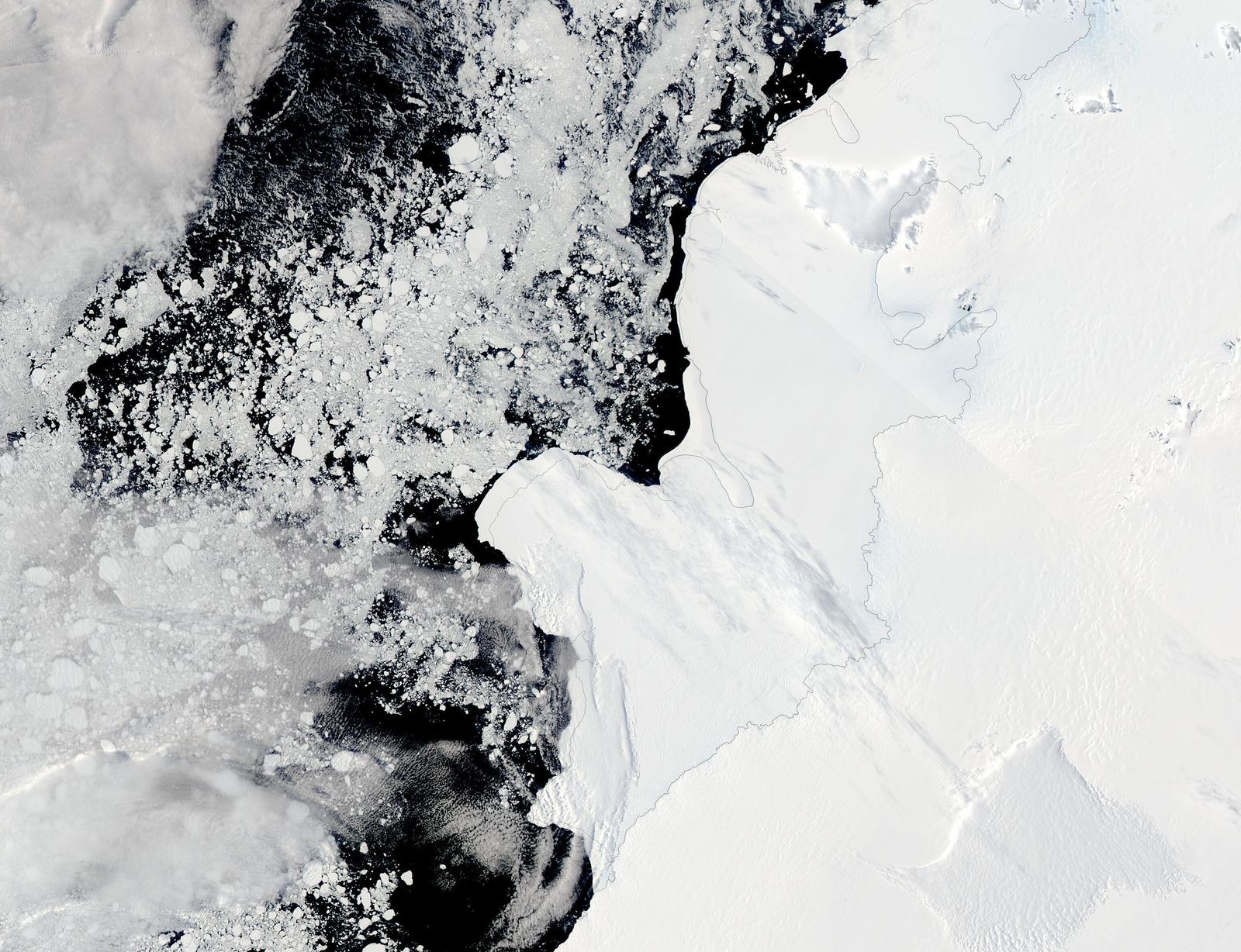







:focal(1532x1182:1533x1183)/https://tf-cmsv2-smithsonianmag-media.s3.amazonaws.com/filer_public/d5/73/d5731a8e-c968-46bd-ac7e-7bf9a86f99f8/sea_ice_off_brunt_ice_shelf_modis_2021-01-31.jpg) Sea ice forms off the edge of the Brunt Ice Shelf in Antarctica’s Weddell Sea.
NASA
Sea ice forms off the edge of the Brunt Ice Shelf in Antarctica’s Weddell Sea.
NASA
The massive ice sheet covering Antarctica holds enough water to raise the global sea level by almost 200 feet. Human-caused climate change has been making it melt, raising the risk of flooding and other damaging effects for people living in many corners of the world.
Now, two new studies reveal the complex ways in which the ocean and atmosphere are interacting with Antarctic ice, potentially spurring even more melting. One, published April 28 in the journal Communications Earth and Environment, showed that deep-ocean heat has crept closer to Antarctica. Another, published last month in the journal Proceedings of the National Academy of Sciences, found that powerful winds have allowed warmer water trapped below the surface to move upward.
Both projects relied on the Argo network, a fleet of robotic instruments that drift around the global ocean collecting data like temperature and salt content at various depths, including beneath Antarctic sea ice. While most bodies of water have a sun-heated top layer, the Southern Ocean’s air temperature is so chilly that the warmer water gets trapped deep below the surface.
But that seems to be changing.
“In the past, the ice sheets were protected by a bath of cold water, preventing them from melting,” says Sarah Purkey, an oceanographer at the Scripps Institution of Oceanography, and co-author of the deep-ocean heat study, in a statement. “Now, it looks like the ocean’s circulation has changed, and it’s almost like someone turned on the hot tap and now the bath is getting warmer.”
Purkey and her colleagues combined Argo data with measurements taken by ships around once every decade. Machine learning helped them generate month-by-month snapshots of the ocean over the past four decades. Analyses revealed that a mass of warm water usually contained in the ocean’s depths has moved closer to Antarctica over the past 20 years, marking the first time scientists have seen this shift throughout the Southern Ocean.
The results didn’t surprise the researchers. “It’s something that had been predicted by climate models due to global warming,” says study co-author Joshua Lanham, a climate scientist at the University of Cambridge, in the statement.
“Our work shows that there’s also an observational trend that suggests that more heat is getting to Antarctica,” says study co-author Ali Mashayek, also a climate scientist at the University of Cambridge, to Time magazine’s Simmone Shah.
Quick fact: The ocean is taking the heatThe ocean is storing more than 90 percent of the excess heat trapped in the atmosphere by the surplus greenhouse gases that humans are producing.
The team behind the other study was motivated by an Antarctic mystery: Even as the world warmed, sea ice continued to expand through 2015. But in 2016, it collapsed dramatically and hasn’t recovered.
Sea ice forms when Southern Ocean water seasonally freezes. It helps protect the Antarctic ice sheet from the damaging effects of waves and storms, so its loss can jeopardize the continent’s ice.
Using Argo data, researchers found that until 2015, increased precipitation had been trapping the warming ocean water at deeper depths, insulating the sea ice. However, strong winds and storms—probably driven by climate change—starting around 2016 seem to have pushed aside the frigid surface water, allowing the warm, deep water to rise, which can melt sea ice and inhibit its formation.
“What we witnessed was basically this very violent release of all that pent-up heat from below that we linked to the sea ice decline,” study co-author Earle Wilson, an oceanographer at Stanford University, tells Grist’s Matt Simon.
The findings show that scientists need more support to build data-collection networks across the Antarctic polar region, says Zachary Labe, a climate scientist at the research non-profit Climate Central, who was not involved in either study, to the outlet. “This is critical, given the rapid changes we are beginning to observe in this part of the world in a warming climate, with potentially significant consequences for global sea-level rise.”
Get the latest stories in your inbox every weekday.
Comments (0)