
Remember me





/https://tf-cmsv2-smithsonianmag-media.s3.amazonaws.com/accounts/headshot/ChristianThorsberg_Headshot.png)
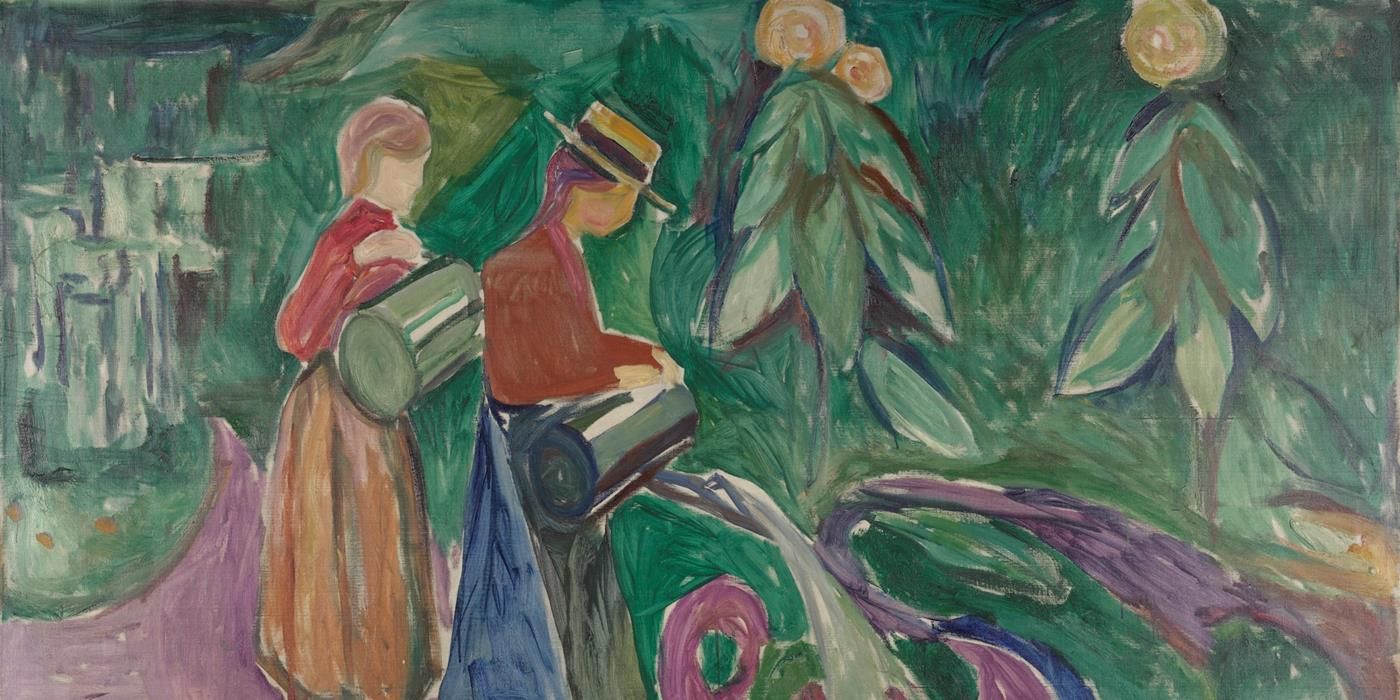
:focal(700x347:701x348)/https://tf-cmsv2-smithsonianmag-media.s3.amazonaws.com/filer_public/37/c8/37c8b0a6-9511-4d41-9cf9-f58491a83ab4/girls-watering-flowers.jpg) Girls Watering Flowers (The Freia Frieze IV), Edvard Munch, 1922, will be on display at the Munch Museum beginning in May.
Halvor Bjørngård, Munchmuseet
Girls Watering Flowers (The Freia Frieze IV), Edvard Munch, 1922, will be on display at the Munch Museum beginning in May.
Halvor Bjørngård, Munchmuseet
A chocolate factory typically produces treats for the tongue. But the historic Freia workshop in Oslo also boasts a feast for the eyes. For a century, it’s displayed a series of artworks that Edvard Munch painted to accompany workers during their lunch breaks.
The factory cafeteria is getting a facelift, creating an opportunity for the lesser-known paintings by one of Norway’s most famous artists to make their museum debut. Moving just a few miles down to the road for a temporary exhibition at the Munch Museum, the large paintings that comprise Munch’s Freia Frieze will anchor a new show fittingly titled “Edvard Munch and the Chocolate Factory.”
“The Frieze and the history of the Freia chocolate factory offer a unique lens to examine the intersections of art, industry, and gender in interwar Norway,” Ana María Bresciani, the curator of the exhibition, says in a statement, per Art News. “Munch pursued alternative, moveable, and non-monumental forms. The Freia commission exemplifies this and challenged the boundaries between public and private art.”
/https://tf-cmsv2-smithsonianmag-media.s3.amazonaws.com/filer_public/2e/ac/2eac34e4-a5df-449b-81bb-ddac3a3b48cd/harvesting_the_tree_the_freia_frieze_v.jpg) Harvesting the Tree (Freia Frieze V), Edvard Munch, 1922
Public domain via Wikimedia Commons
Harvesting the Tree (Freia Frieze V), Edvard Munch, 1922
Public domain via Wikimedia Commons
Roughly three decades after Munch painted the first version of The Scream (1893), Norwegian industrialist Johan Throne Holst approached the artist with a unique proposal: a commission paying about $250,000 to fill the women’s cafeteria at his Freia chocolate factory with new artworks. The effort, which was one of only a few public commissions Munch agreed to in his career, aligned with the artist’s interests in working life, women, children and repose. With notably thin and fast-paced brushstrokes, he worked for two months to paint scenes of young boys fishing at the beach, couples sitting and walking in the woods and girls harvesting fruit and watering flowers.
The scenes reflect a reverence for life’s pleasures outside of work, a balance that Holst strove for as a businessman considered quite progressive compared to the standards of his contemporaries. He manicured the factory’s gardens and park, subsidized workers’ food, kept a family doctor on site and prioritized hygiene, including offering manicures once every 15 days, reports Rosalind Jana for the World of Interiors. Two-thirds of the factory’s workforce were women.
/https://tf-cmsv2-smithsonianmag-media.s3.amazonaws.com/filer_public/ce/6e/ce6e709e-458f-44d8-a548-2c7557fdac8c/dance_on_the_beach_the_freia_frieze_vii.jpg) Dance on the Beach (The Freia Frieze VII), Edvard Munch, 1922
Public domain via Wikimedia Commons
Dance on the Beach (The Freia Frieze VII), Edvard Munch, 1922
Public domain via Wikimedia Commons
“Freia has made a great undertaking,” art critic Jappe Nilsen wrote after the paintings were unveiled, reported Berit Kvam for Nordic Labour Journal in 2013. “It has spearheaded development. It decided that for the workers only the best was good enough and has therefore got Norway’s greatest painter to decorate their canteen.”
Still, long workdays, weekend shifts and a lack of annual leave prompted workers to strike in the 1920s. The artworks carry traces of all the labor workers put in at the factory.
“There is nicotine on the paintings. Maybe it is also cacao powder,” Bresciani tells the World of Interiors. “When you have a work made for public life and you recode it inside the museum space, you have to bring the context along. You cannot ignore the fact that this has been living among workers for 100 years.”
/https://tf-cmsv2-smithsonianmag-media.s3.amazonaws.com/filer_public/56/30/56302b8a-ec96-4595-bbb2-490ee94e8506/vaskekoner-i-trappen.jpg) Charwomen on the Stairs, Edvard Munch, 1906, portrays labor in Norway
Ove Kvavik, Munchmuseet
Did you know? Scream on repeat
Charwomen on the Stairs, Edvard Munch, 1906, portrays labor in Norway
Ove Kvavik, Munchmuseet
Did you know? Scream on repeat
Edvard Munch made four versions of The Scream between 1893 and 1910.
Though this exhibition marks the paintings’ first relocation outside of the factory grounds, in the 1930s the artworks were reinstalled in a larger, all-gender cafeteria, during a formal ceremony backed by an orchestra.
The Freia factory has left its mark on pop culture and history in a few ways. It may have inspired Roald Dahl’s 1964 novel Charlie and the Chocolate Factory. Antarctic explorer Roald Amundsen munched on Freia chocolate during his expeditions.
/https://tf-cmsv2-smithsonianmag-media.s3.amazonaws.com/filer_public/43/40/43405f63-740d-4975-b6c0-afc67ecd25fa/arbeidere-pa-byggeplassen.jpg) Workers on the Building Site, Edvard Munch, 1931 to 1933, a draft for a decoration that Munch intended for Oslo City Hall
Ove Kvavik, Munchmuseet
Workers on the Building Site, Edvard Munch, 1931 to 1933, a draft for a decoration that Munch intended for Oslo City Hall
Ove Kvavik, Munchmuseet
Chocolate lovers may have spotted Munch’s paintings for Freia on select chocolate bar wrappers, but they’ll be able to get a better look at them soon at the Munch Museum, where the Frieze will be accompanied by its preparatory sketches and related works. The show will run from late May through mid-October.
“A rich selection of documentary and archival material gives an extraordinary insight into the times Munch lived in, conditions in the chocolate factory and a changing society,” reads a description of the exhibition on the museum’s website.
“Edvard Munch and the Chocolate Factory” is on display at the Munch museum in Oslo, May 21 through October 11, 2026.
Get the latest stories in your inbox every weekday.
Comments (0)