
Remember me




/https://tf-cmsv2-smithsonianmag-media.s3.amazonaws.com/accounts/headshot/Ellen_Wexler.png)
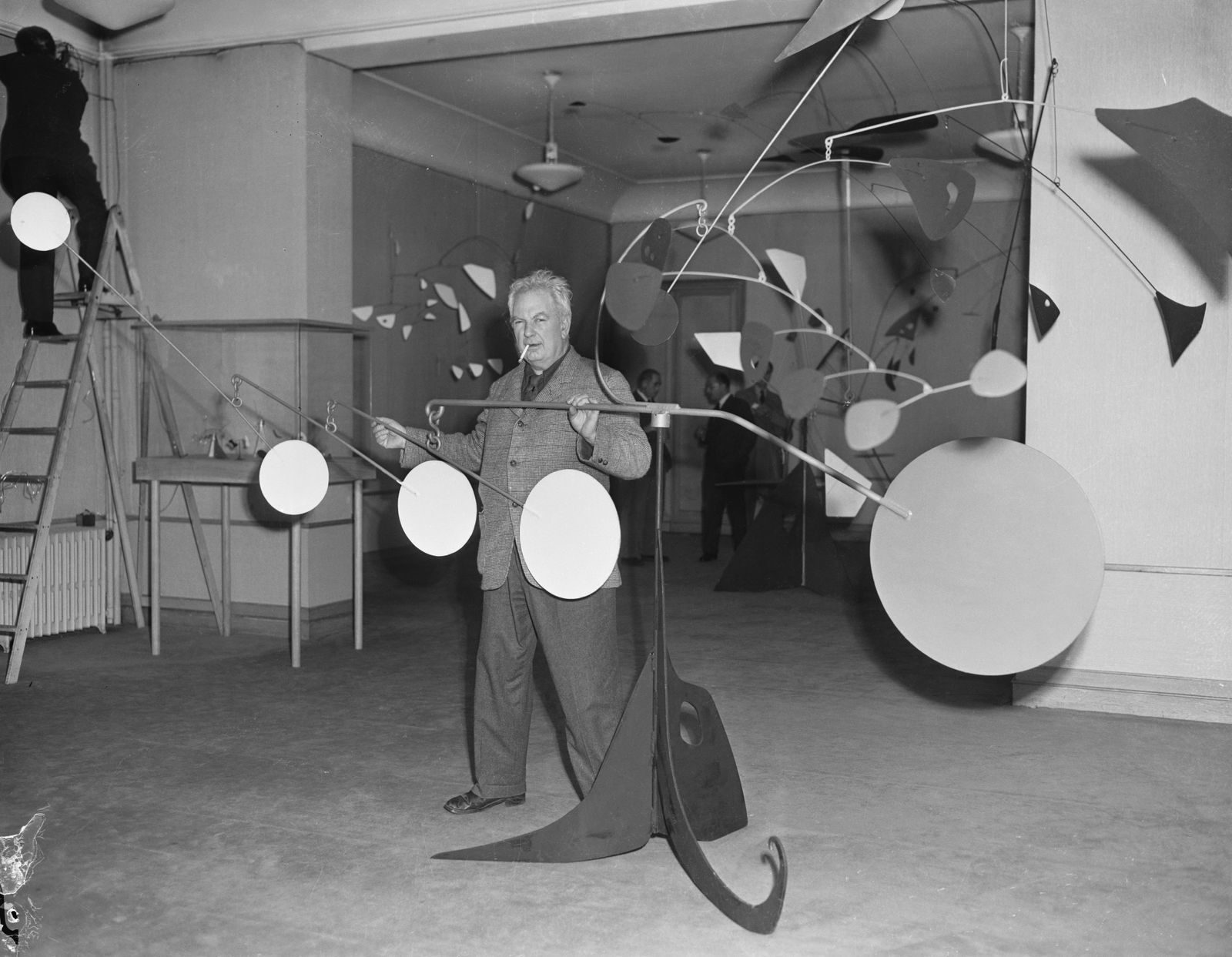
:focal(1955x1526:1956x1527)/https://tf-cmsv2-smithsonianmag-media.s3.amazonaws.com/filer_public/65/88/65883d46-5e21-4cc7-8e44-249c6be57042/gettyimages-517244522.jpg) Sculptor Alexander Calder and one of his mobiles
Bettmann via Getty Images
Sculptor Alexander Calder and one of his mobiles
Bettmann via Getty Images
When Alexander Calder was 11, he made his parents two small animal figurines for Christmas: a dog and a duck, both sculpted from sheets of brass. The dog stood on four legs, with its tail positioned in an upward swirl. But the duck, which rested on its curved underside, rocked back and forth when tapped. Art historians consider it Calder’s first kinetic sculpture.
The year was 1909, and the idea of incorporating movement into sculpture was novel; it would later define Calder’s artistic legacy. Those two early artworks are now on display in a new blockbuster exhibition at the Fondation Louis Vuitton, a relatively new arrival to Paris’ art museum scene. The show commemorates 100 years since the artist’s arrival in France in 1926 and 50 years since his death in 1976.
“Calder’s work holds a unique place in the history of 20th-century art,” Bernard Arnault, president of the museum, writes in the exhibition catalog. “His sculptures are abstract—they do not imitate nature, rather they act like nature. They grow, they move, they possess their own rhythm.”
/https://tf-cmsv2-smithsonianmag-media.s3.amazonaws.com/filer_public/74/36/7436a621-3a3e-4db4-a49e-eacc583e9acf/alexander_calder_dispersed_objects_with_brass_gong_1948.jpg) Dispersed Objects With Brass Gong, Alexander Calder, 1948
© 2026 Calder Foundation, New York / ADAGP, Paris / Art Resource, New York
Dispersed Objects With Brass Gong, Alexander Calder, 1948
© 2026 Calder Foundation, New York / ADAGP, Paris / Art Resource, New York
“Calder: Dreaming in Equilibrium” showcases 300 mobiles (sculptures that move and rotate), stabiles (those that remain stationary), paintings, drawings, wire portraits, carved wooden figures and pieces of jewelry across more than 30,000 square feet of exhibition space. Two of Calder’s monumental stabiles—Black Flag (1974) and Five Swords (1976)—are also on view on the museum’s lawn.
In addition to Calder’s works, the show spotlights art by his contemporaries and friends, including Barbara Hepworth, Pablo Picasso and Paul Klee. Museumgoers will also see photographs of Calder by the likes of Man Ray, Agnès Varda and Gordon Parks.
/https://tf-cmsv2-smithsonianmag-media.s3.amazonaws.com/filer_public/ff/3b/ff3b54fc-30e5-465e-839c-72aa2ebdcb1e/installation_view_of_the_exhibition_calder_rever_en_equilibre_exhibition_presented_from_april_1.jpg) Two of Calder's large-scale sculptures on the museum's lawn
© 2026 Calder Foundation, New York / ADAGP, Paris / © Fondation Louis Vuitton / David Bordes
Two of Calder's large-scale sculptures on the museum's lawn
© 2026 Calder Foundation, New York / ADAGP, Paris / © Fondation Louis Vuitton / David Bordes
The exhibition is organized chronologically, starting downstairs with the tiny dog and duck sculptures, both just over four inches long. But first, visitors will encounter Calder’s 19-foot-long mobile Triumphant Red (1963) hanging in the lobby. As the New York Times’ Emily LaBarge writes, this sculpture’s placement hints that the artist’s career “was anything but linear.”
Born in Philadelphia in 1898, Calder grew up in a family of artists. His grandfather and father were both sculptors, and his mother was a renowned painter. His parents encouraged his early artistic pursuits, but as he neared high school graduation, they urged him to prioritize financial security.
Calder initially heeded this advice, graduating from the Stevens Institute of Technology with a degree in mechanical engineering in 1919. He knew he was talented at working with his hands, a skill that he hoped would serve him well in an engineering career. A few years later, feeling dissatisfied with his work, he enrolled in classes at the Art Students League in New York City.
/https://tf-cmsv2-smithsonianmag-media.s3.amazonaws.com/filer_public/be/5b/be5ba056-5bb8-4751-8369-beb925117a61/sacha_stone_calder_and_the_cirque_calder_1926-1931_1929.jpeg) A photo by Sacha Stone of the sculptor with Cirque Calder
© 2026 Calder Foundation, New York / ADAGP, Paris / Art Resource, New York / © Sacha Stone
A photo by Sacha Stone of the sculptor with Cirque Calder
© 2026 Calder Foundation, New York / ADAGP, Paris / Art Resource, New York / © Sacha Stone
In 1926, Calder moved to Paris, where intellectuals, writers, artists, expats and many others had sparked a creative renaissance. There, Calder started work on an ambitious piece known as Cirque Calder, a miniature circus filled with dozens of tiny wire sculptures of animals and performers. The artist would stage elaborate performances lasting as long as two hours, manipulating his creations by hand. Museumgoers can see the sculptures alongside videos of Calder’s productions. “This piece is one of the highlights of the exhibition,” Le Monde’s Harry Bellet writes. “It is on exceptional loan from the Whitney Museum in New York … and this marks its final trip to France, as its extreme fragility now makes further travel impossible.”
Calder’s artistic breakthrough came in 1930, when he visited the studio of Piet Mondrian, the Dutch artist known for his paintings of red, blue and yellow rectangles. “I suggested to Mondrian that perhaps it would be fun to make these rectangles oscillate,” Calder later wrote. Mondrian wasn’t convinced, but the encounter gave Calder “a shock that started things. Though I had heard the word ‘modern’ before, I did not consciously know or feel the term ‘abstract.’ So now, at 32, I wanted to paint and work in the abstract.”
In 1931, the artist Marcel Duchamp described Calder’s kinetic abstract artworks as “mobiles.” Around the same time, the artist Jean Arp offered the term “stabiles” for his stationary pieces. Today, he’s best known for his mobiles, which are powered by natural air currents. Unlike Cirque Calder, they don’t require the artist’s presence to come to life.
Quick facts: Alexander Calder’s early mobiles One of the mobiles on display in the exhibition is Small Sphere and Heavy Sphere (1932-1933), which features two balls swinging from a horizontal rod. Viewers watch in suspense, waiting to see if the balls will collide with objects—such as a wooden crate, glass bottles and a cymbal—arranged on the ground.“[Calder] revolutionized sculpture,” Suzanne Paget, the artistic director of the Fondation Louis Vuitton, tells Galerie magazine’s Caroline Roux. “Before, it was about volume and mass, and noble materials. Then he comes along, and he starts making the mobiles, and it’s about the void and lightness.”
Later in the exhibition, visitors will see another sculpture Calder made for his mother: an abstract birthday cake. When the candle at its center is lit, aluminum shapes suspended by wires come to life. The sculptor gave it to his mother for her 93rd birthday, nearly half a century after the tiny duck that first set his art in motion.
“Calder: Dreaming in Equilibrium” is on view at the Fondation Louis Vuitton in Paris through August 16, 2026.
Get the latest stories in your inbox every weekday.
Comments (0)