
Remember me
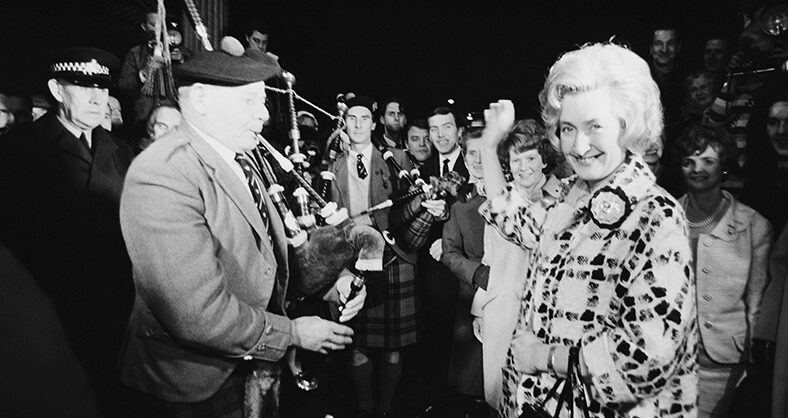
In a 1967 by-election, the SNP candidate Winnie Ewing won the previously safe Labour seat of Hamilton. In the context of that surprise result, the political theorist Tom Nairn reviewed five new books of “tartanry” and considered the difficulties of expressing Scotland’s unique identity.
The success of the Scottish National Party at Hamilton and Mrs Ewing’s triumphant descent on Westminster give added interest to this year’s tartanry. Her path was paved with literature like this,* all published in London (except Mr Kerr’s Opinion Survey) but destined for Scottish and Scotophile bedside tables. Anyone wishing to come to terms with Scottish Nationalism must embark upon a course of it, for this is the deep-rooted cultural substratum of the movement.
Discussion of the relationship between literature and society tends to focus on writing which is good, and which just because of this – by its inner intensity, its real autonomy – escapes from too exact a social definition. But most printed matter presents no such problems. The social function of most books is obvious, and these are no exception. Printed Scottishry exists to feed and sustain a certain appetite in a considerable reading public.
The appetite is for an image: although on different topics the books are really all about one and the same thing, a certain picture of Scotland and the Scots. This is already indicated by the jackets. Mr Kerr’s Survey and Scottish Pageantry show the old Scottish heraldic lion, Famous Scottish Lives has Mary Stuart on her familiar way to the chopping-block, Highland Clans a sunset ruin in a loch. These ritual invitations reassure the reader about the framework of the experience: he can fall asleep with his consciousness of the cult image soothingly retouched. To devotees, the image is significant because it is felt to be themselves, a necessary definition of the national experience they share, or would like to share. Hence, tartan literature is best defined as a constantly renewed exercise in narcissistic self-consciousness.

Subscribe to the New Statesman today and save 75%
The exercise is compulsive because of the deep, central uncertainty in the experience it is related to. Such a perpetual mirror-gaze can only come out of deep anxiety about identity: the scrutiny must continually satisfy the doubts, and yet never can, in the sense of becoming a naturally felt and confident identity, peacefully located on the margins of awareness. It remains in the centre, irascible and self-assertive, too easily hurt by the mildest criticism, boastful for fear of not being noticed, over-sensitive to trifling differences, obsessive to those in the grip of it and tedious to strangers. Visitors to Scotland – or even acquaintances of Scots abroad – dread this sadness like the plague.
The history of the anxiety lies in a persistently different national experience deprived of forms of expression appropriate to it. The difference, profound, stubborn, enduring, too little understood abroad (or, often, by Scots themselves), lies mainly in the Scottish Reformation, and in the distinctive temperament and style of life this massive upheaval forged. Preceding capitalism in Scotland, this religious revolution was the distinctive mould for modern society there, rather than the factors familiar from the more studied evolution of other nations. If one may attempt to paraphrase a recent, brilliant discussion of the formation of modern society: in his Social Origins of Dictatorship and Democracy, Barrington Moore Jr maintains that the matrix of modern societies lies in the character of their previous agrarian structures, in the prevailing nature of the relationship between Lords and peasants. But Scottish agrarian society seems to have had few distinctive features of its own. In the pre-industrial period Lowland agriculture was mainly on the English model. This society was brutally “modernised”, and in effect rushed through a process which corresponded to the long-drawn-out phase of “enclosures” elsewhere in Britain.
Still, this development encapsulated the distinctively Scottish experience within itself. For a period nearly as long as that of the enclosures, this experience has struggled for expression, a unique and fascinating moral world. Its very stubbornness and resistance to time reflects this lack of expression. So do the various disguises it has assumed, in lieu of the institutions which might have corresponded to Scottish nationality. These are the hair-raising collection of absurdities familiar to everyone, the international image of Scottishry. The present collection of books offers as good a panorama of this false consciousness as any.
Top of this particular heap is unquestionably Albert Mackie, better known as ‘Macnib’ to several generations of Edinburgh Evening News readers, and now editor of my candidate for Europe’s worst weekly, the Edinburgh Weekly:
“Life north of the Tartan Curtain can be as sober as Sabbath blacks and the next moment as gay as a swinging kilt…”
he opens up. The rich contradictions of the Scottish nature! “It is also possible,” he goes on, “that the incidence of exaggerated Calvinism among us is itself a reflection of our natural gaiety.” But of course! Even the long dark winters help a bit, for they “have given us a hearty propensity for the consolations of good cheer”. Those capable of following this diseased logic to its conclusion will find in Scottish Pageantry many a couthy description of the ceremonial side of Scots life, from Royal Court to Town Council. William McConagall would not have despised this work. Famous Scottish Lives presents a rich diet of Scottish heroes, from William Wallace up to Sir Boel Spence. It goes without saying that no attempt is made to relate the parade to any consideration of real Scottish personality or culture – although plainly the Calvinist self-made man is a type of some historical importance both here and in North America, and is also of the greatest psychological interest. Professor Donaldson’s survey of Scottish monarchy carries us into the historical dimension of phoniness. Histories of Scotland already exist, for those who want to study it (including the competent Short History of which Professor Donaldson was co-author along with RL Mackie). Pride in one’s history is a weak and stupid sentiment anywhere, which can only be based on wilful ignorance and the desire to delude oneself. That it should still be so widespread in Europe is a common shame, and one of the strongest cultural arguments for unification. That it should be so overwhelmingly strong in Scotland is understandable, in terms of the country’s need for real identity, yet doubly shameful because of the deeply wretched and tragic nature of Scottish history.
It will be strong for a good while yet, to judge by AJC Kerr’s valuable Scottish Opinion Survey. At only 15s, this is by far the best buy of the batch, although the fine photographs of The Highland Clans are attractive even at 63s. Mr Kerr’s Survey probes the opinions of what he calls “educated and responsible” circles, on the question of self-government. This national bourgeoisie ranges from Scots mentioned in Who’s Who to a range of local worthies who have political influence – “The doctor, the minister, the headmaster, the provost and the laird”. Of those who replied to Mr Kerr’s questionnaire 121 favoured a continuance of the Union in its present form, and 177 wanted some change: either self-government for Scotland within a federal system, or complete independence. More wanted federation than independence, but still – the “verdict of the élite”, as Mr Kerr puts it, would seem to be for important changes. “As for the working class,” he confidently declares, “they are overwhelmingly in favour of self-government, with a majority for a clean break.”
The sleekit conformism of the élite may have been undermined on the main issue; but it apparently has little confidence in the Scottish National Party as its agent of possible change. The SNP has been criticised as unduly right-wing in outlook, even judged by modest Tory-lite standards. It is nothing like right-wing enough for the bourgeoisie whose comments fill Mr Kerr’s pages. Obviously convinced that the SNP is incapable of running a tartan gift shop competently, the notables see it as a hot-bed of cranks and “rebel-song-singing idiots”. “Too much of a lunatic fringe still – requires dilution”; “needs less long-haired theorising”; so run the comments.
The SNP’s relations with the intellectuals are even more troubled. Mr Kerr himself is an expellee of the SNP. The party, he points out acidly: “has shown… a remarkable propensity for expelling good men who think along unorthodox lines… There are probably more SNP expellees in Scotland than Tory or Labour expellees in Britain.”
In consequence, he continues, “the average of intellectual ability… is far higher on the Nationalist fringe than within the SNP”. Alienated from the intellectuals, the Nationalist movement must remain bound within the world incarnated in these books, worshipped for so long and with such faith that it has become reality for the Scots. Who will do them the real national service of emancipating them from this?
[Further reading: Inside the mind of Tony Benn]
Content from our partnersRelated
This article appears in the 29 Apr 2026 issue of the New Statesman, The cover-up?