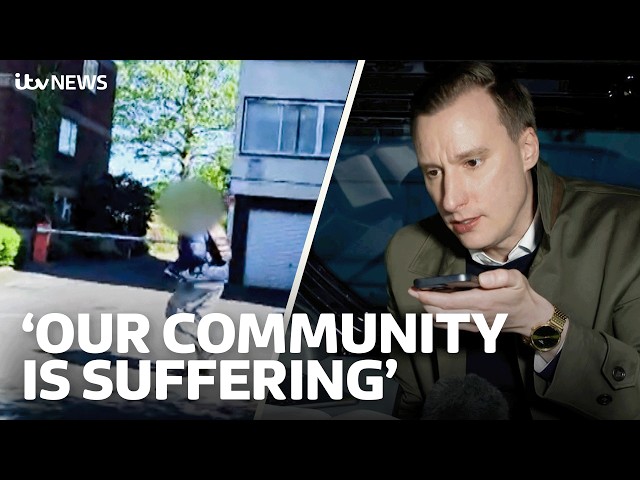
Wales spends more per person on public services than England. Yet in the two biggest areas controlled by the Welsh government, education and health, outcomes are often worse.
Wales has lagged behind the rest of the UK on reading, maths and science for two decades, while patients are much more likely to be stuck on long hospital waiting lists.
What, then, is going wrong? Ahead of a vital Senedd election next week, it’s a question many voters will be asking and something the next Welsh government will need to answer.
In a classroom in Cardiff, a group of Year 7 pupils are trying to get on the same page.
Like in comprehensive schools across Wales, many have arrived at Willows High School having learned very different things.
That’s because, in Wales, there is no longer a set list of topics that every child must learn, so what pupils are taught can vary widely from one primary school to another.
Wales’ new curriculum was launched in 2022 and gave schools more freedom to choose what they teach. Rather than focus on knowledge the curriculum aims to develop general skills as well as place an emphasis on health and well-being.
For secondary schools, this can mean pupils start from very different baselines. In one lesson I attended, a teacher asked her Year 7 class which periods of history they had covered in primary school, and it quickly became clear there was little consistency between them.
"Some of them learned different stuff to me in History,” 11-year-old Mason tells me of his fellow pupils. "Some of them learned about World War I whereas we didn’t, we learned about World War II."
His classmate Madison has a similar story about the Tudors, which other pupils had already been taught whereas her primary school had not. She says she had to "start from the beginning" and work hard to catch up with them.
"The system is designed for teachers to be able to teach what they want and for the children to do discovery learning to a certain extent," deputy head teacher Kelly Bubbins tells me.
"We’re finding that standards can then be very variable when they come in to our school."
Critics say it’s a similar story in the NHS. Like in schools, spending per person on health in Wales is higher than in England, with a significant increase in staffing in recent years. But the number of treatments has not kept pace and outcomes are often worse.
In England, waits of more than two years for treatment have effectively been eliminated. In Wales, although times are falling, thousands of patients are still waiting that long.
In rural mid-Wales, Susan Williams tells me she’s been waiting more than two years for surgery on her spine and still doesn’t know when the operation will take place. Sue is a school bus driver and worries that she’ll soon have to give up a job she loves as the pain intensifies.
"They told me I’d been waiting 69 weeks - then said the wait was now 140 weeks. I just don’t understand how that happens."
"It does get you down. You do feel quite depressed at times, because you’re in pain all the time and you don’t know when it’s going to end."
But the reasons behind those longer waits are complex. Many point to Wales having an older, poorer and therefore sicker population. But the IFS says that despite increased funding and staffing, the number of patients being treated has not risen at the same rate, which suggests a problem with productivity.
Recovery from the pandemic has also been slower than in England, and differences in how services are organised may also play a role.
In the waiting room at Clerk Avenue Surgery in Cwmbran, a teary-eyed Sarah tells me she waited two and a half years waiting to be treated for an embarrassing bladder problem.
"It was really frustrating, because you just feel like you’re not being listened to."
She also suffered with mental health problems due to the wait.
• Subscribe to ITV News on YouTube:
http://bit.ly/2lOHmNj
• Get breaking news and more stories at
http://www.itv.com/news
Follow ITV News on TikTok
https://www.tiktok.com/@itvnews?lang=en
Follow ITV News on Instagram:
https://www.instagram.com/itvnews/
Follow ITV News on Facebook:
https://www.facebook.com/itvnews/
Follow ITV News on X:
https://twitter.com/itvnews 



































































































































































Comments (0)