
Remember me







We must prepare for a period in which global cooperation survives not because of American leadership, but in spite of its absence, writes Terence Cosgrave
I would like to wish a Happy New Year to everyone and begin immediately discussing the issues and problems of the Irish health service, but it’s a bit pointless when the United States government is murdering its own citizens, invading and ‘capturing’ any countries it feels it has a right to ‘own’, and is possibly intent on starting a war with Europe over Greenland.
It’s not possible in the context of this new world to be optimistic about the New Year, and in place of hoping that good things happen, we are in a state of hoping to limit the bad things that very much look like they will happen.
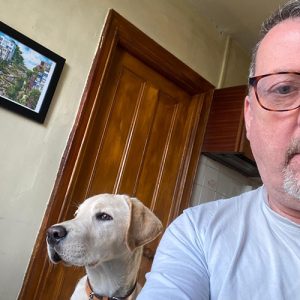
Terence Cosgrave and pup
Let’s begin with the awful wilful murder of a US citizen by her own government. It’s striking that this is a white woman, since black people have been regularly killed by American policemen for a long time. Violence directed by the American police against mainly young black men had long been accepted as just another part of American life, until the televised murder of George Floyd (a few miles from where this incident took place) shocked a lethargic American public into action.
That action slowly and eventually led to police officer Derek Chauvin being charged with murder, and ultimately being sentenced to over 20 years in prison. We are unlikely to see a similar sentence being handed down to the shooter in this incident. Vice-President JD Vance called him one of ‘our’ officers in a social media post following the murder. He obviously believes that these ICE agents serve the Trump regime, rather than the American people.
Trump (of course) went on TV to denounce the victim and to lie repeatedly about what happened, presumably (I’m being kind) without having seen any video of the incident. He said the victim ran her car over an ICE agent, which the video shows is a lie. He said that the shooter was ‘recovering in hospital’ when the shooter was observed by cameras walking around the scene after the incident. He then fled the scene – which also used to be a crime in America.
We are used to Trump’s lies and his ‘flooding the zone’ – the attempt to fill the media with so much conflicting information, people don’t know what to believe. Even in this case, where he is attempting to get people to disbelieve their own eyes, he is ruthless in his pursuit of the lie, the dissembling, the twisted narrative.
America has truly become a full fascist state. Its government now murders people it doesn’t like. Disgusting sycophants like Jesse Watters on Fox News point out that the woman used pronouns, was a lesbian and a ‘self-proclaimed poet’. For many Americans, that damns her and makes her life unworthy.
What has that country become? Where have you gone Joe Di Maggio?
But all of this is merely incidental as to why we need to be concerned about America’s growing drift from reality. Yesterday, the Trump regime also withdrew from 66 international organisations, signalling that the US is no longer interested in global co-operation of any kind. This includes climate change, a threat to us all, but one that the Trump administration calls a ‘hoax’.
The withdrawal from these bodies is not some abstract diplomatic reshuffle or a bit of bureaucratic tidying-up for a new administration. It is a deliberate act of sabotage against the very idea that countries can work together to solve problems that do not respect borders. Climate change does not stop at customs posts. Pandemics do not pause to check passports. Financial contagion, food insecurity, migration flows and technological risk all spill effortlessly across frontiers. The United States knows this perfectly well. Its retreat is not born of ignorance, but of ideology.
International cooperation places limits on power. It requires compromise, evidence, rules and, occasionally, humility. For an administration built on grievance, dominance and the constant assertion of ‘America First’, that is intolerable. Cooperation implies equality. It suggests that the US is one nation among many, not a divinely entitled empire. Walking away from 66 international organisations is therefore not policy, it is performance: a theatrical rejection of the post-war world order that the US itself once designed and led.
It is worth remembering why those institutions existed in the first place. They were created after the catastrophic failure of nationalism in the first half of the twentieth century. The lesson drawn from two World Wars was simple: unrestrained states, acting solely in their own perceived interest, eventually drag everyone into disaster. The United Nations, the World Health Organization, climate accords, arms control treaties and development bodies were imperfect attempts to civilise international behaviour. They were guardrails, not shackles.
America now sees those guardrails as an insult. In withdrawing, it is signalling that it no longer accepts any external constraint on its actions. That should worry everyone, including Americans themselves. When the most powerful state on Earth rejects shared rules, it does not become freer; it becomes more dangerous.
The climate dimension alone should terrify us. The US is one of the largest historical and current contributors to greenhouse gas emissions. Its withdrawal from climate cooperation is not a neutral act; it actively undermines global efforts to limit warming. Every other country is asked to do more, to cut faster, to bear greater cost, while the US shrugs and walks away. This is not just hypocrisy, it is vandalism. The effects will be felt most acutely by poorer countries that contributed least to the problem, but Europe will not be spared. Floods, heatwaves, food price shocks and migration pressures are not theoretical future risks; they are already here.
Then there is public health. The memory of COVID-19 seems to have evaporated in Washington, replaced by conspiracy theories and culture war nonsense. Global disease surveillance and coordination exist precisely because viruses do not care about ideology. By stepping back from international health bodies, the US weakens early warning systems and coordinated responses, increasing the risk that the next outbreak becomes another global catastrophe. This is self-harm dressed up as sovereignty.
The same pattern repeats across arms control, humanitarian aid, development finance and scientific cooperation. Each withdrawal frays another thread in the already strained fabric of global stability. The Trump regime presents this as strength, but it is the strength of a wrecking ball, not of a builder. Destroying systems is easy. Creating workable alternatives is hard, and the US has offered none.
What makes this especially alarming is the vacuum it creates. When the US disengages, others step in. China is only too happy to expand its influence in international institutions, setting standards and norms that reflect its own authoritarian preferences. Russia, though weaker, thrives in chaos and fragmentation. A world without American engagement is not a neutral world; it is one shaped by powers far less interested in democracy, human rights or the rule of law.
Europe, including Ireland, must therefore abandon any lingering illusions. We can no longer assume that the US is a reliable partner committed to shared values or collective problem-solving. That era is over, at least for now. The question is how we respond. Do we cling desperately to a relationship that no longer exists, or do we grow up and act accordingly?
This does not mean hostility for its own sake, but it does mean realism. Europe must strengthen its own capacity to act independently, to defend international law, to invest in climate action, public health and development, even when Washington refuses to do so. It means deepening cooperation with like-minded countries elsewhere. It means accepting that the US, as currently governed, is not a stabilising force, but a destabilising one.
There is also a moral dimension that should not be ignored. International cooperation is not just about efficiency; it is about solidarity. It is about recognising that our fates are linked, that suffering in one part of the world eventually echoes elsewhere. The US withdrawal represents a rejection of that basic human insight. It says, in effect, that if others burn, drown or starve, that is not America’s problem. History suggests that such indifference never lasts, because the consequences always return.
For Irish readers, this moment should resonate deeply. We are a small country that has benefited enormously from a rules-based international order. Our prosperity, security and ability to punch above our weight diplomatically all rest on the idea that Might does not automatically make Right. When a superpower tears up that idea, small states are the first to feel the chill.
This is not a call for panic, but it is a call for clarity. The United States is withdrawing from the world, not because the world has failed, but because cooperation conflicts with the authoritarian instincts now driving American politics. That withdrawal will make the world poorer, more dangerous and less predictable.
The New Year, then, begins not with hope, but with a grim form of resolve. We must prepare for a period in which global cooperation survives not because of American leadership, but in spite of its absence. Whether we can rise to that challenge will shape the decades ahead. 
Comments (0)