
Remember me

When the International Association of Cape Horners first saw the light of day in its earliest form in 1936 in St Malo, the Last Grain Race (as so brilliantly recounted by Eric Newby) had just been sailed from Australia to Europe, mostly by Gustaf Erikson’s tall ships. But those tough old captains whose very raison d’etre was disappearing, those seasoned veterans in St Malo were determined that the demanding way in which they’d made a living would not be forgotten, and so they brought this very special body into being.
Nowadays, the Association has evolved to celebrate all who have sailed round the Horn, with Sir Robin Knox-Johnston as President and Jean-Luc van den Heede as VP, while its offices are in the port of Les Sables d’Olonne. There, the typically corporate French council push their town as though it is one big commercial conglomerate with many diverse maritime subsidies, and bringing the Cape Horners under their umbrella was a no-brainer.
 Seasoned sailors. Jean-Luc van den Heede (left) Vice President of the International Association of Cape Horners, with the President, Sir Robin Knox-Johnston.
But while it is now recreational sailors who make up the strength of the Association, the standards set by the original old salts have been maintained. To be in the Cape Horners’ modern Hall of Fame, you have to have been in a yacht or sailing vessel of some kind in which rounding the Horn has been part of a continuous 3,000 mile voyage, with no use of engine for propulsion purposes while at sea.
 Cape Horn as seen from Sam Davis of Strangford Lough’s Rival 41 Suvretta in March 2011. Photo: Sam Davis
This means that the IACH has been able to induct members on an almost industrial scale from the big heavily-sponsored Round the World races. Yet gallant solo or small-crewed sailors who struggled to weather the Horn east-west don’t make the cut, as almost invariably at some stage they have had to seek shelter in the archipelago at the southern tip of South America.
SLOCUM AND O’BRIENAlthough it has been calculated that Joshua Slocum (already a big sailing ship Cape Horn veteran) managed to get west of the Horn with his pioneering east-west solo circumnavigation in Spray in 1895-98, he was driven back and eventually had to use the channels to get to the Pacific without properly doubling the Horn.
 Joshua Slocum’s Spray was blessed by an ability to self-steer when the sails were properly trimmed.
Then in December 1924 Conor O’Brien and a crew of three came in from the west directly from New Zealand with the 42ft gaff ketch Saoirse. Though he’d already experienced some ferocious conditions in his global circumnavigation, particularly to the southward of the Indian Ocean, this first proper rounding of the Horn by an amateur sailing yacht was relatively straightforward.
 Conor O’Brien’s globe-girdling Saoirse, as re-created by Liam Hegarty of Oldcourt for the late Fred Kinmonth. It is now recognised that Saoirse’s west-east rounding of Cape Horn in December 1924 was a world first.
The record keepers, however, give prominence to solo sailors, and in 1934 a Norwegian, Al Hansen, with his 36ft Colin Archer-style gaff cutter Mary Jane, “crewed” by a friendly dog and a gallant kitten, made the first solo rounding, and it was also the first east-west doubling. Unfortunately Mary Jane was wrecked in a storm off the coast of Chile and Hansen and his two pets were never heard of again, but in any case in terms of the strict record-keeping, he tripped at the 3,000 mile hurdle.
 Al Hansen of Norway with the 36ft Mary Jane achieved the first east-west rounding of Cape Horn by an amateur sailor in 1934.
 Al Hansen and his crew – all were lost in a storm off the coast of Chile.
Then in 1942 while the rest of the world was at war, the Argentinian Vito Dumas made a global circuit with the 31ft Colin Archer-type Bermudan ketch Lehg II from Buenos Aires, calling only at Capetown and Wellington, and rounding the Horn west-east in the southern winter. But as his voyage did not take him across the Equator and was essentially a circuit of Antarctica, it has a special category of its own, although the Cruising Club of America did in time award him their Blue Water Medal “without date”.
 Marcel Bardiaux began building his boat Les Quatre Vents in secret in German-occupied France during World War II, and then in 1952-58 he sailed her round the world with an east-west rounding of Cape Horn.
 The track recorded by Marcel Bardiaux in his winter rounding of Cape Horn east-west.
Even more harsh in his down-grading is French sailor Marcel Bardiaux (1910-2000). He managed to build much of his 9.38 m (31ft) wooden sloop Les Quatres Vents in secret despite the German occupation of France during World War II of 1939-45, and eventually in the southern winter of 1952, he found himself trying to negotiate Cape Horn east-west with this slip of a boat.
 Les Quatre Vents anchored off Ushuaia after rounding Cape Horn in 1952, reputedly the first yacht ever seen at this furthest south town in the world.
He made it, but as his track chart shows, it was definitely not in the clean-cut style expected by the Cape Horn association. And even though the battered little Les Quatres Vents (which had survived being completely rolled back in Le Maire Straits) went on to be the first yacht ever seen in the most southerly port of Ushuaia and then finally completed the global circumnavigation in 1958, Bardiaux’s name seems to have slipped below the radar.
UP-DATED CAPE HORN LISTINGYet it’s only fairly recently that the listing for the crewed roundings has been amended again, this is how it now looks here
It took a while and the Irish Cruising Club’s re-publication of Conor O’Brien’s Across Three Oceans for the Saoirse Centenary during 2023-2025 to set the record straight. But as Saoirse was totally engineless and had logged 5,800 miles direct from Auckland when she reached Port Stanley via Cape Horn on 6th December 1924, it was as though O’Brien and his three shipmates had sailed with those IACH requirements inscribed on a yellow sticky on the chart table bulkhead.
 Conor O’Brien at the helm during the pioneering world voyage of Saoirse, Dun Laoghaire to Dun Laoghaire, June 20th 1923 to June 20th 1925.
Those requirements are so demanding that at present it seems that Conor O’Brien was completely out on his own for half a Century as the first rounding on a proper voyage with a crew. Yet just as it has taken a while to get the Saoirse achievement into proper perspective and recognition, so in time we may find that there are some unsung sailors who did the 3,000 mile business between Conor O’Brien in 1924, and Butch Dalrymple-Smyth (once upon a time of Crosshaven) and his skipper Ramon Carlin and their mates with the Swan 65 Sayula in the Whitbread Round the World Race in 1974.
SOLOS SET THE PACEAnd of course the solos had set the accelerating pace onwards from Francis Chichester in 1967, with Robin Knox-Johnston achieving the first non-stop global circuit round all the great capes in 1969 in his own-built 32ft bermudan ketch Suhaili.
 Robin Knox-Johnston with Suhaili Photo: Bill Rowntree / PPL
It was a singular and magnificent achievement which drew a clear line under the story of sailing round Cape Horn. Yet it seems the lure of Cape Horn is greater than ever, and the IACH refers to it as “the Everest of sailing”. And as it happens, a year or two ago, when we were up to our tonsils in the O’Brien Centenary, we pointed out that he was also a mountaineer who climbed in Snowdonia with the group that centrally included Everest challengers George Mallory and Sandy Irvine.
O’BRIEN’S OWN EVERESTHowever, with his fiery temperament, O’Brien was not on the short-list for their final Everest team aiming at 1924. Yet in a cruel irony it was revealed that the remains of Sandy Irvine had been found on Everest in 2024, though with no definite proof he and Mallory had made the summit. But at almost exactly the same time, the Centenary of O’Brien’s successful and definite rounding of Cape Horn was being celebrated in Ireland.
In the Himalayas, they have Holy Mountains, and we have them too in Ireland, but special areas of sea get no more recognition than being thought of as maybe sacred places. Yet we’ve found that if you sail through Scotland’s Corryvreckan under controlled conditions, it amounts to an up-lifting spiritual experience, and doubles the Maelstrom does the same in spades, so Cape Horn will have the same effect. So how did it get its neat yet powerful name?
HOORN – DUTCH PORT OF CHARMIt’s a while since we were in the port of Hoorn, the ancient south-facing harbour on the western shore of the Markermeer south of the Ijsselmeer in The Netherlands beside what – in its saltwater days – was the Zuyder Zee. We remember Hoorn as a quietly pleasant and very neat and tidy township (you’re in North Holland, after all), and now of an essentially lakeside nature, yet enhanced by its salty history.
 The Dutch port of Hoorn in 1649, when it was at its trading and exploration high point.
For Hoorn was once upon a time a splendid seaport, one of the Six Chambers of the globally-trading Dutch East India Company. The intrepid captains of this august organization were expected not only to return with their ships well laden with exotic and valuable cargoes, but equally to raise awareness and inside knowledge of the most remote coasts on earth.
Thus modern Hoorn has the convenience – thanks to the Zuyder Zee being dyked off to become the Ijsselmeer and the Markermeer – of being tide-free, yet colourfully hinting at the atmosphere of a legend-laden once-salty waterfront, a harbour from which robust sailing ships departed “for other places beyond the seas”.
THE DUTCHMEN LEFT THEIR MARKIn those other places beyond the seas, the Dutchmen left their mark. But as they were also leaders in cartography, the names they gave to some of the world’s most conspicuous coastal features tended to be the names that have stayed with us down the ages.
 The southern tip of South America is a decidedly complicated place, and back in the early days of European exploration, it offered endless opportunities for naming rights.
But in any case the most southern tip of South America remained nameless for some time. For although Francis Drake in his east-west round the world voyage in 1577-1580 gave his name to the Drake Passage or Drake Strait between South America and the then merely-speculated Antarctic continent, the westerlies were such that he reputedly gave the name of Cape Difficulty to the southernmost tip, and eventually accessed the Pacific north of it through the Straits of Magellan as pioneered by Magellan and Elcano during the first global circumnavigation in 1519-1522.
CAPTAIN SCHOUTEN GETS THE NAMING RIGHTSAlthough this was the Great Age of European Exploration, it wasn’t until 1616 that Dutch sea captain Willem Schouten and his supporting merchant Jacob Le Maire explored the area in any detail. While they hailed from Hoorn, they were commercial rebels against the trade restrictions of the Dutch East India Company, and with the ships Eendracht (a former East India vessel) and Hoorn, they were trying to find a clear if stormy way to the riches of the east.
 Captain Willem Schouten of the Eendracht as portrayed in 1625.
In attempting to do so, Le Maire’s ship Hoorn was wrecked. But with the entire surviving company of the two ships now crowded aboard the Eendracht, they broke through to the Pacific past the southern island with useful knowledge of the local area, and named the southernmost headland Cape Hoorn.
CAPE HORN NAMED FOR THE SHIP, NOT THE TOWNIt’s usually thought that the world’s most famous headland is named for the port of Hoorn. But a study of the area as mapped today reveals the importance of the Le Maire Straits. So the backers of the expedition clearly sought permanent memorials, and after Jacob Le Maire shipped aboard Eendracht to round the Horn east-west at least nominally under Schouten’s command, he was commemorating his lost ship every bit as much as he was honouring his home town when it was agreed they’d call the newly-identified headland Cape Hoorn.
Meanwhile the gallant Eendracht, which managed to complete the global circumnavigation to get back to The Netherlands on 1st July 1616, is best remembered through the 55-metre Dutch sail training schooner Eendracht, built 1989 and sailing with rather more creature comforts than her 17th Century namesake.
 The modern Dutch sail training ship Eendracht, built in 1989, is luxurious by comparison with her 17th-century predecessor. Photo: Nick Edwards
All this naming history is of course totally Euro-centric, and the incredibly tough Yaghan people of the area – the world’s most southerly inhabitants – will surely have had their name for the island on which Cape Horn is located, if not for the Horn itself.
But either way, its anglicisation to Cape Horn was a publicity winner, providing two crisp syllables to convey a harsh and unforgiving place where the wind’s noise is mad-making, and drifting icebergs can be added to the onward sweep of the huge swells of the Great Southern Sea.
SEA RACE FROM NEW YORK TO SAN FRANCISCOFor a while in the mid-19th Century, as the new American nation of the USA pushed west across often hostile territory to find the gold and other riches of the Pacific coast, the safest way to get there was aboard a big sailing ship prepared to sail from New York to San Francisco via Cape Horn.
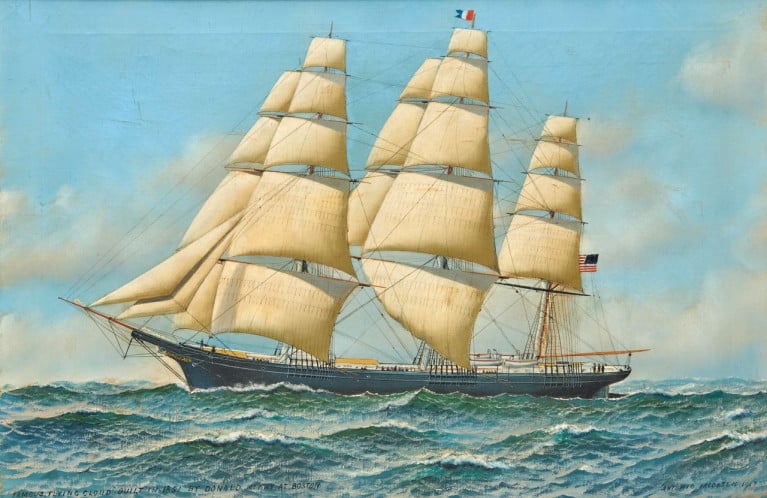
The great Donald McKay of Boston was the best creator of these “super clippers”, and the record for the passage – 89 days and 8 hours – was set by McKay’s mighty Flying Cloud in 1854. It was a very special achievement, as the navigator was Eleanor Creesy, wife of the Captain Josiah Perkins Creesy.
 Conor O’Brien as portrayed by his wife Kitty Clausen.
VITAL NAVIGATING SKILLS
The importance of her skills in setting the record cannot be over-estimated, for in the great westerlies south of Cape Horn, accurately calling the tack to make northward along the west coast of South America could make a difference of several days in getting to San Francisco as quickly as possible.
The advent of trans-America railroads and highways, the Panama Canal in 1914, and universal air travel mean that today Cape Horn has been transformed from a sailor’s nightmare into a tourism novelty. The challenge is still very much there, but over-coming it is not an economic urgency.
 Saoirse departs from Dun Laoghaire June 20th 1923.
However, in looking back over its gradually-tabulated story, we can indeed assert that when Conor O’Brien and Saoirse took their departure from Dun Laoghaire at 16:30 hrs on June 20th 1923, it indisputably was history in the making, and his rounding of Cape Horn in December 1924 was a real and now universally-acknowledged first.
 The voyage of the Saoirse from 1923 to 1925 was the first made by a vessel flying the Tricolour ensign of the new Irish Free State, but at this South American port, Conor O’Brien appears to be covering all options.
Comments (0)