
Remember me



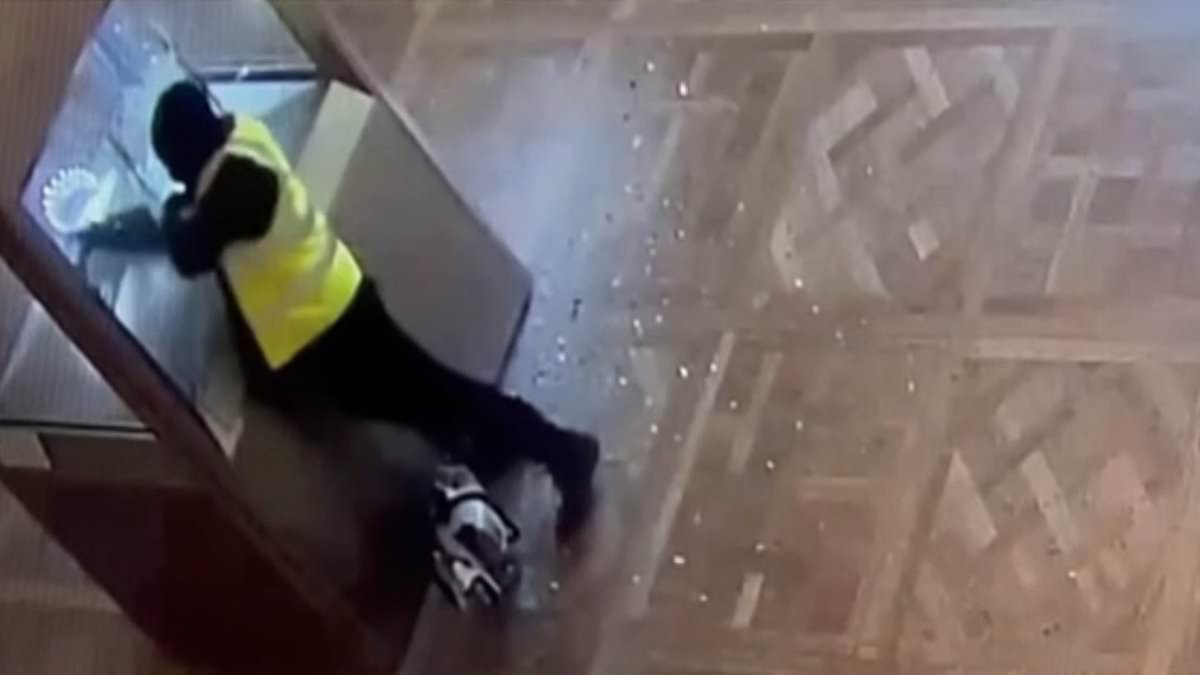
CCTV footage has shown the moment the Louvre heist thieves smashed into display cases and ransacked £76million of jewellery.
The minute-long security camera clip, shared on French TV news show Sept à Huit, captured two burglars each breaking into the glass cases before brazenly seizing their loot.
One of the masked thieves could be seen using his forearm to punch through cracked glass before reaching inside and grabbing three precious ornaments.
He then stuffs the goods into an inside pocket under his hi-vis jacket before picking up his bag, which sits in a scattering of broken glass, and quickly walks away.
Both thieves can then be seen working together to smash their way into a second, larger case, stealing pieces of valuable jewellery before dashing from the scene.
The entire operation, which saw £76million worth of jewellery stolen, lasted only four minutes, from 9:35am to 9:39am, on October 19 at the Louvre's Apollo Gallery.
Within a week, two men in their 30s from Seine-Saint-Denis were arrested in connection with the raid on October 25, one of them at Charles de Gaulle Airport while trying to board a plane to Algeria.
Both were already known to police from past burglary cases. Investigators said they matched trace DNA evidence recovered from a helmet left at the scene of the crime to one of the suspects.

The minute-long security camera clip, shared on French TV news show Sept à Huit, captured two burglars each breaking into the glass cases before brazenly seizing their loot

Both thieves can then be seen working together to smash their way into a second, larger case, stealing pieces of valuable jewellery before dashing from the scene
After four days, the prosecutor's office revealed that the two arrested had partially admitted to their involvement, and that they were charged with organised gang theft and criminal conspiracy.
Five more suspects were arrested on October 29, only one of whom was thought to be part of the four-man team.
Two were charged before a magistrate on October 31 - a 37-year-old-man, with theft and criminal conspiracy, and a 38-year-old-woman, with organised theft and criminal conspiracy with a view to committing a crime.
Both denied any involvement, and three were released.
The prosecutor's office reported on November 25 that four more suspects from Paris were detained by police.
WHAT JEWELS WERE STOLEN? Tiara from the jewellery set of Queen Marie–Amélie and Queen Hortense Necklace from the sapphire jewellery set of Queen Marie–Amélie and Queen HortenseEarring, part of a pair from the sapphire jewellery set of Queen Marie–Amélie and Queen HortenseEmerald necklace from the Marie–Louise setPair of emerald earrings from the Marie–Louise setBrooch known as the reliquary broochTiara of Empress EugénieLarge bodice knot (brooch) of Empress EugénieOne was charged before a magistrate on November 27 - a 39-year-old man, with organised gang theft and criminal conspiracy. The man is believed to be the final member of the four-man team.
The other three detained on November 27 were released.
Charges have been filed against five suspects so far; however, the location of the jewels remains unknown, and none of the pieces have been recovered.
'The interrogations have not produced any new investigative elements,' top Paris prosecutor Laure Beccuau said this week, three months after the broad-daylight heist.
But the case remains a top priority, she underlined: 'Our main objective is still to recover the jewellery.'
On the morning of October 19, the thieves parked a mover's truck with an extendable ladder below the Louvre's Apollo Gallery, housing the French crown jewels.
Two of the thieves climbed up the ladder, broke a window, and used angle grinders to cut glass display booths containing the treasures, while the other two waited below, investigators say.
Beccuau has said the heist was carried out by petty criminals rather than organised crime professionals.
Shortly after the theft, it was revealed by the Louvre's director that the only camera monitoring the Galerie d'Apollon was pointing away from a balcony the thieves climbed over to break in.
The four then fled on high-powered motor scooters, dropping a diamond-and-emerald crown in their hurry.
But eight other items of jewellery – including an emerald-and-diamond necklace that Napoleon I gave his second wife, Empress Marie-Louise – remain at large.
Beccuau said investigators were keeping an open mind as to where the loot might be.

The tiara, pictured, from the jewellery set of Queen Marie-Amélie and Queen Horten that was made in Paris in the 19th century, was taken

Empress Eugenie's tiara (pictured), created by Alexandre-Gabriel Lemonnier in 1853, was stolen

Thieves also got away with an emerald necklace, pictured, from the Marie-Louise set made by master jeweller François-Régnault Nitot in 1810

The gang swiped the necklace, pictured, from the sapphire jewellery set of Queen Marie-Amélie and Queen Hortense. It was made in Paris between 1800 and 1835

Empress Eugenie's brooch, pictured, which contains 2,438 diamonds, was stolen in the raid

French police officers stand next to a furniture elevator used by robbers to enter the Louvre Museum, on Quai Francois Mitterrand, in Paris on October 19, 2025
'We don't have any signals indicating that the jewellery is likely to have crossed the border,' she said, though she added: 'Anything is possible.'
As for anyone coming forward to hand over the jewels, that would be considered to be 'active repentance, which could be taken into consideration' later during a trial, she said.
A fifth suspect, a 38-year-old woman who is the partner of one of the men, has also been charged with being an accomplice but was released under judicial supervision pending a trial.
Investigators still had no idea if someone had ordered the theft.
'It's a hypothesis under consideration, but it cannot be asserted as more certain than any other,' the prosecutor said.
'We refuse to have any preconceived notions about what might have led the individuals concerned to commit this theft,' the prosecutor said, while adding that detectives and investigating magistrates were resolute.
'We haven't said our last word. It will take as long as it takes.'
The president of the Louvre, Laurence des Cars, has since admitted the museum had failed in its responsibilities, but denied that security had been overlooked - saying that from the time she took office in 2021 she had been warning constantly of the need for more investment.
Since the incident, security measures have been tightened around France's cultural institutions.
The Louvre has transferred some of its most precious jewels to the Bank of France following the heist.
Comments (0)