
Remember me





Whales returning to the Gulf of St. Lawrence are increasingly sharing the same food, a trend that reflects how warming waters and changing prey are reshaping one of the North Atlantic’s most important feeding grounds.
The Gulf of St. Lawrence is an important seasonal stop for multiple whale species that arrive each summer to rebuild energy reserves. As waters warm, ice cover shrinks, and prey availability becomes less predictable, whales face the problem of coexisting when food is harder to come by. A new long-term study, published in Frontiers in Marine Science, suggests that fin, humpback, and minke whales are adjusting not by outcompeting one another, but by reshaping how they share resources.
“Highly mobile species like baleen whales can use several strategies to reduce competition, for example, by shifting their feeding timing or area, or selecting different prey within a feeding area,” said first author Charlotte Tessier-Larivière, in a press release.
Read More: Those Orcas Wearing Salmon Hats? It Might Not Be as Cute as You Think
Tracking Whales Sharing Food in a Warming Ocean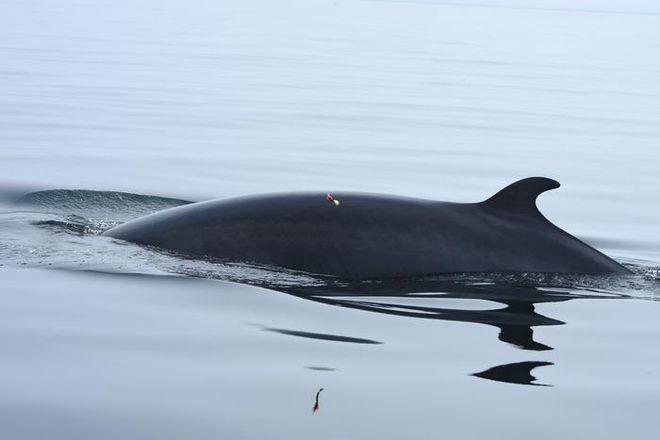
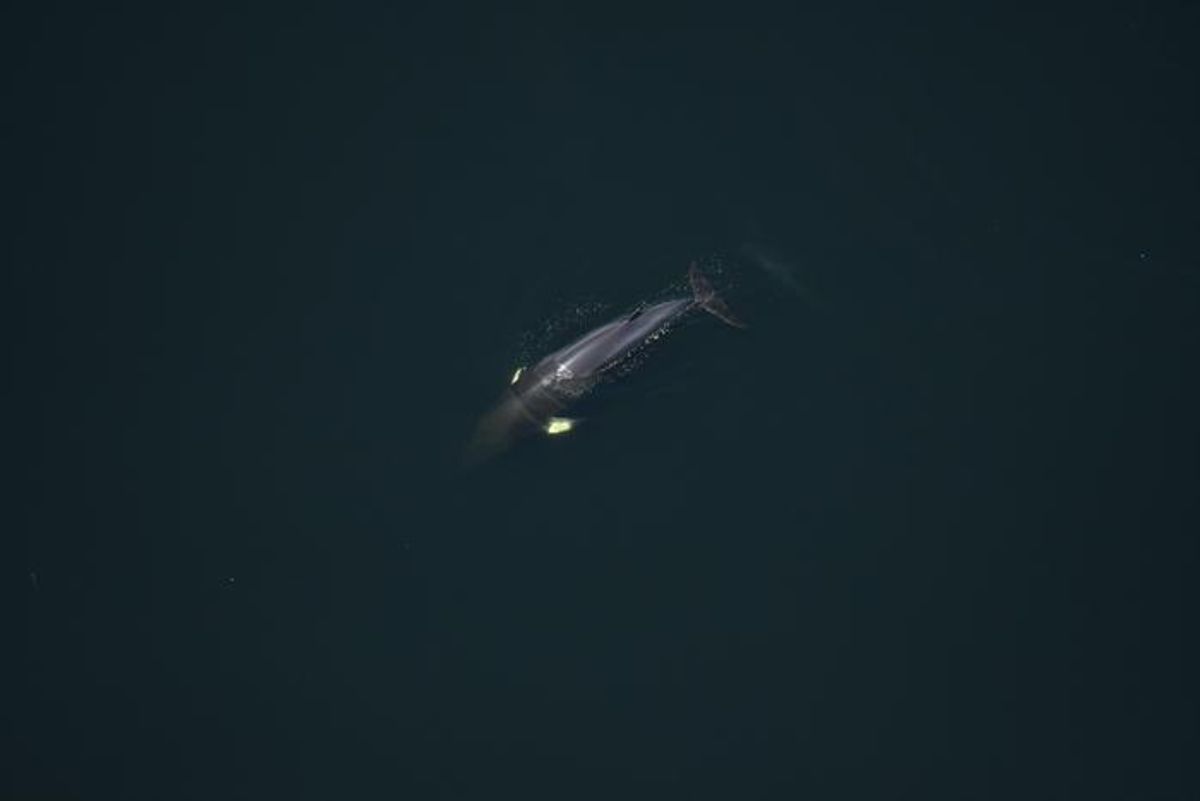
Minke whale with a biopsy arrow.
(Image Credit: Fisheries and Oceans Canada)
The findings draw on a 28-year study published in Frontiers in Marine Science that tracked how whale diets in the Gulf of St. Lawrence have shifted since the early 1990s. Researchers analyzed carbon and nitrogen isotope signatures from more than 1,100 skin samples collected from fin, humpback, and minke whales between 1992 and 2019, using those chemical markers to reconstruct long-term feeding patterns.
Across three periods marked by warming waters and ecosystem change, all three species showed a steady move away from krill and toward fish such as capelin, herring, and mackerel. But instead of converging on the same diet, their core feeding niches became more distinct in the most recent years.
Sharing Food Without Crowding Out CompetitorsIn the early 2000s, overlap among the whales’ feeding niches was substantial. Minke whales, in particular, shared about 65 percent of their core feeding niche with fin and humpback whales combined. Humpback whales overlapped with minkes by roughly 56 percent, while fin whales overlapped with minkes by about 42 percent.
By the 2010s, niche overlap declined across the board. Minke whales still shared food with the other species, but the overlap dropped to about 47 percent. Humpback whales showed a far sharper shift, with overlap with minkes falling to roughly 9 percent. Fin whales also reduced overlap with minkes, from 42 percent to about 29 percent, while overlap between fin and humpback whales remained near zero throughout.
Rather than converging on identical diets, the whales appeared to be fine-tuning how they used shared prey. Even as all three species relied more heavily on pelagic fish, they partitioned those resources in ways that limited direct competition, whether by feeding on different proportions of prey, using different areas, or separating in time.
What These Shifts Mean for a Warming OceanThe study also highlights how differently each species is positioned to cope with change. Humpback whales occupied the highest trophic level and relied on relatively narrow, fish-centered diets. Fin whales showed the greatest flexibility, with broader diets and wide variation among individuals, while minke whales fell between the two, balancing fish-based feeding with notable individual differences. Those contrasts help explain how the three species continue to coexist as conditions shift.
“This ecosystem seems sufficiently productive and offers alternative prey that are partitioned across space and time,” Tessier-Larivière said. “These conditions promote co-existence rather than one species outcompeting and excluding the others.”
As climate change reshapes marine ecosystems, the study suggests that adaptability may hinge not just on what species eat, but on how effectively they share what remains.
Read More: Both Female and Male Beluga Whales Take Many Mates, and It May Protect Their Genes
Article SourcesOur writers at Discovermagazine.com use peer-reviewed studies and high-quality sources for our articles, and our editors review for scientific accuracy and editorial standards. Review the sources used below for this article: