
Remember me






 When you’re given a book about a subject you’re interested in but know little about, you likely have in the back of your mind an idea of what you want to read. Are you sufficiently interested in the subject to delve into an exhaustive, thoroughly-researched dissertation, or are you looking for a shorter, condensed, highlight-driven overview that can help you get your foot in the door without overwhelming you with information?
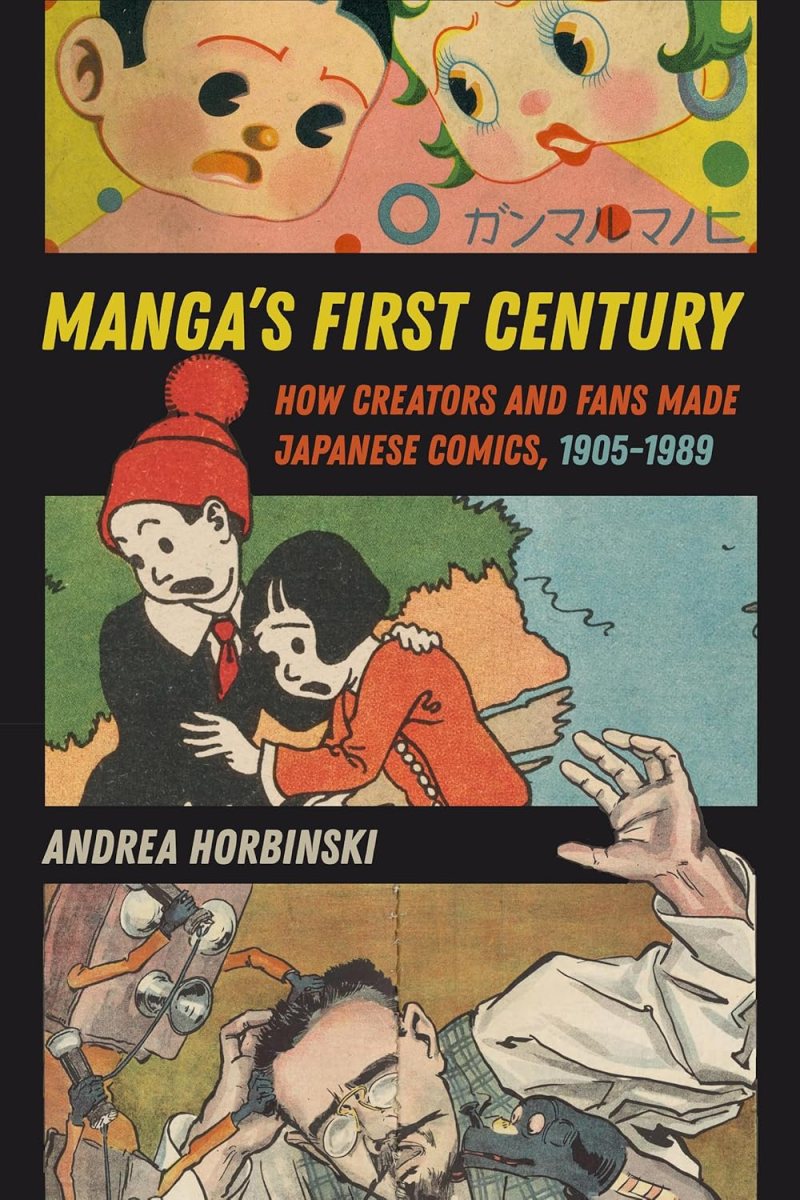
Knowing very little about manga but interested in learning about its origins and evolution, I approached Manga’s First Century with an idealistic perspective about how quickly and easily it would inform me of the subject. The first chapter showed me that this wasn’t the book I had received. Rather, Andrea Horbinski’s exploration of manga is a massive onslaught of detailed information that would constitute a feast for hard-core manga fans hungry for a roadmap to how the art form found its groove from the early twentieth century through its development into the late 1980s, where she ends her account. Instead of the lay-reader-friendly introduction to manga that I was hoping for, Manga’s First Century is nonetheless a fluent, eloquent account of the art form and its many iterations across Japan’s rapidly-shifting social, political, and economic landscapes during the tumultuous, accelerated twentieth century.
Despite its intense popularity in Japan and the increasing number of bookshelves dedicated to the form in American bookstores, relatively little scholarly work has been done on manga. The first, Frederik L. Schodt’s Manga! Manga! The World of Japanese Comics (1983), was published by Kodansha International and sought to introduce Western comics fans to the manga that itself was influenced by late-nineteenth- and early-twentieth-century American and British satirical cartoons. Helen McCarthy, a British scholar who has written extensively about manga and anime since the early 1990s, gave Anglophone readers A Brief History of Manga in 2014 (which includes extensive illustrations and focuses on specific, important dates) and is coming out with The Manga Bible this year. The only scholarly studies of manga that I could find prior to Horbinski’s book are Eike Exner’s Comics and the Origins of Manga: A Revisionist History (2021) and Manga: A New History of Japanese Comics (2025). In the latter book, Exner begins in the 1890s, but then takes the story into the twenty-first century, focusing on the art form’s “structural development” and the ways in which manga publishing itself has shaped its development.
One of Horbinski’s major claims in this book is that she is specifically choosing 1905 as her start date because she wants to decouple manga from earlier forms of Japanese art. However, Exner’s earlier Comics and the Origins of Manga specifically claims that it, too, “challeng[es] the conventional wisdom that manga evolved from centuries of prior Japanese art” and “explain[s] why manga and other comics around the world share the same origin story” (publisher’s synopsis). This argument over timelines is important in how scholars and fans understand manga’s origins, so it’s not surprising that both Exner and Horbinski are interested in nailing down a date. Horbinski specifically points to “ponchi-e,” the Japanese term for Punch drawings, a form which itself derived from the magazine of the same name, launched in England in 1841.
Inspired by Mr. Punch of the Punch and Judy puppet shows popular in England from the nineteenth century, the magazine focused on social and political satire. In Japan, such cartoons evolved into what we call manga at the turn of the twentieth century, thanks to the work of pioneers Imaizumi Ippyō and Kitazawa Rakuten. The latter’s “artistic and satirical innovations, focused on political subjects, made Tokyo Puck [a satirical Japanese magazine inspired by the American magazine of the same name] Japan’s first manga magazine and him its first professional mangaka” (p. 307). Rakuten was succeeded by Okamoto Ippei, who moved manga out of its political and social satire corner to comment on the larger Japanese society as it industrialized and competed with Europe and America.
Horbinski appropriately launches us into this history of manga with the image of a boy dashing through the streets of Kumamoto, desperate to get his hands on a monthly manga magazine and some of the freebies that come with it. Reading this, I was reminded of my older brothers, who grew up in the 1970s and ’80s reading every Marvel and DC comic they could get their hands on, begging my parents to take them yet again to the local comic book store so they could get the latest issue of … whatever it was. It’s this devotion and enthusiasm that, according to Horbinski, has characterized manga since it launched into the popular Japanese imagination with Ippyō and Rakuten.
For the two pioneers, manga was a break from Edo-era visual art (1603-1867) and situated itself more forcefully in modern times, which allowed it to easily morph and evolve with the changing times (and the changes came thick and fast in the twentieth century—see two world wars, Japan’s “economic miracle” of the ’70s and ’80s, etc.). Horbinski clearly explains in her introduction that she wants to tell “a history … rather than the history,” focusing on a few key themes in order to develop her argument. Given this, it is surprising that Horbinski offers little discussion of the studies that have come before by Schodt, McCarthy, and Exner. Though her bibliography is extensive, she only cites Exner once in the book and never mentions the other two authors except in the bibliography.
One could counter this by noting that Horbinski must have spent countless hours in the archives that she lists, finding information about the many manga magazines and clubs that sprang up as manga gathered steam. Her specific interests in this book (given the subtitle) include the ways in which the manga establishment and the manga on the periphery have established a productive tension over the years, with “upstarts working on the margins seeking to revolutionize the medium’s content and audiences” (p. 5). Horbinski has also offered a focused analysis on format and “format as platform,” since “manga has oscillated between newspapers, magazines, four-panel comics, serialized multi-chapter stories, dojinshi [self-published works], and ebooks” (p. 7).
Horbinski offers us a street-level view of the impacts of, for instance, censorship, changing gender norms, technological innovation, and marketing (especially to children) on the shifting of manga from satire to storytelling, taking us on a tour through: Manga’s Origins, 1905-1928; Manga During Wartime, 1928-1946; Manga in the Postwar Era, 1945-1963; TV Manga and the Age of Revolution, 1963-1975; and Manga Turns Postmodern, 1975-1989. From political cartoons in the early 1900s to a dizzying array of magazine and book manga telling stories for every demographic and about any topic one could think of, Horbinski shows how manga has come to stand for an art form that the masses love because it speaks to them.
Some manga reflects the speed of our modern age (content, style), while some is more stylized (flowers, celestial bodies), and yet others offer us adorable cats and other animals. Despite its seemingly infinite variety, however, manga still has at its core a specific kind of style that has evolved for the twenty-first century. I took my own tour of the manga section at my local Barnes and Noble after reading Manga’s First Century and was immediately intimidated, faced with hundreds of manga volumes. Taking a few off of the shelves and paging through, I thought of what Horbinski writes about how the art style has been driven by the artists who read manga growing up first imitating those forebears and then launching their own interpretations. Reading Manga’s First Century deepened my appreciation, then, of the ways in which manga has saturated Japanese society and spread around the world. It didn’t take me by the hand and give me recommendations, though, so I’ll have to get those from a trusted manga enthusiast who can guide me toward the books and compilations I might like. But I have no doubt that I’ll find something.
Like Loading...
Comments (0)