
Remember me





 In 1912, Edgar Rice Burroughs’s A Princess of Mars saw publication in The All-Story (under the title Under the Moons of Mars). It introduced the American reading public to John Carter: a swashbuckler extraordinaire whisked away to Mars to court beautiful women, to bounce about the red planet with gravity-defying leaps, and to swing a sword. Burroughs’s pulp sensibilities drip from the opening pages and launch the reader quickly and expertly into what has become one of the most influential action-adventure power fantasies, injecting his narrative with heaped helpings of wistful longing for a world in which physical prowess reigns supreme—and he packaged it all within a boundless imagination that, even today, feels exciting to read.
Burroughs’s Barsoom saga pulses with energy. Indeed, much of Burroughs’s writing can be characterized by momentum and motion, slinging the reader literally across the solar system with the blink of an eye or the turn of a page. Faced with the question of getting Carter from Earth and onto Mars, Burroughs simply channels the power of “irresistible enchantment” (A Princess of Mars [Penguin, 2007], p. 12). As Carter stares at the red planet, “it seemed to call across the unthinkable void, to lure me to it, to draw me as the lodestone attracts a particle of iron” (p. 12). Readers (both in 1912 and 2025) might wonder how Carter planned to travel to Mars, a seemingly impossible task in a world still reliant on horses and trains. But Burroughs’s Carter is quick to remind us that, “[my] longing was beyond the power of opposition; I closed my eyes, stretched out my arms toward the god of my vocation and felt myself drawn with the suddenness of thought through the trackless immensity of space. There was an instant of extreme cold and utter darkness” (p 12). And thus Burroughs ends one chapter and dares the reader to continue onto the next, which he opens with a wonderfully understated sentence: “I opened my eyes upon a strange and weird landscape” (p. 13). Questions of explanation, of rationality and logic and sense are completely eschewed in favor of immediacy, wonder, and imagination: pulp, in a word. “My inner consciousness told me as plainly that I was upon Mars as your conscious mind tells you that you are upon Earth,” Carter explains, continuing with “you do not question the fact; neither did I” (p. 13). Leave your reason at the door; we’re here to rock and roll.
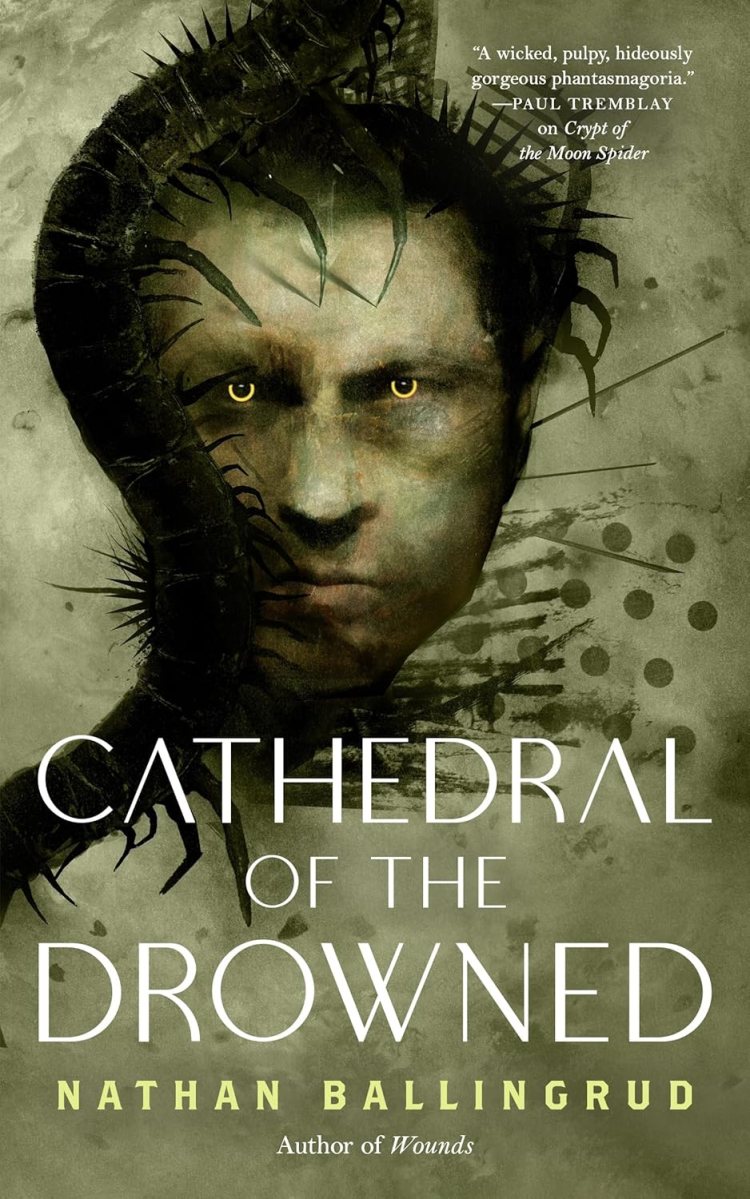
Nathan Ballingrud’s Cathedral of the Drowned, a sequel to his Crypt of the Moon Spider (2024), exists in this pulp tradition, reveling in the inexplicable and launching its characters across the stars with the flick of a short and declarative sentence, disappearing them into “angles of light” across the cosmos (p. 91). But where pulp afforded Burroughs an opportunity for tales of heroic escapism (tossed with imperialism for good measure), Ballingrud takes a decidedly different tack. While he maintains the imaginative wonder of pulp storytelling, he dumps the conventional male power fantasy and replaces it with an alternative fantasy (or horror, depending on your philosophy): (dis)entanglement. If A Princess of Mars imagines an embodiment of power and physical superiority encapsulated in the sculpted physiques of beautiful, individual bodies, Cathedral of the Drowned collapses those boundaries. In Ballingrud’s hands, the body itself disintegrates into pulp, enmeshed not in the Cartesian safety of singular consciousness but instead spread across a mass of entangled, creaturely bodies which is cosmic in reach.
It is this interrogation of embodiment, wrapped in the Lovecraftian dread of the Other and the pulp sensibilities of Burroughs, that I found most compelling in Ballingrud’s novella, a slim volume that never feels slight. His characters are at turns ruthless and pathetic, endearing and distancing, and the scope of the characters’ relationships remains grounded, even while the scale reaches out to the stars. As with Ballingrud’s previous short story work (particularly his excellent collection Wounds [2019]), I was simultaneously repulsed, fascinated, horrified, and certainly never bored.
The story begins in medias res, shortly after the events of Crypt of the Moon Spider. Veronica, the abused housewife shipped to the moon’s experimental mental asylum run by (mad) scientist Dr. Barrington Cull, has found seeming fulfillment as “the new queen of hell,” abandoning her human shell in order to assume the mantle of a spider god (p. 54). The inmates are now running the asylum, as it were, and Dr. Cull has fled to Earth. Meanwhile Charlie (also called Grub), a former bodyguard sent to protect mob interests on the moon, has been bifurcated between mind and body, with the former—Charlie—strapped into a satellite and blasted to the moon of Io and the latter—Grub—finding itself the new home for hundreds of soon-to-hatch spider eggs. But we open in 1924 in Red Hook, with mob boss Goodnight Maggie dealing with Sicilians encroaching her territory, a disruption to her supply chains of moonsilk (a resource spun from those creepy space spiders on the moon which is used as an hallucinogenic drug), and a pining for Charlie, who she believes has been lost.
As with all good pulp, the explanations for 1920s space travel and interdimensional spiders that weave magical webs is left where it belongs in the stuffed bin of Who Cares. Instead, the inciting incident is a series of two unexpected visits for Goodnight Maggie: Dr. Cull—whose face “no longer looked much like a face at all,” having mostly sloughed off in his escape from the moon—arrives desperate for refuge from the Alabaster Scholars (moon people who worship the spider queen); and Charlie, who seems to manifest in her closet as “a metal orb sprouting dozens of long silver spines in every direction … oily water trickled from it in a series of steady streams, as if it rested beneath a small waterfall she could not see” (pp. 2, 8-9). This is all in the first few pages. Even for a sequel, Cathedral of the Drowned is bursting at the seams with expansions of the setting: intersecting and competing character motivations, a giant rocket cathedral that crash-lands on the lush jungles of Io only for its missionary crew to fall victim to alien centipede monsters, and time travel. It’s a lot. But for me, the storytelling seams are stretched but never split. Ballingrud somehow holds all of this together and in the process raises a giant middle finger to the in-vogue narrative conventions, so encouraged by the age of streaming, in which stories are stretched beyond their proper bounds. This novella moves with the speed of Burroughs and the detail-density of your average Warhammer 40k novel (not to mention lots of 40k imagery—see the giant rocket cathedrals that have crash-landed and decayed in the swamps of Jupiter’s moon).
My initial attraction to Ballingrud’s work is this sense of horrific wonder and Lovecraftian worldbuilding. It’s all so cool and ticks all the boxes in my pulp-loving brain. Dr. Cull explains to Goodnight Maggie: “My belief is that the silk tended by the lunar spiders contain the memories of a spacefaring being, of which our moon is a remnant. Perhaps its skull, or perhaps just part of its skull. I believe the use of the silk somehow grants the spiders access to hidden avenues through space and time, allowing them to bypass the restrictions of conventional travel” (p. 31). The moon as part of the skull of a galaxy-huge eldritch being? Transdimensional spider silk? Yes, please, give me more. When brain-in-a-jar Charlie arrives on Io’s moon and is carried by the titular “drowned” to the sinking cathedral, “he beheld the vaulted arches of the cathedral’s interior, stone walls decorated in frescoes besmeared with lichen, the twinkling lights of switchboards and circuitry lighting the darkness like candy-colored stars” (p. 20). Ballingrud’s prose glories in the gothic and the gory, often mixing them to great effect—and generating a wonderful tension between beauty and ugliness that is a hallmark of pulp horror.
But, while my initial interest in Ballingrud and his Lunar Gothic Trilogy comes from the heavy metal of it all, my lingering investment is rooted in the ecologies and philosophies undergirding the texts. Crypt of the Moon Spider established an interest in the Cartesian dualism that informs much Enlightenment and post-Enlightenment thought, and Cathedral of the Drowned pushes this philosophy into the kind of literal symbol that genre storytelling makes possible. In brief, for centuries Western culture has labored under the belief that the mind, one’s consciousness, wields supremacy over the merely animal meat-sack of the body: “I think, therefore I am.” In other words, who we are becomes divorced from the materiality of our own existence; or, more accurately, what we call consciousness is divorced from materiality itself and instead imagined as purely abstract and symbolic and somehow disconnected from the body. Of course, this belief is ultimately incorrect, or at best incomplete, and for decades now much work has been done to correct its harmful implications, particularly in the work and writings of disability activists and disability studies. As an alternative to Cartesian dualism, we might imagine our bodies—including our minds—as an always-emerging series of overlapping materialities that are infinitely enmeshed and mutually dependent. The implications of this are, potentially, horrifying and exposing: We don’t like to imagine that our own minds are outside our control and beholden to material influence, existing in the same state of perpetual vulnerability within which our “non-thinking” bodies exist; we don’t like to imagine that something else is making our decisions. Ballingrud’s work understands this anxiety.
The Charlie/Grub character is my favorite in the work precisely because he becomes our angle into interrogating embodiment. Charlie, as we learn, “was born in a jar on the moon,” and his brain/consciousness is placed by Dr. Cull into a small satellite that is then launched into space, to peer into the dangerous mysteries of the cosmos (p. 13). As he comes into his consciousness, Charlie is aware of his body—Grub—on the slab next to him. He wonders “was the part of the brain in his body on the table the defective part? Or was it this part, himself, contained in the jar? Both were being rebuilt by the spiders and the moonsilk” (p. 13). This kind of disembodiment and existential dread at its recognition is familiar territory, and there are times where Ballingrud leans a bit too heavily into the body/mind split, to the point where the critique itself becomes muddled, a victim of its own critique, and the edge of the idea is dulled. Indeed the text maintains the distinct separation of Charlie and Grub despite their origin as a singular organism, a move that seems to reify the Cartesian split itself. But when Charlie arrives on Io, the novella introduces an embodied ecology of violence that sharpens and complicates everything, exciting me as a reader.
Ultimately, at the risk of spoiling how wild and weird Ballingrud makes everything, Charlie becomes inextricably entangled with the truly bizarre flora and fauna of Io, and his own individualism is collapsed into a violent, non-human collective. Ecology itself is neither sentimental nor sterile nor sanctimonious—it is consuming, violent, and terrifying because it requires self-annihilation, and Ballingrud’s work is never afraid to acknowledge this uncomfortable truth. Charlie’s violation leads to disambiguation, and from that loss of self something new is born. It is here that Goodnight Maggie re-enters the narrative in a truly stunning turn of events which takes the novella into mythic territory, where those pulp staples of sex and violence and revelation all collide to form new worlds and new peoples and—actually, you’ll have to read it for yourself. No, really: This is a novella to be experienced.
Like Loading...
Comments (0)