
Remember me





 You know what they say about second novels, especially when an author’s first published novel was an absolute hit and it’s hard to imagine anything ever topping it. In 2024 I discovered and devoured Hiron Ennes’s Leech (2022) and was utterly blown away by the worldbuilding, the storytelling, the attention to detail, the political angle, and one of the best final scenes I’d ever come across—like an opposite to the iconic closing shot of Thelma and Louise (1991), freezing and emphasising an instant of catharsis, hope, and freedom after a gruelling and heart-breaking journey. The reader is very much aware that this moment may not last very long and that whatever comes next is uncertain, but closing a post-colonial Weird body-horror thriller on a character’s well-deserved flash of euphoria felt extremely satisfying. While waiting for The Works of Vermin to come out, I didn’t know what to expect, but I was giddy with anticipation. Would Hiron Ennes ace it again? (Spoiler, no spoiler: yes, they did.)
In stark contrast to the Arctic Gormenghast that Leech is set in, the world of The Works of Vermin seems almost twee—but only for half a second before we dive into the details. The main location of the plot is the city of Tiliard, which has been built on (and under, and inside) a massive tree stump and is described much like a giant millipede, appearing to “teeter on its many twisted legs” formed by dangling roots (p. 3). It is surrounded by an acid river, the Catoptric, which pretty much instantly dissolves all organic tissue. The worldbuilding is steampunk-adjacent, with lights and machines powered by “sap,” but the tree and the teratological creatures that inhabit it, as well as the effects of their various venoms, make clear that this book is still rooted very firmly in the category of Weird fiction.
The factor that drew my attention first, while I was still finding my way around the main characters and their day-to-day lives, was the degree to which Tiliard is structured according to a rigid and seemingly inescapable class system which permeates and dictates everything. On the surface of the tree stump there is the overcity, with palaces, villas, theatres, and grand plazas inhabited by the upper classes—aristocrats, high army officials, the clergy, and their various favourites (especially artists), playmates, and servants. The undercity, meanwhile, is located in the roots (which is, in Ennes’s baroque writing style, often referred to as the rhizosphere); it houses the city’s many indentured workers, like the exterminators that keep the overcity safe from venomous beasts of all sizes, as well as a big population of beggars, thieves, street urchins, connivers, smugglers, and jacks of all trades. This way, they are also kept away and out of sight of the posh inhabitants of the overcity. Inside the stump, threaded through like wood-beetles’ borings, is the midcity, seldom openly referred to, but essential for Tiliard’s economy, since this is where the various manufactories are run (and where at least one prison might be located).
Readers will notice, especially since characters actually repeatedly joke about this, that while this book is roughly fantasy literature (or at least one of its stranger siblings), there are no dragons. In their place we get vermin the size of horses, and/but fighting them seems very mundane, at least from the perspective of an exterminator—who takes the place of a knight in threadbare, multi-patched armour. One quite common type of vermin, the chimera millipede, reads very M. John Harrison to me, since it changes shape while being fought and can take on the appearance of any of your loved ones while you’re killing it (p. 11). To the exterminator, this is just Wednesday.
Finding my footing in this storyworld took me a while, since Ennes employs a narrative style that matches the off-and-on hallucinogenic effects of having been bitten by one of the more notorious bugs of the undercity. First encounters with characters and locations are abrupt, with no infodumps, no introductions or explanations, no backstory—but often deliberately employing estrangement (as in Viktor Shklovsky’s concept of “defamiliarization,” making the familiar strange through choice of words and unusual, often literal, descriptions). It therefore takes a while to find where and when a scene is set and what is happening. For example, one of the main characters is introduced like this: “Guy Moulène has once again, due to a blue moon or a bad mood, trapped himself in a child’s body” (p. 7). Only paragraphs later do we realise that he is fast asleep and caught in a dream.
In alternate chapters we follow two storylines, one in the undercity and another one in the overcity. The working-class narrative follows a team of exterminators, and as we learn their names we also get an implicit introduction to the gender system in Tiliard. While linguistically everything is quite binary (in the city’s Germanic-ish hodgepodge lingo, women are addressed as “Vra,” “Vralen,” or occasionally “Mamselle,” men as ”Eir”), gender presentation (clothing, hairstyles, makeup, scents, gestures, and behavior) is generally quite fluid. The undercity plot’s main characters are Guy (to me his name reads very much as a placeholder, like “Jack”), his little sister Tyro (who shares this name with a masculine character from an opera), his bunkmate and bestie Dawn (a gender-neutral name with rather soft, feminine associations which is used by a burly ex-soldier), and their team leader Three (she/her; we later learn that she signed up under the name 37923). None of the names they officially use are their so-called thumb names, which are kept secret and only known to close family.
On a regular workday mission, the team comes across a monster never mentioned in their perpetually edited and added-to exterminators’ manual: a streetcar-sized venomous centipede, which, in a lovely literary pun, seems to have made its nest under the opera house. When I first had a look at the blurb of The Works of Vermin, I thought that it would be a straightforward story about Guy’s quest to kill what Three keeps jokingly referring to as his “dragon.” How wrong I was to think that this plot could be so simple! First of all, instead of dying, the centipede molts and multiplies, and the smaller centipedes break through into the overcity and have to be hunted down. What happens then is actually the start of everything else.
In a plot development that I call “capitalism kills, literally,” a wealthy man named Bertram Gorslung buys up the extermination company during the ensuing crisis (that is, when it is cheap), and starts harvesting the monster-centipede’s toxin, a substance called ecdytoxin (likely derived from ecdysis, the word for the molting process of an insect, derived in turn from the Greek words ékdysis, “getting out, escape,” and ekdýein, “to take off,” relating to the idea of “coming out/apart”—all of which will make a lot of sense later). Then he starts taking out the competition by chemical warfare: One by one, rival businesses suffer strange devastating “accidents” which look exactly like deliberate attacks using ecdytoxin, and their activities are quickly signed over to Gorslung’s growing empire.
To the employees who accidentally caused their company’s crisis (while fighting the centipede, as part of their jobs), Gorslung presents himself as a benefactor on the surface, telling them that, while their previous employers would have had them killed for their catastrophic blunder, he will only issue them new contracts—with conditions that can be changed at will and without previous notification. Guy for one is very much aware that this will turn him into Gorslung’s lifelong slave, but his arms are already covered in tattoos signifying a level of debt that he will never be able to pay off, and he already runs an illegal side hustle as a bishop’s secret callboy—all to keep his younger sibling out of the same situation, so that Tyro can grow up with the potential for a better, freer life. Tyro, on the other hand, is tired of grownups making all the decisions on behalf of teenagers. He only wants to be taken seriously and to get a job to save up for the ever-elusive escape from Tiliard—so it’s easy for Gorslung to get Tyro to sign up for his new division of toxin-harvesting kids, collecting ecdytoxin in direct interaction with the captive beast.
In a quick succession of plot climaxes—which build like a series of explosions sparking off each other—Guy (having himself suffered from intrusive hallucinations after a bug bite) learns that Tyro has been repeatedly bitten by the centipede and will likely suffer from unthinkable random transformations. Ecdytoxin, it emerges, is a poison that creates rather than destroys, working on its victims like a surreal cancer. So Guy storms the toxin harvesting room and starts to destroy everything, more or less blindly hacking away at the captive creature. Chaos ensues: The lab burns, people get shot, Guy and Tyro try to flee to a riverboat but are captured; as a punishment for Guy’s killing his “dragon” after all and disrupting all of Gorslung’s plans, with what seems like almost a gentle gesture Gorslung flings Tyro into the Catoptric.
In between all these chapters, we get the second narrative, among the decadent overcity’s high society. Everything starts with two rather close friends who are simultaneously obsessed with each other and in fierce competition when it comes to romantic adventures and telling each other tall stories. Elspeth is a painter commissioned by and engaged to the city’s current ruler, the Laurel Chancellor, who will likely have her killed once his portrait is finished and their wedding registered by society as an appropriately public spectacle; Aster is a famous perfumer, mixing toxin-based scents for people like the Laurel Chancellor and the leader of the city’s troops, the Marshal Revenant. Everyone in the overcity wears perfume, both as a status symbol and fashion statement, as well as to manipulate people into perceiving their looks and personality traits in the warped ways caused by the chemicals used in the concoctions. It’s all about being seen with and by the right people, attending plays and operas in which performers are executed for real, and enjoying tiny tidbits of lavish feasts. Apart from the Chancellor’s whims, there isn’t any political system: Everyone fears him and the Marshal, so they either try to stay on their good sides or attempt not to be noticed.
When a mysterious outsider arrives, Aster and Elspeth vie for his attention (while trying to play it down). He baffles everyone: Mallory vant Passand doesn’t seem to care about fashions or status, walking around in vastly outmoded suits and coats, speaking with a country accent they consider oafish, and—above all—never wearing perfume. Aster, amazed that Mallory isn’t repulsed by the tetrodotoxin toxin-based type of consumption she suffers from, gets pulled into romantic adventures with him in a formerly posh part of the overcity now reduced to overgrown ruins. The Chancellor, meanwhile, starts to send out all sorts of agents to investigate Mallory, wanting to find out about his background and motive for coming to Tiliard. In Mallory’s own words, his arrival is about “loose threads”—a nice pun, as it will turn out—and “[t]ying up a family matter” (p. 26).
While showing Mallory some seriously warped bits of the city—broken and resealed streets, melted and mutated statuary and architecture—Aster explains that upheavals like the one that caused this destruction happen in Tiliard once every generation or so. The last regime change is usually referred to as “the Revival,” and various movements (and art styles) just replace each other once in a while—Repressionism, Revivalism, Extemporism, who cares. Tricksily, these scars on the city are connected to the events in Guy and Tyro’s storyline: The overcity narrative is actually set many years after the undercity one. I literally gasped when I realised that almost all the key characters in the decadent Revivalist plotline are characters I already knew well in the days of the “dragon hunt”—now older, changed by time, and using new names, titles, and bynames. The structure of this book is so well planned out that all of the facts are visible from page one, but the city’s social and architectural structure provides us with endless red herrings. Once Mallory’s identity is revealed, you might think this book would turn into a revenge story, but then again: Mallory never said he was there for revenge, only to find family (I was clinging to the description of two characters’ matching eye colour until what I hoped for was proved right).
At one point, Bertram Gorslung says: “Ecdytoxin is a gift. So many volatile compounds can destroy. Very few can create. It just needs the right hands to direct it” (p. 254). He is a sociopath; of course he thinks that his hands are the right ones. The only thing he cares about is his own success, wealth, and power. When the main characters of the “dragon hunter” plot get bitten by the centipede, however, the toxin affects them each differently. I personally think that it brings out each person’s inner truth and emphasises it, makes them more themselves. The traumatised opera fan becomes a mad composer. The valiant soldier turns into an indestructible killing machine (dependent on a concoction of mayfly to erase troubling memories). Tyro becomes a boy.
Looking back to when everyone thought of Tyro as a girl, there were so many signs that this was more than uncomfortable for them: They always preferred boys’ clothes and boys’ activities and were repelled by even the thought of being gifted traditional girls’ garments and trinkets; they cut off their hair in a bout of panic, they tried to sign up for a job under a masculine name, and having their first period may have been an experience of body horror for more reasons than just being uninformed. Above all, Guy always had one pet name for his younger sibling, which was “princeling.” So when the river Catoptric dissolves Tyro’s body (or outer shell), the ecdytoxin-induced mutation—manifesting as many thin self-knitting threads in place of human flesh—reassembles the child as a boy. The boy climbs up out of the river alive and is raised outside the city under his thumb name (another sign that he is now truly himself): Mallory vant Passand. And when Mallory first attends a performance of the elusive composer Olaf Aufhocker’s opera “Saint Guylag and the Dragon,” he knows that his brother is still alive in the city and writing all of his bedtime stories into librettos.
When Bertram, now the self-appointed Chancellor, learns about Mallory’s identity, he gets his pet composer—Guy Moulène turned Olaf Aufhocker, whose thumb name has always been Emmory vant Passand—out of the underground prison where he has been keeping him all this time. He thinks of the brothers only as potential lures for each other, as he himself only enjoys tormenting others and wielding power over them. But Mallory’s transformation is the antidote to Bertram’s ecdytoxin-powered “Revivalism”: By then we have already noticed that his threads, which can be hidden in embroidery (among other things), unmake the effects of ecdytoxin. And, for somebody so intent on appearances that he prefers to mask his real face with toxin-scents and cannot even look at portraits of himself, what could be a worse punishment than being stripped of all illusion? Mallory was never out for revenge; he only comes to heal the city (and potentially Aster) as a collateral consequence of his quest for his brother. The most beautiful moment when the brothers are reunited is Emmory’s reaction to Mallory’s transition. He only says, “God, look at you. I’m so … so sad I didn’t get to see you grow. But I’m so glad to see you grown” (p. 415).
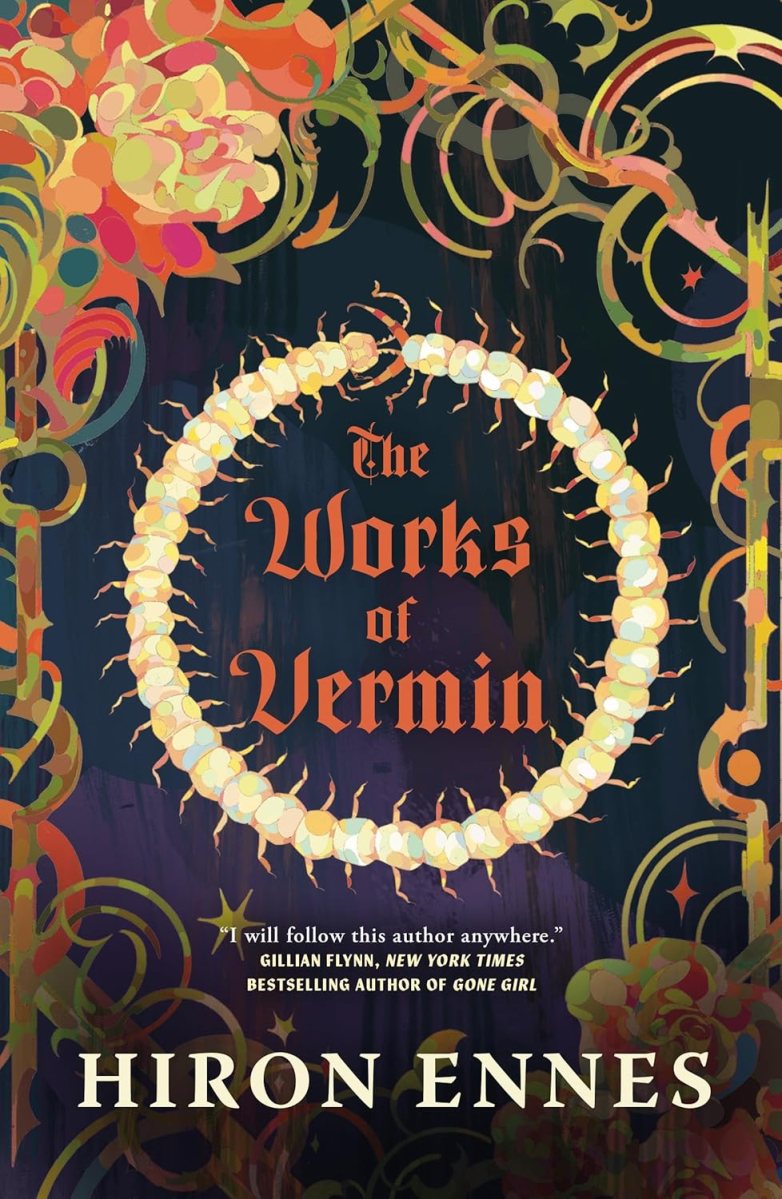
The centipede in the shape of an Ouroboros on the cover, the “dragon” centerpiece of this story, the source of ecdytoxin: All represents eternity and self-renewal, the cyclical nature of life, death, and rebirth. The connection of ecdytoxin and Mallory’s rebirth is obvious, including the above-mentioned etymological angle: Mallory sheds his outer layer, molts like the centipede, only to be re-created and, in the other meanings of the word, to come out (in more than one sense) and finally escape. But the Ouroboros is also used by Bertram Gorslung as an emblem for his business empire.
Poisons are deadly weapons but (“in the right hands”) can be diluted, micro-dosed, or modified to be used as medicines. We can read the centipede, then, as the cyclical nature of society—each new regime “eating its own tail,” bringing about its own undoing, its corruption and downfall enabling the next uprising, the next change: Just as Gorslung, in his own downfall, mirrors the fate of his captive vermin. Indeed, from the title and cover illustration to the very last paragraph, everything in this book is about so-called vermin. They are not just hunted by fumigators, replacing the dragons of mythology and traditional fantasy literature. The city itself is likened to an insect or an arthropod, and the people inhabiting the tree stump often seem like a colony of termites. In the course of Gorslung’s rise to power, more and more entries in the exterminators’ manual are about people (underground agents, dissidents, other undesirables). But when people start referring to other people as disposable in this way, who are the real vermin?
In Gorslung’s lab, the centipede provides the means of production, since ecdytoxin is now used in everything from perfumes to buildings. But it is kept strung up and immobilised by a veritable slave-owner and top-feeding capitalist. But can it ever really be killed? It just molts and multiplies, which means that there is still hope for the revolution once its chains are sprung.
The Works of Vermin is about trans euphoria. It contains sex scenes that, while never revealing anyone’s anatomical setup (because that’s really none of our business), demonstrate that good sex is not essentially about penises. As Mallory grows into the role of the hero, his story sparks so much happiness, and with each other character’s positive response this happiness is added to. I really enjoyed the exterminators working together as a team, squabbling, saving each other’s lives, bickering, then relaxing in the rhizosphere’s bath-houses; I loved the overgrown part of the overcity where Mallory takes up house in what I later recognized as the former Bishop’s mansion. While this story is full of trauma and abuse and deceit, it’s also full of surprises and adventures and actual joy. Even though at the end we know that nothing is really resolved, that “the city turns, and turns, and turns” (p. 423), we close the book feeling good about the brothers’ happy reunion, and about a concomitant wonderful adventure for Elspeth and Aster, who we last see running away hand in hand, a potentially happy queer couple. But that’s really none of our business either.
Like Loading...
Comments (0)