
Remember me



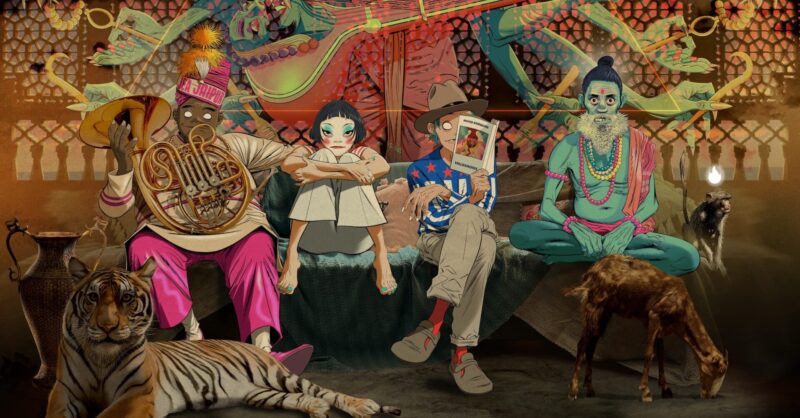

It takes balls to start your record with a five-minute instrumental played on a bamboo flute, but Gorillaz aren’t interested in frontloading an album with bangers. What do we mean by conventional album structure anyway, you can imagine Damon Albarn saying. Western? Just as the gargantuan The Mountain starts to crumble a bit, 35 minutes in, there is “Damascus”, a whirlwind of rap, from the man once known as Mos Def, and Syrian singing from Omar Souleyman, who once ran a free bakery for refugees in a Turkish border town.
Gorillaz have a cast-iron belief in their strange, hybrid formula, and that is where Albarn finds his pleasure. There are certain musicians who need to cross-pollinate, but some of his earlier diversions have been pretentious (Dr Dee) and some corny (Mr Tembo). In Gorillaz, alongside rappers and a broad sweep of musicians, Albarn always performs without embarrassment, his Bowieish melodies free to roam on exotic backdrops. “Casablanca” is impressionistic and arty without being cold. The Moon Cave is the band as you first heard them, 25 years ago, with a bouncy baseline and rubbery beats, the musical equivalent of a pair of Vans. There is the same swagger there was back then, and a knowing use of retro strings that evokes the millennial chill out gods, Air and Lemon Jelly. “The Happy Dictator”, which features Sparks, is a diversion into eighties synth pop the likes of which they would not have made back in 2001 – but otherwise Gorillaz’ sound has neither aged nor dated, rather like cartoon characters. (Gorillaz are an animated, “virtual” band featuring Murdoc, 2-D, Noodle and Russell Hobbs.)
Both Albarn and his bandmate, the artist Jamie Hewlett, recently lost their fathers and The Mountain is a response: it was also inspired by a trip to India. It achieves that valuable thing in a record – a cast of mind, a mood, which gives the music cohesion despite the stylistic fusion. “Orange County” is a fragmentary song – a ghost, really – featuring sitar, whistling and a moment of complete silence: “The hardest thing is to say goodbye to someone you loved”. I can hear a dramatic character at work in these songs, someone warm, and worn down by life and experience.” The Empty Dream Machine” reminded me of Robert Plant’s wistful classic “Big Log”, and Bowie’s posthumous Blackstar: “I thought I’d got my life straight, I thought I’d changed it, but it seems I’ve been crawling lately”. “The Sweet Prince” imagines Albarn at his dying father’s bedside.
The rappers, especially The Roots’ Black Thought, bring life to the music – but the literal dead appear too, spliced in from Albarn’s earlier projects: Mark E Smith, Dennis Hopper, Tony Allen. Eminem’s friend from D12, Proof (shot after a dispute over a pool game in 2006) raps from beyond the grave on “The Manifesto”. I remember when this kind of posthumous collaboration was still a thing of wonder – Barry Manilow made a “duet” album with all his departed musical icons. Now, it’s as normal as the idea of a cartoon band.

Subscribe to the New Statesman today for only £1 a week.
[Further reading: We know everything and nothing about Molly Russell]
Content from our partnersRelated



Comments (0)