
Remember me




Nature
The places and phenomena that make headlines — the Grand Canyon, the Northern Lights, the Great Barrier Reef — are extraordinary.
But the natural world keeps far stranger secrets. These are 40 of them: lesser-known phenomena, overlooked places, and quietly astonishing creatures that most people have never heard of. Each one is real. Each one will make you see the planet a little differently.
Section 01
01
Veryovkina CaveCaucasus Mountains, Abkhazia

Photo by Dan Meyers on Unsplash
The deepest cave on Earth plunges 2,212 meters — over a mile and a quarter — straight down into the Caucasus Mountains. Explorers who reach the bottom describe conditions more alien than anything on the surface: crushing pressure, total silence, zero light, and creatures that have evolved in complete isolation for millions of years. Among them: a blind cave shrimp, colorless beetles, and the deepest-dwelling millipede ever recorded. Scientists consider the extreme lower chambers among the most inaccessible environments on the planet.
02
Eisriesenwelt Ice CaveWerfen, Austria

Photo by Tomás Robertson on Unsplash
The name means “World of the Ice Giants” — and once you’re inside, that feels about right. Eisriesenwelt is the largest accessible ice cave on Earth, stretching more than 42 kilometers into the mountain. The paradox is that the cave’s deep interior stays cold enough year-round to prevent the ice from ever melting — warm summer air never penetrates far enough. What visitors find instead is a palace of frozen formations: towering ice columns, crystalline archways, and frost crystals that shatter light like chandeliers.
03
Zhijin CaveGuizhou Province, China

Photo by Andy Wang on Unsplash
Most famous caves have one or two remarkable features. Zhijin Cave has 120 distinct types of crystalline formations across 13.5 kilometers of passages — the highest concentration of cave geology ever documented in a single system. Among them: a 17-meter-tall translucent formation called the Silver Rain Tree, mushroom-shaped calcium deposits, and chambers so vast they contain their own weather patterns. It took scientists decades to fully map it. They’re still finding new passages.
04
Zacatón SinkholeTamaulipas, Mexico

Photo by Alfonso Betancourt on Unsplash
At 339 meters deep, Zacatón is the deepest water-filled sinkhole on Earth — so deep that when NASA sent an experimental robot called DEPTHX to map it in 2007, the mission doubled as a practice run for exploring the oceans of Jupiter’s moon Europa. The sinkhole formed during the Pleistocene through volcanic activity that acidified underground water and slowly dissolved the surrounding limestone over thousands of years. Its bottom has never been reached by a diver.
05
Cenotes of the YucatánYucatán Peninsula, Mexico

Photo by Sergio Rodríguez on Unsplash
Beneath the flat limestone landscape of Mexico’s Yucatán Peninsula lies the world’s largest known underwater cave system — thousands of kilometers of flooded tunnels connecting hundreds of sinkholes called cenotes. The Maya considered them sacred portals to the underworld, and it’s easy to see why: shafts of sunlight pierce the water from above, illuminating crystal-clear freshwater maintained at a perfect 75°F year-round, surrounded by ancient stalactites formed when the caves were still dry. The deepest blue holes remain incompletely explored.
06
Sima de las CotorrasChiapas, Mexico

Photo by Matheus Protzen on Unsplash
The name means “Pit of the Parrots” — and every morning at sunrise, thousands of green parrots burst upward from this 140-meter-deep, 160-meter-wide limestone sinkhole in a spiraling green vortex that has to be seen to be believed. The birds roost in cliff-face caves overnight and pour out each dawn in a synchronized spiral following the shape of the pit. Ancient Maya murals on the cave walls suggest humans have been watching this spectacle for thousands of years.
Section 0207
Mosquito Bay, Puerto RicoVieques Island, Puerto Rico

Photo by REGINE THOLEN on Unsplash
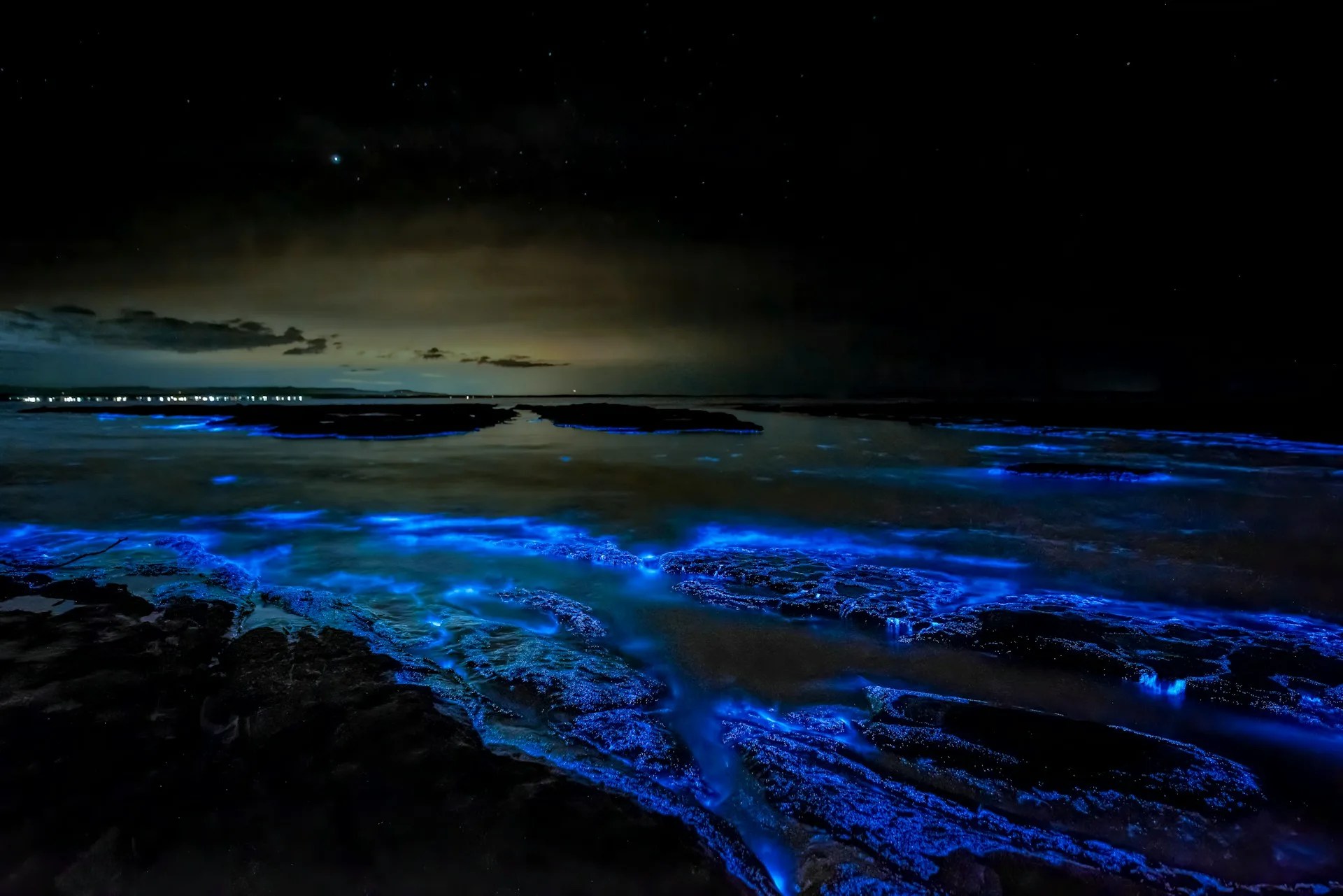
Officially the brightest bioluminescent bay on Earth, Mosquito Bay contains an almost incomprehensible concentration of light-producing organisms: up to 750,000 Pyrodinium bahamense dinoflagellates per gallon of water.
The bay’s unusual S-shaped entrance traps the organisms inside, while surrounding mangrove trees feed them essential nutrients. Every movement through the water — a paddle stroke, a swimming arm, a fish darting past — produces a flash of electric blue. On the darkest nights, people who swim here describe looking at their own hands and seeing them glow.
08
Waitomo Glowworm CavesNorth Island, New Zealand

Photo by Luca Calderone on Unsplash
The glowworms of Waitomo are not worms at all — they’re the larvae of a fungus gnat found nowhere else on Earth called Arachnocampa luminosa. Each larva hangs up to 70 silk threads from the cave ceiling, baited with sticky droplets, and uses its blue-green bioluminescence as a lure to attract flying insects. The result, viewed from below, is indistinguishable from a clear night sky filled with stars. The chemistry behind the glow uses a unique luciferin pathway found in no other species on the planet.
09
Deep-Sea Hydrothermal VentsMid-Ocean Ridges, worldwide

Photo by Алекс Арцибашев on Unsplash
When hydrothermal vents were first discovered in 1977, they overturned one of biology’s foundational assumptions: that all life on Earth ultimately depends on sunlight. The ecosystems around these underwater geysers — where water erupts at 400°C into near-freezing ocean — derive energy entirely from chemical reactions, supporting giant tube worms up to 2 meters long, ghostly white crabs, eyeless shrimp, and microbial mats in colors not seen anywhere else in nature. These communities live in complete darkness, sustained by Earth’s internal heat alone.
Section 0310
Blood Falls, AntarcticaMcMurdo Dry Valleys, East Antarctica

Photo by Patrick Adlam on Unsplash
From a distance, it looks like a wound in the ice. Blood Falls is an iron-rich brine that seeps from Taylor Glacier onto the frozen surface of West Lake Bonney, staining the white landscape a deep, unsettling crimson. The water has been trapped in a subsurface lake beneath the glacier for approximately 1.5 million years — long enough for iron to accumulate in extraordinary concentrations. When it finally reaches the surface and meets oxygen, it rusts. Scientists studying the microbes that survive in this ancient, oxygen-free brine believe they may offer clues about life on other planets.
11
Fingal’s CaveIsle of Staffa, Inner Hebrides, Scotland

Photo by Adrien Olichon on Unsplash
Sixty million years ago, a lava flow cooled so slowly and evenly that it fractured into perfect hexagonal columns — the most mechanically stable shape for releasing surface tension as rock contracts. Today, those columns form the walls and floor of Fingal’s Cave on the uninhabited island of Staffa: a cathedral-sized sea cave whose geometry looks more like human architecture than geology. The cave’s natural acoustics so moved Felix Mendelssohn during a visit in 1829 that he composed an entire overture inspired by the sound of waves inside it.
12
Penitentes Snow FormationsHigh Andes, Chile and Argentina

Photo by Andrea Pasquali on Unsplash
At high altitudes in the Andes, the combination of intense solar radiation, low humidity, and freezing temperatures creates one of nature’s strangest landforms: fields of tall, blade-like snow and ice formations called penitentes. Rather than melting uniformly, the snow sublimates directly into vapor — faster in some places than others — leaving behind forests of frozen spires that can reach two meters in height. Charles Darwin encountered them during his Andes crossing and wrote about them with obvious bewilderment.
13
Tsingy de BemarahaNorthwest Madagascar

Photo by Ranjini Hemanth on Unsplash
“Tsingy” translates roughly as “the place where one cannot walk barefoot” — which is an understatement. This UNESCO World Heritage karst plateau features razor-sharp limestone needles, some reaching 100 meters high, separated by deep crevasses and underground rivers. The isolation created by these natural walls has produced one of Earth’s most unique ecosystems: 85% of the wildlife found here exists nowhere else on the planet, including lemurs that have evolved to leap barefoot between the blades.
14
Richat StructureAdrar Plateau, Mauritania

Photo by Eslam Tawakol on Unsplash
From space, it looks like a giant eye staring up from the Sahara: a 40-kilometer-wide circular formation of concentric rings that has guided astronauts for decades. For years, scientists assumed it must be an impact crater — nothing else seemed capable of producing such perfect geometry at such scale. It’s not.
The Richat Structure is a geological dome that formed from below, where ancient rock was pushed upward and then sculpted over millions of years by erosion into the concentric rings visible today. The mystery of why it’s so perfectly circular remains only partially explained.
15
Moeraki BouldersKoekohe Beach, Otago Coast, New Zealand

Photo by Eddie Mark Blair on Unsplash
They look like giant stone eggs left on a New Zealand beach — dozens of near-perfect grey spheres, some over two meters across, scattered across the sand as if placed by hand. In fact, the Moeraki Boulders are septarian concretions: calcium carbonate formations that grew on the ancient seafloor over 4 to 5.5 million years, before being exposed by coastal erosion. Cracked open, each one is lined with shimmering calcite crystals. The Māori believed they were food gourds washed ashore from a legendary wrecked canoe.
16
Darvaza Gas CraterKarakum Desert, Turkmenistan

Photo by Ybrayym Esenov on Unsplash
In 1971, Soviet geologists accidentally broke through into a vast underground cavern, causing the ground to collapse and leaving a 70-meter-wide crater spewing methane. Their solution was to set it alight and wait for it to burn out. It hasn’t. More than 50 years later, the Darvaza Crater — known locally as the Door to Hell — still burns day and night, a churning pit of orange flame visible for miles across the flat Karakum Desert. Explorer George Kourounis descended into it in 2013 and found living bacteria in the soil at the bottom.
17
Sailing Stones of Death ValleyRacetrack Playa, Death Valley, California

Photo by Grant Durr on Unsplash
For most of the 20th century, the sailing stones of Death Valley were one of geology’s most stubborn mysteries: rocks weighing up to 300 kilograms that moved on their own across a flat, dry lakebed, leaving trails hundreds of meters long — but no one had ever seen them move. The answer, confirmed in 2013, turned out to be almost poetic: winter rain freezes overnight into thin “windowpane” ice sheets that the gentlest breeze can push, carrying the rocks along at up to 5 meters per minute. The stones move in slow silence, leaving their trails behind like signatures.
Section 04
18
Catatumbo LightningLake Maracaibo, Venezuela

Photo by Scott Osborn on Unsplash
Where the Catatumbo River meets Lake Maracaibo, a storm has been raging almost continuously for centuries. This is the world’s most electrically active place: up to 40 lightning strikes per minute, 160 nights per year, concentrated over an area about the size of a city. Sailors have used it as a navigation beacon for 500 years. Marco Polo documented it. The precise mechanism — a unique collision of cold Andean air, warm Caribbean humidity, and methane rising from the lake’s oil-rich floor — produces more lightning per square kilometer than anywhere else on Earth.
19
Singing Sand DunesBadain Jaran Desert, Inner Mongolia, China
 Sjoerd van Oort -Creative Commons
The dunes of the Badain Jaran — some reaching 490 meters, the tallest stationary sand dunes on Earth — make noise. Not the whisper of blowing sand, but a deep, resonant booming that Marco Polo described as “musical instruments, drums and clash of arms” and that can be heard from kilometers away. The phenomenon occurs when sand avalanches down steep slip faces and perfectly rounded, silica-coated grains vibrate in synchrony. Scientists have measured the sound at over 100 decibels. Louder than a lawnmower.
Section 0520
Socotra Dragon Blood TreesSocotra Archipelago, Yemen

Photo by Andrew Svk on Unsplash
Socotra has been isolated from the mainland for roughly 6 million years, long enough that 37% of its plant species exist nowhere else on Earth. The dragon blood tree is its most iconic resident: a bizarre upturned umbrella of a tree whose branches grow only at the tips, creating a dense, flat canopy that provides shade from the scorching sun below. Cut the bark and it bleeds a dark red resin used as dye, medicine, and varnish since ancient times. The island’s flora is so alien that astronauts viewing it from the International Space Station have described it as looking like another planet.
21
Okavango DeltaKalahari Desert, Botswana

Photo by Maria Baltazzi on Unsplash
Most river deltas empty into the sea. The Okavango empties into the Kalahari Desert — and then just stops, spreading across 15,000 square kilometers of sand before evaporating entirely. What makes this one of Earth’s most extraordinary ecosystems is its timing: the floods arrive during the dry season, not the wet one, creating an inland oasis precisely when the surrounding desert is at its most parched. The result is one of Africa’s great wildlife spectacles — elephants, lions, leopards, and wild dogs concentrated in a landscape that seems to appear from nowhere and then disappear again.
22
Milford Sound Underwater EcosystemFiordland, South Island, New Zealand

Photo by Sylvain Cleymans on Unsplash
Milford Sound receives up to 9 meters of rainfall per year — so much that a permanent layer of dark, tannin-stained freshwater sits atop the saltwater below. This blocks the sunlight that would normally warm and oxygenate the surface, creating conditions that typically only exist in the deep ocean. The result is an upside-down ecosystem: species that normally live at 200-meter depths — rare black coral trees, sea pens, living sponges — thrive here at snorkeling depth, found nowhere else so shallow on Earth.
23
Ball’s PyramidPacific Ocean, 20km from Lord Howe Island, Australia

Photo by Wolfgang Hasselmann on Unsplash
Ball’s Pyramid is the world’s tallest sea stack — a sheer volcanic spire rising 572 meters from the Pacific Ocean — and it harbors one of the most unlikely survival stories in natural history. In 2001, scientists rappelling down the rock found 24 individuals of the Lord Howe Island stick insect living beneath a single tea tree shrub on a ledge 100 meters above the sea. The insect had been considered extinct for 80 years. The entire known wild population of a species, clinging to existence on a cliff face smaller than a parking lot, in the middle of the Pacific.
24
The Deep BiosphereSubsurface rocks and sediments, worldwide

Photo by 𝕡𝕒𝕨𝕤 𝕒𝕟𝕕 𝕡𝕣𝕚𝕟𝕥𝕤 on Unsplash
Beneath our feet, in the microscopic pores of rocks kilometers underground, there is a biosphere. Scientists estimate this hidden world has a volume twice the size of all Earth’s oceans combined, and contains microbial biomass that may exceed the combined weight of every animal on the surface.
These organisms live in total darkness, under crushing pressure, at temperatures that would kill anything on the surface, surviving on chemical reactions alone. Some are estimated to reproduce once every 10,000 years. They have been alive since before the dinosaurs.
25
Atacama SuperbloomAtacama Desert, Chile

Photo by Juan Cortez Estay on Unsplash
The Atacama Desert is the driest place on Earth that isn’t Antarctica — some areas receive less than 2mm of rain per year, and there are weather stations that have never recorded a drop. And yet, hidden in the soil, seeds wait. When El Niño brings rare rainfall — it happens perhaps once every few years — the desert blooms. More than 200 wildflower species, most found nowhere else, carpet the landscape in dense color that looks placed there by hand. The performance lasts only a few weeks before the desert reclaims itself. Then the seeds go back to sleep.
Section 0626
Spotted LakeSimilkameen Valley, British Columbia, Canada

Photo by Peter Robbins on Unsplash
In summer, Khiluk Lake — known as Spotted Lake — reveals itself as one of the strangest landscapes in North America. As the water evaporates, it leaves behind hundreds of mineral-rich pools in varying shades of green, blue, and yellow, separated by natural mineral walkways.
The colors depend on which minerals dominate each pool: magnesium sulfate produces greens, calcium carbonate blues, and sodium sulfate whites. The lake contains one of the highest concentrations of Epsom salts on Earth. During World War I, the minerals were harvested for ammunition manufacturing.
27
Lençóis MaranhensesMaranhão State, Northeastern Brazil

Photo by Roi Dimor on Unsplash
On a map, this looks like a desert — and in many ways it is. Vast white sand dunes extending 70 kilometers along Brazil’s northeastern coast, some reaching 40 meters high. But between June and September, the spaces between the dunes fill with rainwater that cannot drain away — the bedrock beneath is impermeable — creating hundreds of turquoise and emerald lagoons suspended between the dunes like scattered jewels. Fish appear in waters that were bone dry just months before. By December, the lagoons evaporate entirely. Then the cycle begins again.
28
Atacama Altiplanic LagoonsSan Pedro de Atacama, Chile

Photo by Diego Marín on Unsplash
Hidden at 4,500 meters elevation in the driest desert on Earth, the Baltinache lagoons are seven bodies of water so intensely turquoise they look digitally enhanced. Laguna Cejar’s salinity occasionally exceeds the Dead Sea — high enough that you float effortlessly without trying.
Three species of flamingo — Andean, Chilean, and James’s — feed in the shallows, their pink reflections doubling in the still, mineral-rich water. The contrast between white salt, blue sky, snowcapped volcanoes, and the almost surreal color of the water is unlike anywhere else on Earth.
Section 07
29
The KākāpōOffshore sanctuary islands, New Zealand

Photo by Andreas Sjövall on Unsplash
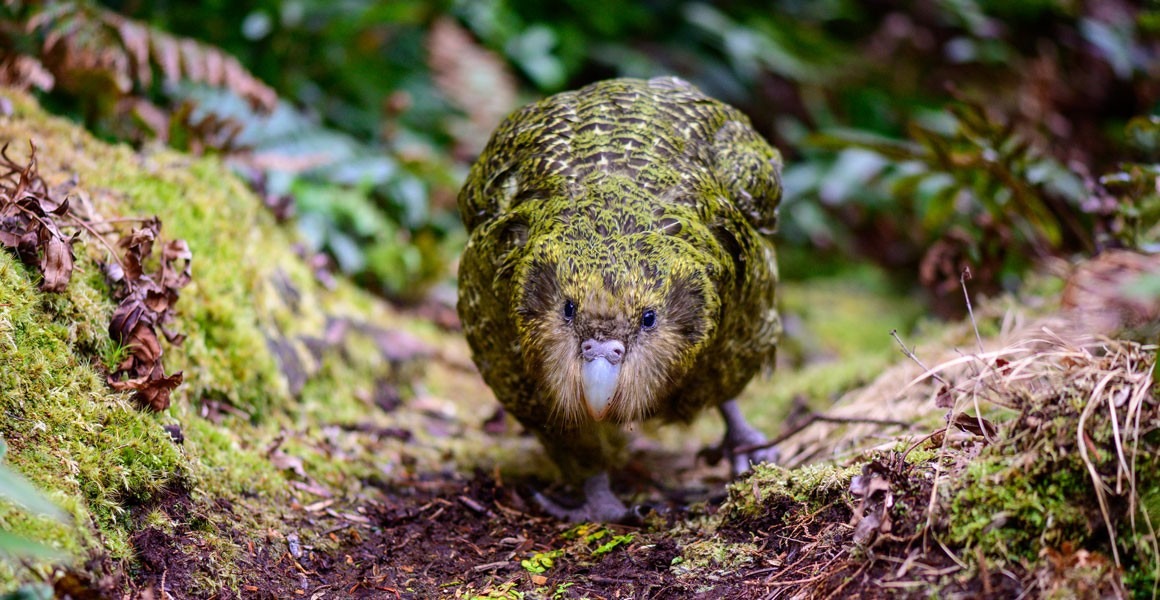
The kākāpō is the world’s heaviest parrot, its only flightless parrot, and possibly its most fragrant — it smells like honey and flowers, which scientists believe evolved as camouflage before mammalian predators arrived. It can live to 100 years old, weighs as much as a house cat, and makes a booming sound during breeding season that carries for kilometers. There are currently around 250 left on Earth, all of them named individually by conservation teams who know each bird personally. The kākāpō exists in defiance of every rule a parrot is supposed to follow.
30
Baikal SealLake Baikal, Siberia, Russia

Photo by Paul Kapischka on Unsplash
Lake Baikal is the world’s oldest, deepest, and most voluminous freshwater lake — and it contains the world’s only exclusively freshwater seal. The nerpa, or Baikal seal, has lived in isolation here for approximately 2 million years, long enough to evolve into an entirely distinct species. Nobody is entirely certain how its ancestors got there. The leading theory involves ancestors migrating from the Arctic along an ancient river system that no longer exists. Today, roughly 80,000 of them live in a lake that contains more fresh water than all of North America’s Great Lakes combined.
31
The OkapiIturi Forest, Democratic Republic of Congo

Photo by David Valentine on Unsplash
The okapi — half zebra, half giraffe in appearance, and actually neither — wasn’t known to Western science until 1901. It managed to hide in the dense Ituri rainforest of central Africa, unseen by European explorers for centuries, despite being the size of a large horse. It is the giraffe’s only living relative and shares its long blue-black tongue, used to strip leaves from branches and clean its own ears. Extraordinarily shy, it remains one of the least-studied large mammals on Earth. Even in prime okapi habitat, sightings are rare enough to be remarkable.
32
Parícutin VolcanoMichoacán, Mexico

Photo by Thomas Fields on Unsplash
On February 20, 1943, farmer Dionisio Pulido was plowing his cornfield in rural Mexico when the ground began to smoke. By the next morning, a cinder cone nine meters tall had formed. Within a week it was over 100 meters high. Parícutin grew from flat farmland to a 424-meter volcano in nine years — the only time in recorded history that science has been able to document the entire birth-to-adulthood life cycle of a volcano from its very first moment. The buried ruins of San Juan Parangaricutiro, with only the church tower still visible above the hardened lava, are still there today.
33
Opalised Fossils of Lightning RidgeLightning Ridge, New South Wales, Australia

Photo by Clark Van Der Beken on Unsplash
Every fossil found at Lightning Ridge has been transformed into opal. Not just preserved — transformed: the original material replaced, molecule by molecule, by silica that has crystallized into the iridescent fire of precious opal. Dinosaur bones, ancient molluscs, plant stems — all rendered in shifting color. The conditions that allow this to happen are so specific that Lightning Ridge is the only place on Earth where it occurs reliably. A dinosaur claw that shimmers green, blue, and orange as you turn it in the light. Prehistory made beautiful by geology.
Section 08
34
TardigradesEverywhere — your garden, your roof, the deep ocean

Photo by Kristian Hunt on Unsplash
Tardigrades — also known as water bears or moss piglets — are half a millimeter long, have eight stubby legs, and are essentially indestructible. They survive temperatures near absolute zero and above 150°C. They withstand radiation doses hundreds of times the lethal human level. They endure pressures six times greater than the deepest ocean trench. Exposed to the vacuum of space, they curl into a state called cryptobiosis and wait it out. They have survived all five of Earth’s mass extinctions. Right now, there are almost certainly tardigrades living in the moss growing on your roof.
35
Atacama Desert MicrobesCore Atacama Desert, Chile

Photo by Alexander Belikoff on Unsplash
In the driest core of the Atacama Desert, where decades pass without measurable rainfall, scientists have found microbial communities living in the soil — active ones. These bacteria survive on the thinnest possible margins, spending years in dormancy then springing briefly to life during rare moisture events that come not from rain but from coastal fog. When even that fails, some extract water directly from hygroscopic minerals in the soil. They are the closest thing Earth has to the hypothetical life that might exist on Mars — and scientists study them for exactly that reason.
36
Iceland’s Lava TubesIceland

Photo by Kay Si Ying on Unsplash
Iceland sits atop one of the most volcanically active places on Earth, and beneath its surface lies a network of more than 500 known lava tubes — tunnels formed when the outer crust of a lava flow cools and hardens while molten rock continues to drain through the interior. Some stretch for over a kilometer. Grjótagjá combines the extraordinary with the surreal: a lava tube that contains a natural hot spring, where crystal-clear geothermally heated water fills the rock chamber in absolute silence.
37
Lord Howe Island600km east of mainland Australia

Photo by Andrés Beltrán Espinosa on Unsplash
Lord Howe Island is only 11 kilometers long, but its isolation in the Pacific Ocean has made it one of the most biologically distinct places on Earth. Nearly half of its native plant species are found nowhere else.
More than 60% of its insect species are endemic. It contains the world’s southernmost coral reef and the most intact island ecosystem remaining in the Pacific. And somewhere in its forests, if you look carefully enough at the right time of night, you might find a Lord Howe Island stick insect — a creature so rare it has its own entry in this article.
38
Luminous Lagoon, JamaicaFalmouth, Jamaica

Photo by The Tampa Bay Estuary Program on Unsplash
The Martha Brae River meets the Caribbean Sea at Falmouth, Jamaica, and where those two bodies of water mix — freshwater and salt in a precise ratio — dinoflagellates thrive year-round. What makes the Luminous Lagoon unusual among bioluminescent bays is its consistency: no seasonal variation, no best time of year. The surrounding mangrove forest provides a constant supply of nutrients that keeps the organisms at peak concentration. On moonless nights, jumping into the water produces a full-body halo of cold blue light.
39
Soufrière Springs, DominicaSoufrière Valley, Dominica

Photo by HsinKai Tai on Unsplash
Dominica’s interior is essentially a slowly erupting volcano. At Soufrière, geothermal vents heat sulfur-rich water to 46°C and push it to the surface through a landscape so inhospitable to plant life that the surrounding area looks like the surface of another world: bare, mineral-stained rock in yellows and oranges, surrounded by steam. And then, a short walk away, Cold Soufrière — a pool of strikingly cool water fed by the same geothermal system, so counterintuitive against its surroundings that first-time visitors touch it twice to make sure.
40
Changtang PlateauNorthern Tibet, China

Photo by HsinKai Tai on Unsplash
At elevations between 4,300 and 7,000 meters — higher than the summit of most mountains — the Changtang Plateau covers 700,000 square kilometers of northern Tibet in near-total desolation. And yet it supports extraordinary life: wild yaks, snow leopards, Tibetan bears, and the chiru — the Tibetan antelope — which was nearly hunted to extinction for its undercoat, one of the finest natural fibers on Earth. The chiru migrates to remote calving grounds at the highest elevations on the planet to give birth. The exact location remained unknown to science until the 1990s.
The natural world is not finished surprising us. New species are still being discovered — in deep ocean trenches, in remote rainforest canopies, in the DNA of organisms we thought we understood. New geological formations are still being named. The deep biosphere, the ocean floor, the interiors of glaciers — these remain among the least explored places on Earth. The list above is not definitive. It’s a starting point.
Sources: UNESCO World Heritage documentation, NOAA Ocean Exploration, Guinness World Records, Atlas Obscura, National Geographic, peer-reviewed geological and biological literature. Photography: Unsplash contributors as credited above, Creative Commons on WordPress
Discover more from Moss and FogSubscribe to get the latest posts sent to your email.
Comments (0)