
Remember me





See All Key Ideas
JAKARTA — A palm oil company is ramping up its destruction of forests that are home to critically endangered orangutans in a UNESCO Biosphere Reserve on the island of Borneo, according to satellite imagery and government sources.
In October 2025, Mongabay reported that PT Equator Sumber Rezeki (ESR) had clear-cut 1,376 hectares (3,400 acres) of forest between January and August 2025, based on satellite image analysis by Satya Bumi, an Indonesian environmental nonprofit. Prior to that, ESR had cleared no more than 195 hectares (482 acres) of forest. The company is operating within a 15,000-hectare (37,000-acre) oil palm plantation concession in Kapuas Hulu, a district in Indonesia’s West Kalimantan province.
Now, an updated analysis by Satya Bumi shows that ESR further accelerated its rainforest clearing in the final quarter of 2025, razing an additional 1,492 hectares (3,687 acres) of forest from October to December. It has now cleared a total of 3,063 hectares (7,569 acres) of forest within its concession, according to Satya Bumi.
 Map that shows deforestation in palm oil company PT Equator Sumber Rezeki’s concession in Kapuas Hulu, West Kalimantan, Indonesia.
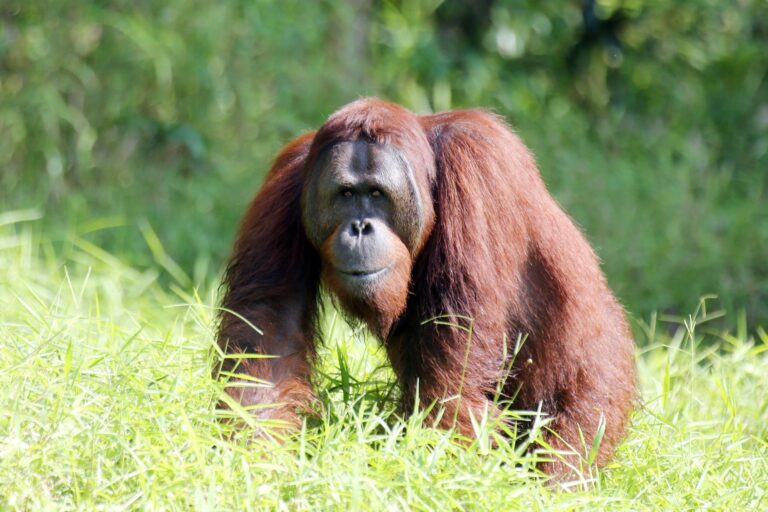
ESR’s concession overlaps with part of the Labian–Leboyan watershed, a wildlife corridor connecting Betung Kerihun and Danau Sentarum national parks — two of the last strongholds for the critically endangered Bornean orangutan (Pongo pygmaeus).
The corridor and parks form part of the UNESCO-designated Betung Kerihun–Danau Sentarum Biosphere Reserve, whose forests sustain hundreds of species of wildlife, including sun bears, hornbills and giant rafflesia flowers. They also provide water, food and livelihoods for Indigenous Dayak communities whose cultures are closely tied to the land.
Indonesia’s Ministry of Forestry told Mongabay in January it had become aware of the deforestation by ESR from a Mongabay social media post in September 2025. A subsequent field inspection by the Betung Kerihun and Danau Sentarum national park authorities confirmed that ESR was indeed logging the forest inside its concession and that there were pockets of orangutan habitat also located inside the concession.
According to Satya Bumi, 1,892 hectares (4,675 acres) of the forest cleared in 2025 was identified as orangutan habitat in a 2016 population and habitat viability analysis. This is a regular assessment involving government authorities and scientists, Satya Bumi told Mongabay. The analysis placed the total area of orangutan habitat within the land now included in ESR’s licensed area at nearly 4,000 hectares (about 10,000 acres).
The forestry ministry told Mongabay in January it had identified 7,335 hectares (18,125 acres) of orangutan habitat within the concession. It did not say whether any of this had been cleared by ESR. Satya Bumi said the ministry’s higher figure might be attributable to its use of more recent data, which the nonprofit doesn’t have access to.
Field surveys by Indonesian NGO LinkAR Borneo recorded at least 10 orangutan nests in the concession, the group said in a statement. All 10 are located in Labian village, LinkAR Borneo researcher Raden Deden Fajarullah told Mongabay.
First Borneo, the Jakarta-based conglomerate that owns ESR, did not respond to questions.
 The location of PT Equator Sumber Rezeki (ESR)’s palm oil concession in Kapuas Hulu, West Kalimantan, which overlaps with a UNESCO biosphere reserve.
The deforestation has raised alarm among environmental groups, which warn that without immediate intervention, the activity could accelerate habitat fragmentation and increase human-wildlife conflict.
Just 104,700 Bornean orangutans are thought to remain in the wild, down from about 200,000 in 1999, according to WWF.
“Entering early 2026, these findings serve as a stark warning to the government, law enforcement authorities, and plantation companies,” Riezcy Cecilia Dewi, a campaigner with Satya Bumi, said in a statement. “Without firm action to stop deforestation and protect orangutan habitat, Indonesia’s commitment to biodiversity protection and sustainable forest management will continue to be questioned.”
 A time lapse of deforestation in First Borneo’s PT Equator Sumber Rezeki concession in Kapuas Hulu, West Kalimantan, Indonesia. The Planet time lapse imagery is courtesy of forest monitoring site Nusantara Atlas.
Orangutans under siege
A time lapse of deforestation in First Borneo’s PT Equator Sumber Rezeki concession in Kapuas Hulu, West Kalimantan, Indonesia. The Planet time lapse imagery is courtesy of forest monitoring site Nusantara Atlas.
Orangutans under siege
In a written statement to Mongabay, the management authority for the two national parks acknowledged the presence of orangutan habitat and the corridor’s ecological function inside ESR’s concession. But it did not identify any plan to halt or pause ESR’s clearing activities to protect the habitat.
Instead, the national park authority said proposals had been made to designate orangutan habitat pockets outside the concession as preservation areas, while habitat pockets located inside the concession would be proposed as areas of high conservation value (HCV). Cooperation mechanisms for managing the habitat pockets would also be established.
HCV is a land management concept used to identify and protect areas with critical ecological or social importance inside production landscapes such as oil palm and industrial timber concessions.
In Indonesia, HCV is not a formal land-use category under zoning laws. As such, any HCV set-aside inside ESR’s plantation would require the company’s agreement to preserve and would function as a voluntary conservation commitment rather than a statutory prohibition on land clearing — unless it’s reinforced through certification or contractual supply-chain requirements.
The Teraju Foundation, an Indonesian nonprofit, says “up to 80%” of the concession meets HCV standards like those put forth by the HCV Network, a network of NGOs and companies working to advance the methodology.
Any orangutan habitat would be a shoo-in for HCV status under any reasonable criteria, primate researcher Wanda Kuswanda of Indonesia’s National Research and Innovation Agency (BRIN) told Mongabay.
Designating an area as HCV can help orangutans when implemented properly, but does little good when treated as a box-ticking exercise, Wanda said. In landscapes such as the Betung Kerihun–Danau Sentarum corridor, HCV areas truly benefiting orangutans would need to be fairly wide and connected to protected forests rather than to isolated patches established only to meet minimum percentage requirements.
“The key is that the wider the corridor, the greater the potential to strengthen orangutan populations,” Wanda said.
Satya Bumi said the ESR case highlights deeper flaws in Indonesia’s plantation licensing system, notably the failure to properly integrate biodiversity data into zoning plans and permit issuance from the outset.
“The fact that most of the [concession] overlaps with orangutan habitat shows that habitat protection was not a primary consideration from the beginning,” the group said, warning that any future HCV designation in the ESR concession risks becoming a symbolic corrective layered over damage that’s already occurred.
If the government and ESR are genuinely committed to protecting orangutan habitat inside the concession, the company should reallocate, restrict or even relinquish parts of its licensed area, Satya Bumi added.
 Betung Kerihun National Park in West Kalimantan Province precisely in the Kapuas Hulu district. Image courtesy of Sabar Minsyah/Wikimedia Commons.
Land conflicts
Betung Kerihun National Park in West Kalimantan Province precisely in the Kapuas Hulu district. Image courtesy of Sabar Minsyah/Wikimedia Commons.
Land conflicts
Village officials from some communities located inside ESR’s concession told Mongabay last September that they never agreed to let the company use their land and were surprised to find that parts of their territory had been included in its license without their consent.
At least five villages — Senunuk, Setulang, Labian, Labian Ira’ang and Mensiau— have territories that overlap with ESR’s license area.
Besides obtaining government permits, palm oil firms must also negotiate with local landowners for the right to use their land. But Indonesia’s Indigenous communities typically hold land communally, and they often lack government land titles. And while Indonesian villages have elected leaders, they also make important decisions — such as whether to hand over land to a corporate developer — through a consensus-based method known as musyawarah.
A well-documented tactic for companies seeking land in a village that may not want to do business with it or whose residents are divided on the matter is to fraudulently buy the land from someone falsely claiming the rights to it.
Mongabay’s on-the-ground reporting and fieldwork by several NGOs show Senunuk and Setulang have made agreements with ESR, allowing it to plant oil palms on parts of their land; Mensiau is split, with one of its hamlets, Entebuluh, making an agreement with the company while another, Kelawik, has rejected it; and Labian and Labian Ira’ang have formally rejected the company’s overtures.
In Labian, however, a group of 14 individuals have undercut the village’s collective decision-making process to make their own agreement to lease land to the company, according to Raden, the LinkAR Borneo researcher. Mongabay has not been able to verify the NGO’s findings.
According to Raden, ESR promised to pay 3.5 million rupiah ($206) per hectare for leased land (about $83 per acre), hire local landholders as employees, and return the land once its permit expires in several decades.
The land signed over to ESR is located in a hamlet of Labian called Ngaung Keruh. Raden said the 14 individuals are from another hamlet but hold certain land-use rights in Ngaung Keruh, triggering internal tensions within the village.
An agreement signed on Nov. 12, 2025, initially divided which land could be leased to the company and which would remain under village control, Raden said. However, the agreed area was smaller than the 500 hectares (1,235 acres) requested by ESR in its annual work plan to the government.
Two days later, on Nov. 14, the group of 14 individuals rejected the agreed-on boundaries and carried out land measurements with the company, leading to the annulment of the agreement, Raden said. Subsequent meetings at the village office failed to reach a new consensus.
 A traditional longhouse in Setulang village, Kapuas Hulu district, West Kalimantan, where Banying, 62, an elder in a local Dayak Iban community, lives. Image by Hans Nicholas Jong/Mongabay.
Questions over permits
A traditional longhouse in Setulang village, Kapuas Hulu district, West Kalimantan, where Banying, 62, an elder in a local Dayak Iban community, lives. Image by Hans Nicholas Jong/Mongabay.
Questions over permits
LinkAR Borneo has also raised concerns over the legality of ESR’s operations.
Raden told Mongabay that during meetings he attended with district and provincial officials, authorities said the company’s right-to-cultivate permit, or HGU — the final authorization required before large-scale agricultural operations can begin — was still in process.
During a Jan. 20 meeting with community representatives, the Kapuas Hulu Plantation and Livestock Agency acknowledged that ESR does not yet hold an HGU, according to Satya Bumi, which said it attended the meeting. Officials at the meeting said ESR had obtained a plantation business permit, known as IUP, and that its process was in line with a 2025 government regulation on licensing.
However, the western portion of ESR’s concession appeared on the website of the National Land Agency in late January 2026, which normally only happens after a company has obtained an HGU, indicating that ESR has acquired one for that part of its concession.
If it doesn’t have the permit, however, clearing at plantation scale would raise questions about whether land rights have been finalized.
Raden said parts of ESR’s concession consist of peatland that had never previously been cultivated by local communities. However, ESR’s permit application did not state that the area was peatland, he said.
“Our field research in Senunuk shows peat depth exceeding 2 meters [6.6 feet], and the area is very close to Danau Sentarum,” Raden said. “We conclude this is protected peatland based on our visual observation, including the depth of drainage canals.
“The core issue is not only whether the peatland is protected or cultivation peatland,” he added, “but that ESR’s permit application never stated that the area was peatland. That is the fundamental problem.”
Raden said LinkAR Borneo has flagged these issues to local authorities, but that officials have so far said only that they would coordinate with higher levels of government, without indicating concrete enforcement steps.
On orangutan habitat, local officials agreed that oversight was necessary but deferred responsibility to district authorities, Raden said.
“We are considering reporting directly to the National Land Agency regarding the company’s legal standing,” Raden told Mongabay. “To our knowledge, [the agency] is currently focusing on disciplining companies operating without HGUs.”
Mongabay asked the Ministry of Forestry to clarify whether ESR holds an HGU and whether clearing activities should be halted pending further review, but received no response by the time this story was published.
Mongabay also reached out to the Kapuas Hulu district head, who declined to comment.
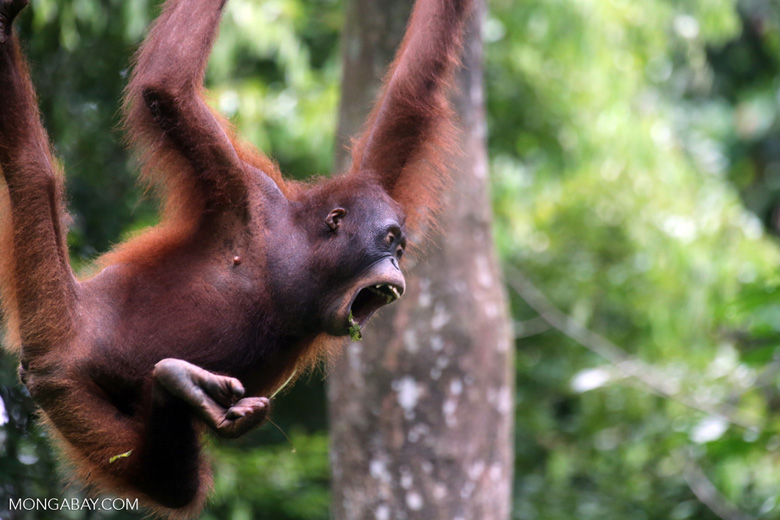
 A Bornean orangutan. Image by Rhett A. Butler/Mongabay.
A ‘leakage actor’
A Bornean orangutan. Image by Rhett A. Butler/Mongabay.
A ‘leakage actor’
ESR is a subsidiary of Jakarta-based First Borneo Group, owned by Indonesian tycoon Alexander Thaslim. First Borneo controls several other oil palm concessions besides ESR in West Kalimantan and Riau provinces that U.S. campaign group Mighty Earth says have cleared rainforest.
As a result, First Borneo has been placed on “no-buy” lists by multiple palm oil traders. However, Mighty Earth says the conglomerate has continued clearing forest and selling palm oil into global supply chains.
Satellite analysis cited by Mighty Earth shows more than 3,600 hectares (8,900 acres) of deforestation across three First Borneo concessions between 2023 and 2025.
In Borneo, First Borneo doesn’t own any palm oil processing mills, and instead sells its palm fruit to mills owned by other companies, in some cases as far as 350 kilometers (about 220 miles) away — well beyond the distances many companies typically monitor, according to Mighty Earth.
That allows palm oil linked to deforestation to enter supply chains that are marketed as deforestation-free.
After Mighty Earth presented its evidence to traders and mill operators, some mills agreed to stop sourcing palm fruit from First Borneo concessions. Major traders, including Golden Agri-Resources (GAR) and Wilmar, said they were engaging with suppliers and tightening controls, with GAR acknowledging the need to expand its monitoring radius to plantations within 150 km (90 mi) of its mills.
However, Mighty Earth says its investigation also found cases where companies continued to source from First Borneo even after claiming to have stopped, underscoring gaps between corporate commitments and enforcement on the ground.
The organization argues that voluntary no-deforestation policies have so far failed to block high-risk producers like First Borneo, and has called on companies to strictly enforce no-buy policies, expand supply-chain due diligence, and suspend mills that continue sourcing from the group.
“With improved road networks in the region, [palm fruit] from leakage actors like First Borneo can easily enter supply chains through mills hundreds of kilometers away,” Mighty Earth said in an article, adding that companies sourcing from West Kalimantan should conduct due diligence within at least a 150-km radius.
The group says the case illustrates why binding regulations such as the European Union’s antideforestation regulation are needed to ensure traceability to plantation level and prevent deforestation-linked products from entering global markets.
Without effective enforcement, First Borneo concessions, including ESR, will continue to have incentives to clear forest and expand plantations, environmental groups warn — threatening biodiversity and the communities who depend on these forests.
“For Indigenous Dayak communities living within and around the national parks, forests are sources of food, medicine, water, culture and the future,” said Ahmad Syukri, executive director of LinkAR Borneo. “When forests are cleared, they lose everything.
“This is not just about trees being cut down,” he added. “It’s about the survival of communities that have safeguarded these forests for generations. Biosphere reserve status must not become an empty label.”
Banner image: A Bornean orangutan. Image by Rhett A. Butler/Mongabay.
FEEDBACK: Use this form to send a message to the author of this post. If you want to post a public comment, you can do that at the bottom of the page.

Comments (0)