
Remember me





See All Key Ideas
In October 2025, environmental officers arrived unannounced at the Parangaba Fair that takes place every Sunday in Fortaleza, in northeastern Brazil. The market, also known as the Bird Fair, had a reputation for illegally selling small birds, parrots and macaws.
During that Sunday’s operation, agents seized 271 birds and transported them in groups to the Wildlife Screening Center (CETAS) in Fortaleza. There, confiscated wildlife is rehabilitated for possible reintroduction to the wild. These rescue and rehab centers are managed by Brazil’s federal environmental agency, IBAMA.
Within days, some small, multicolored African lovebirds, from the genus Agapornis began to sicken — and die. Targeted by the pet trade, these parrots sometimes carry circovirus, a genus of viruses that afflict a wide range of birds.
It was a growing crisis.“The [seized] birds kept arriving and tests were being conducted, and then they started coming back positive,” said Fernanda Gaia, IBAMA’s environmental analyst at the center.
The diagnosis triggered a red alert: the hundreds of birds housed at CETAS were at risk. Staff isolated the sick birds.
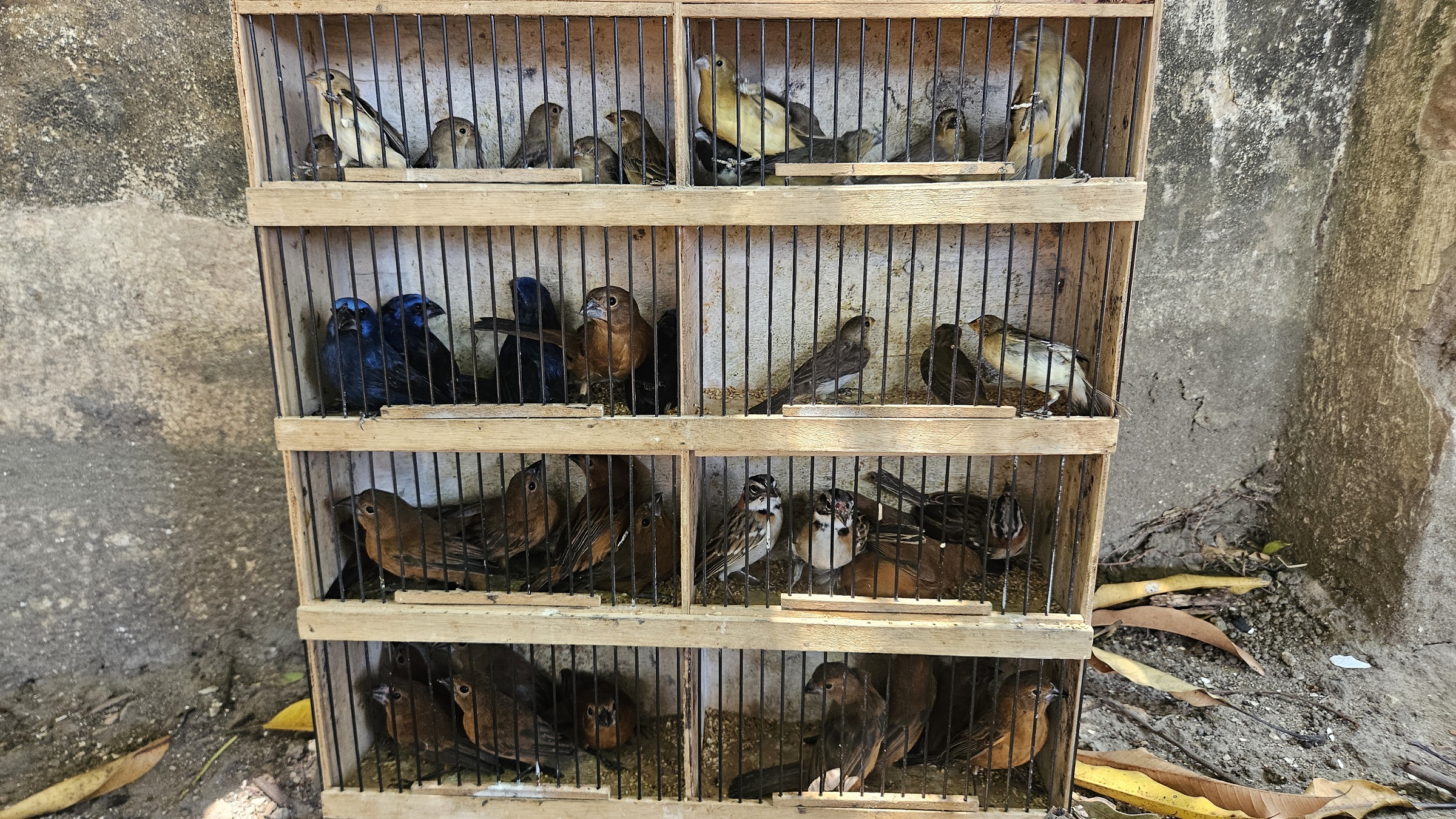
 IBAMA agents seize birds sold illegally at the Parangaba Fair in Fortaleza. Image courtesy of Daiane Cortes/IBAMA.
Then, in January 2026, there was another scare. Two turquoise-fronted Amazon parrots (Amazona aestiva) were diagnosed with avian polyomavirus. This disease, first discovered in Canada and the U.S. in the 1980s, acts much like circovirus.
To prevent further infections, IBAMA closed the Fortaleza CETAS to new bird arrivals for 90 days. “With the detection in more species, both with circovirus and polyomavirus, and knowing that at this time of year the arrival of chicks is very common, we [closed the center] as a protective measure,” Gaia said.
In total, about 80 birds had to be euthanized due to either circovirus or polyomavirus infection.
On alertCircovirus parrot is a circovirus strain that affects more than 60 species of psittacines, the order that includes parrots, macaws and parakeets. Symptoms include malformed or lost feathers; fragile, deformed beaks; skin lesions and compromised immunity, which can lead to pneumonia or other secondary infections.
Commonly known as psittacine beak and feather disease, there’s no known cure. It’s particularly deadly for young birds, and spreads rapidly, making the disease a death sentence: Infected birds must be euthanized to prevent an epidemic.
Brazilian experts have been on alert for circovirus since May 2025, when the disease was discovered in critically endangered Spix’s macaws (Cyanopsitta spixii). Once considered extinct in the wild, these birds were bred in captivity in Germany and brought over to Brazil in January 2025 to repopulate the wild in a celebrated reintroduction program.
But on May 12, the breeding center in Curaçá, in Bahia state, notified authorities that seven of its birds had tested positive for circovirus. One of them was a chick that had been born in the wild and had never been in captivity. The other six were raised in captivity and were being prepared for release.
In November, Brazilian environmental authorities captured the 11 Spix’s macaws that had already been rewilded by the reintroduction program and made a shocking discovery: Every one of them tested positive.
Circovirus, which is native to Australia, had never before been found in wild birds in Brazil.
The country had previously recorded cases in birds that passed through rehabilitation centers, breeding facilities or zoos. With the confirmation of infection in wild birds, the fear is that circovirus will spread and infect birds in other parts of the country.
“I don’t even like to think about that scenario,” said Alice Soares de Oliveira, a veterinarian with the wildlife department of the city of São Paulo. “It would be a tragedy.”
IBAMA told Mongabay that it “maintains continuous monitoring of records and suspicions of circovirus and polyomavirus in other regions of the country.” But the agency didn’t reveal whether there are other confirmed cases.
 A Spix’s macaw infected with circovirus at a breeding facility in Curaçá, Brazil. Image by Miguel Monteiro for Mongabay.
Trafficking as a disease risk
A Spix’s macaw infected with circovirus at a breeding facility in Curaçá, Brazil. Image by Miguel Monteiro for Mongabay.
Trafficking as a disease risk
Detection of the virus at the Fortaleza fair revealed a new and dangerous way it could spread: Open-air markets of this type operate nationwide.
In an email, IBAMA said there’s oversight: These markets are “subject to permanent monitoring by environmental agencies.” However, there aren’t enough environmental agents to handle enforcement. The Parangaba Fair, for example, was previously raided in 2022, yet the bird trade there continued.
IBAMA acknowledged the danger, saying that wild animal markets “significantly increase the risk of pathogen dissemination.”
“The big problem with these markets is the mixing of wild animals with domestic [exotic] animals, like the rose-ringed parakeet [Psittacula krameri] and creatures that came from outside Brazil,” said biologist Yuri Marinho Valença, “and they carry the viruses from their region.” Valença is part of a program reintroducing turquoise-fronted Amazons in Pernambuco state.
The stress these animals are subjected to is another factor in the spread of the disease, said IBAMA’s Gaia. “[The traders] want to optimize space to sell more. So they take small packages, pack them as much as they can, put [the birds] inside backpacks; inside boxes,” she said.
With dozens of animals crowded together and transported under poor conditions — barely able to breathe, too hot, cold, hungry, thirsty — healthy birds grow weak and more susceptible to infection.
Under these conditions, those that already carry the virus are more likely to transmit it. “[Circovirus], which is sometimes latent, resumes [activity] and the animal may begin to develop signs or shed the virus into the environment.” It’s transmitted through feather dust and feces.
CETAS in the eye of the stormAcross Brazil, IBAMA’s network of CETAS rehabilitation centers are the primary destination for birds rescued from animal trafficking. To prevent disease transmission, the animals are quarantined and tested upon arrival, and releases are restricted in risky situations.
However, isolation and testing are not simple tasks. After the October raid at the Parangaba Fair, 271 birds arrived at the Fortaleza CETAS, severely stressed and in terrible health. “[A situation like this] demands logistics, resources and time, which is why measures are not taken in the blink of an eye,” Gaia said.
Speedy testing is crucial, but it can take up to three weeks to get results from partner laboratories that analyze samples. Often, tests must be repeated, as false negatives are common.
To prevent an epidemic, “The [rehabilitation centers] must be very judicious,” said Oliveira, the São Paulo vet. “They must have an effective quarantine structure, with a veterinarian who observes the animals from the moment they’re received, checking their condition and monitoring their progress.” Meanwhile, some of the 25 CETAS centers spread across the country don’t have a veterinarian, she added.
 This blue-and-yellow macaw (Ara ararauna), infected by circovirus, was delivered to the Wildlife Management and Conservation Center in São Paulo. Image courtesy of Alice Soares de Oliveira.
Infectious diseases like circovirus and polyomavirus enter Brazil through both illegal trafficking and legal import of exotic birds, which is allowed in some cases with authorization from environmental agencies.
Sanitary control measures, however, are far from ideal. While the Ministry of Agriculture and Livestock uses a network of official laboratories to ensure that Brazilian agribusiness remains free of diseases like avian flu and foot-and-mouth disease, the same level of care doesn’t apply to wildlife imports.
“In federal terms, we would have to think about a list of diseases that would be mandatory to test for in both imported animals and those arriving at screening centers,” Oliveira said.
Without proper control measures, newly seized birds could jeopardize years of work rehabilitating numerous threatened species that might have been returned to the wild. Oliveira emphasized the danger: If an animal is doing well, ready to be released, and becomes infected, it could compromise the entire stock, she said.
“[Rehabilitation] is already a slow process,” Gaia said. “With an outbreak like this, everything gets slower.”
Banner image: Birds crowded and under severe stress make open-air markets like the Parangaba Fair in Fortaleza ideal locations for the spread of diseases. Image courtesy by Daiana Cortes/IBAMA.
This story was first published here in Portuguese on March 3, 2026.
More to explore:
Citation:
Olivares, R. W., Bass, L. G., Sáenz-Bräutigam, A., Sandí-Carmiol, J., Villada-Rosales, A. M., Dolz, G., … Uzal, F. A. (2025). Psittacine beak and feather disease in 2 free-living great green macaws: A case report and literature review. Journal of Veterinary Diagnostic Investigation, 37(4), 666-673. doi:10.1177/10406387251333410
FEEDBACK: Use this form to send a message to the author of this post. If you want to post a public comment, you can do that at the bottom of the page.

Comments (0)