
Remember me

See All Key Ideas
TSWALU KALAHARI RESERVE, South Africa — From high on a promontory in the Korannaberg Mountains, a mountain zebra (Equus zebra hartmannae) peers down to the west across the green-dappled plain below, the sun rising behind. In the distance, wild dogs (Lycaon pictus) hunt in the veld, verdant after early rains. And nearby, white rhinos (Ceratotherium simum) graze among thorny thickets.
These species, and dozens more, persist here thanks to a decades-long effort to rewild a sliver of Southern Africa’s great desert and dry savanna. The Tswalu Kalahari Reserve has become a sanctuary for rare and threatened animals, drawing in a steady stream of well-heeled tourists from around the globe. More recently, the reserve’s managers have embarked on a quest to increase the carbon stored in its soils — a quest that relies heavily on the reserve’s animals.
At first glance, places like Tswalu might not seem suited for stockpiling carbon. The Tswana people call this part of the world Kgalagadi — “the waterless place.” Fickle precipitation in the Kalahari averages a scant 10-50 centimeters (4-20 inches) annually, and much less in some years. That means the comparative lushness here in late 2025 could evaporate if the rains don’t carry on throughout the austral summer of the Southern Hemisphere.
To date, most nature-based carbon storage efforts have focused on fast-growing tropical forests, expanding native or plantation tree cover that draws carbon out of the atmosphere. Soil carbon, by contrast, is slower to accumulate, and it’s more laborious and expensive to monitor.
But globally, soils hold roughly three times as much terrestrial carbon as forests and other aboveground vegetation.
There’s value in leveraging carbon “the hard way, with the help of science,” says Matthew Child, CEO and co-founder of the carbon and biodiversity project developer Rewild Capital. Rewild Capital is partnering with Tswalu for its carbon project. Child and like-minded scientists contend that carbon stored in forests is more susceptible to being lost as a result of clearance or fires. Soil, meanwhile, has the potential to be a more durable climate solution.
 A bat-eared fox (Octocyon megalotis). Image courtesy of Tswalu Kalahari Reserve.
‘The disturbance regime’
A bat-eared fox (Octocyon megalotis). Image courtesy of Tswalu Kalahari Reserve.
‘The disturbance regime’
The Tswana and other peoples of the Kalahari have long adapted to the whims of the harsh landscape. But climate change, driven overwhelmingly by the use of fossil fuels in industrialized, wealthy countries, has exacerbated the severity of its temperatures and droughts. As a result, the Kalahari is more vulnerable to degradation — for example, from livestock overgrazing — and its soils hold less carbon.
The Oppenheimer family, which built its fortune on South Africa’s gold and diamond mines, acquired Tswalu in 1999 and continued the previous owner’s model of buying up adjoining land from farmers and restoring it for conservation. The reserve is now about the size of Hong Kong, at 118,000 hectares (292,000 acres). Child and others suggest that allowing places like Tswalu to recover and managing the presence of wildlife that have co-evolved with the Kalahari’s sparse vegetation could reawaken long-dormant dynamics in worn-out landscapes.
“Rewilding is not just about putting the original species back into place,” Child says. “It’s about restoring the disturbance regime.”
As paradoxical as it might seem, the movement of hoofed herbivores over the land can elevate densities of carbon in the soil, instigated by a complex waltz of chemical reactions driven by soil-dwelling microbes. With the right balance, proponents say, the great herds carry the potential to restore not only biodiversity, but also the resilience of delicate landscapes in an uncertain future of a warmer world.
“Arid lands are the place where we’re going to be feeling it the most, but where we can get the greatest returns,” says Duncan MacFadyen, the head of research and conservation at a consortium of businesses and nonprofits called Oppenheimer Generations that represents the interests of its namesake family. “I think Tswalu shows how rewilding can mitigate climate change through soil carbon storage and improve land productivity.”
 Evening storms on the horizon at Tswalu. Image by John Cannon/Mongabay.
 Accommodations at Tswalu befit the reserve’s reputation as a provider of high-end safaris. Image by John Cannon/Mongabay.
Restoring — and managing — an Eden
Accommodations at Tswalu befit the reserve’s reputation as a provider of high-end safaris. Image by John Cannon/Mongabay.
Restoring — and managing — an Eden
Through the late 19th century, vast herds of springbok (Antidorcas marsupialis) moved across the greater Kalahari, following the grasses and vegetation coaxed from the red earth by sporadic rains. The San people likened their numbers to the stars of the Milky Way. European settlers reported herds in the tens of thousands that stretched 160 kilometers long by 24 km across (100 by 15 miles).
But by the early 1900s, hunting, fencing and roads had largely brought these sweeping migrations to an end, and with them, potential underpinnings of the soil’s health that scientists are just beginning to understand.
Springbok aren’t huge compared to other antelope — about the weight of a Labrador retriever, though standing taller at the shoulder. But their sheer numbers back then made up for their svelteness, impacting the landscape in seen and unseen ways.
Of course, the springbok, a ruminant in the same family as cows, goats and sheep, wasn’t alone in shaping the landscape, and Tswalu’s managers work to ensure that many native species, including springbok, again populate the veld in appropriate numbers.
The goal of having these animals here, from the giraffes (Giraffa camelopardalis) that browse Acacia trees, to larger antelope like kudu (Tragelaphus strepsiceros) and eland (Taurotragus oryx), is to approximate the once-prevalent, if sporadic, trampling of the landscape by thousands of hooves.
 Springbok (Antidorcas marsupialis) on an early Tswalu morning. Image by John Cannon/Mongabay.
“That’s what the animals naturally do, right?” says Oswald Schmitz, the Oastler Professor of population and community ecology at Yale University in the U.S., who studies biodiversity and ecosystem services. “They graze, they release urine and dung, and then they move. And then you’ve got the fertilizer sitting there on the soil from the animals. It gets absorbed into the soil, and then it gets absorbed by the plants and enhances productivity of the vegetation.”
It’s all part of the “disturbance regime” that Child sees as vital to recreate.
“The trick there is to say, OK, let’s simulate the sporadic grazing events that used to take place in the system that enabled grass recovery in certain landscapes at certain times that ultimately drove up productivity of that entire landscape,” Child says.
But it’s a careful balance.
 The Orange River cuts through the dry plains of the southern Kalahari. Image by John Cannon/Mongabay.
Predators and a ‘landscape of fear’
The Orange River cuts through the dry plains of the southern Kalahari. Image by John Cannon/Mongabay.
Predators and a ‘landscape of fear’
Research points to “a sweet spot of [herbivore] density where you do get good carbon benefits,” Schmitz says. “But if these animals become too abundant, then they also destroy the environment.”
That’s where the management of the reserve led by Tswalu ecologist Wendy Panaino comes in. The goal, Panaino says, is improving resilience in the face of climate change-driven changes in elements like rainfall patterns “happening right in front of our eyes.”
“If you can ensure that your system is as intact as possible, you almost provide a buffer for those more extreme changes,” Panaino says. “We would love to not tinker with the system, but again, you have to at some point.”
At a place like Tswalu, predators play a crucial role in maintaining overall heterogeneity and resilience. Scientists call it “a landscape of fear,” driven by predators like Tswalu’s wild dogs, as well as lions (Panthera leo) and leopards (Panthera pardus); both large cats also live in parts of Tswalu.
The presence of these hunters influences herbivore movements, Schmitz says.
“The ambush predators create this fear factor, and it changes where these animals roam on the landscape and where they eat,” he adds.
From Panaino’s perspective, the result is something like “a predator-prey arms race.” Cheetahs (Acinonyx jubatus) at Tswalu sometimes have broods of four to five kittens — a rewilding success for a struggling species. “That’s huge as far as cheetah conservation goes,” she adds. But too many can knock the equilibrium off balance — for instance, with the “enormous impact” they have on springbok numbers, Panaino says.
 A sample of the historical migrations of springbok in Southern Africa. Image by Mongabay.
That’s part of the reason the Tswalu team monitors populations with annual game counts. They also track the ratios of grazers, like zebras, which feed almost exclusively on grass, to browsers, such as giraffes, that eat woody leaves and branches. Others, like springbok, nibble on both grass and trees. Child points to the importance of browsers in holding back “woody encroachment,” which he notes helps improve the productivity of grasslands and can make a landscape like Tswalu’s less susceptible to severe fire that damages ecosystems and carbon stores.
If managers find that numbers or ratios are out of balance, they can move animals to other reserves. (The Oppenheimers stopped all hunting when they acquired Tswalu in the late ‘90s.)
 The African wild dog (Lycaon pictus), one of Tswalu’s top predators. Image by John Cannon/Mongabay.
What’s happening in the soil
The African wild dog (Lycaon pictus), one of Tswalu’s top predators. Image by John Cannon/Mongabay.
What’s happening in the soil
Today, research at the intersection of rewilding and carbon storage seeks to tease apart the shifts these large-bodied animals prod in the microscopic environments beneath their feet.
At a study site in Botswana, not far from Tswalu, Schmitz and his team are finding that the dead and decaying plant matter that lands on top of the soil is a fleeting repository for organic carbon, as it’s susceptible to fire or erosion that returns the carbon to the atmosphere.
But when herd animals trample that detritus, they “somehow cause the chemistry of the soil to speed up,” Schmitz says, spurring the conversion to inorganic carbon, a sturdier storehouse. “These large herbivores may actually be really, really important players in enhancing the long-term storage and stabilization,” he adds.
Half a world away, in the Indian Himalayas, ecologist Sumanta Bagchi’s work over the past two decades has led him to an important and similar conclusion: “Not all carbon is the same.” Bagchi, an associate professor at the Indian Institute of Science’s Centre for Ecological Sciences in Bengaluru, has been comparing areas with livestock and with wild animals to pastures that aren’t grazed at all in a natural laboratory of sorts. (In a chapter of a forthcoming book, Schmitz describes this type of experimental setup as “the gold standard scientific approach” for understanding the impacts of animals on carbon dynamics.)
Bagchi’s early results turned up curious peaks and troughs in the soil’s carbon contents over time, particularly of the ungrazed sections — a bizarre pattern he says it took his team a while to sort out. Bagchi remembers thinking, “Holy cow, what’s happening here? Why is it jumping so much?”
He and his colleagues found that the unusual spikes and drops stemmed from differences in the stability of the carbon across the unique treatments. The ungrazed sections had more carbon to start with — in the undigested leaves of grass and other vegetation. In the grazed sections, livestock and wildlife ate those plants and exhaled some of the carbon as CO2. In other words, it was leaving the system. But somehow, over time, the overall carbon in the ungrazed sections dipped to levels similar to the grazed sections.
 A female greater kudu (Tragelaphus strepsiceros). Image by John Cannon/Mongabay.
It turns out that the microbial biodiversity in the soil plays an unseen but critical role, connected to the carbon that herbivores don’t expel into the air (from one end of their bodies or the other). Grazing animals digest grass with the help of a cadre of gut-bound microbes. The dung they leave behind then gets eaten up by different microbes in the soil. Because the dung’s already been partly broken down, these soil-bound microbes can readily digest it, breaking the chemical bonds in the organic matter to release the energy the microbes need to function. That process also leaves behind a fraction of carbon that’s not decomposed and which, over time, forms the basis of the long-term storage in the soil.
In the ungrazed systems, leaves of grass and other plants wither and end up on the ground undigested, providing fewer nutrients and less energy to soil microbes than they’d get from manure. As a result, “They end up burning through this carbon much faster,” Bagchi says, leaving less behind in the soil. Over time, that leads, first, to the spikes in carbon as the grass grows, and, later, to those troughs when the microbes have to use more of the carbon in this plant matter.
Bagchi’s research has also revealed that wild animals tend to encourage more carbon storage in the soil than livestock. Interestingly, though, the more nuanced differences weren’t due to the overgrazing that often leads to soil degradation. The team found that the antibiotics we humans often give to sick and healthy domestic animals alike, which end up in animal waste, find their way into the ground. And those antibiotics stay there.
The net effect drives down the efficiency of soil microbes’ metabolisms and, with that, the soil carbon deficit on land grazed by livestock compared to range dominated by wild herbivores.
“Once [antibiotics] enter the ecosystem, they don’t disappear, because nothing can break them [down],” Bagchi says. “They’re supposed to be anti-microbes, and they really are.”
 A critically endangered black rhino (Diceros bicornis). Image by John Cannon/Mongabay.
Don’t count out cattle
A critically endangered black rhino (Diceros bicornis). Image by John Cannon/Mongabay.
Don’t count out cattle
Still, Schmitz says, livestock can play a role under the right conditions.
“Cattle are a functional form of herbivore. They’re a ruminant. They’re a grazer,” he says. “At modest densities, they can also have huge carbon benefits.” But it’s often economics that leads people to overload an area with too many animals, he adds.
“The way they are managed gets in the way of carbon storage, and not the animal themselves,” Bagchi says.
“If you’re looking at ecological justice, we can’t really use the same brush to paint what the industrial beef production economy does and what, say, Maasai and Tibetan pastoralists do,” he adds. “They’re very, very different.”
At a place like Tswalu that’s focused on restoration and rewilding, the tendency may be to bifurcate its history into the then and now, laying blame for a once-degraded state at the feet of the herders and farmers who came before. But that characterization isn’t fair, and nor is the history that simple, says Tswalu’s Wendy Panaino.
As the reserve’s resident ecologist, Panaino knows the challenges of working in a landscape dependent on fitful rainfall. Some years, “[You] might get nothing at all,” she says. To roll with the Kalahari’s capricious weather, farmers and herders had to be clever and understand the system they lived in, Panaino says. “It’s so hard to farm in the first place. So, if you’re not going to do it well, you’re not going to make a living.”
 Aerial view of the waters on a section of the southern Okavango Delta, Botswana. Image by youngrobv via Flickr (CC BY-NC 2.0).
Carbon as ‘a catalyst’
Aerial view of the waters on a section of the southern Okavango Delta, Botswana. Image by youngrobv via Flickr (CC BY-NC 2.0).
Carbon as ‘a catalyst’
Child calls the project at Tswalu “a mini proof of concept” for the way in which carbon credits can economically support restoration. And carbon markets could be “a catalyst” that funds conservation without relying on philanthropic sources, he adds. A key challenge now is to measure and enhance the carbon storage in this ecosystem.
“If we’re going to say we’re rewilding here for tourism but also for these benefits, you better damn well start measuring,” Schmitz says of this type of approach generally.
To date, Tswalu has issued more than 34,000 carbon credits validated by South Africa-based verifier Credible Carbon with a U.N.-backed methodology, and it expects to generate more than 275,000 in total. It’s the first private reserve in South Africa to earn carbon credits, each representing a metric ton of CO2, from wildlife conservation, says Oppenheimer Generations’ Duncan MacFadyen.
From a funding perspective, “The revenue received from the carbon project has truly played a long-term role, I think, in increasing the sustainability of Tswalu,” MacFadyen adds. More broadly, he says, this type of work has the potential to improve the health of the continent’s most vulnerable ecosystems for both the wildlife and the people who rely on them.
From the research perspective, Schmitz says the case for addressing biodiversity loss and climate change together is coming into sharper focus. “The science is just really starting to blow this open,” he adds. Still, some of his fellow scientists remain skeptical.
“Mostly, they say it’s too uncertain yet [and that] we don’t have enough data to say for sure,” Schmitz says. Indeed, existing data show that rewilding doesn’t always boost carbon stocks. Recent work, for example, has shown that the presence of tigers, known for their cosmopolitan historical distribution stretching from the high latitudes of Siberia to equatorial rainforests, enhances carbon storage in some ecosystems but not in others.
 The ground pangolin (Smutsia temminckii) is a sought-after animal sighting at Tswalu. Image courtesy of Tswalu Kalahari Reserve.
Ultimately, success will depend on continued monitoring and evaluation of the data across unique contexts, Schmitz says. “But I don’t think it means we shouldn’t go forward with an ambition to do this work. We just have to do the careful science as we’re going,” he adds, noting the urgency that addressing such globally significant problems dictates.
“We can’t do the science ahead of time. There isn’t enough time.”
Editor’s note: Tswalu Kalahari Reserve provided Mongabay with accommodations and transportation at reduced cost. Tswalu had no editorial input on the content of this article.
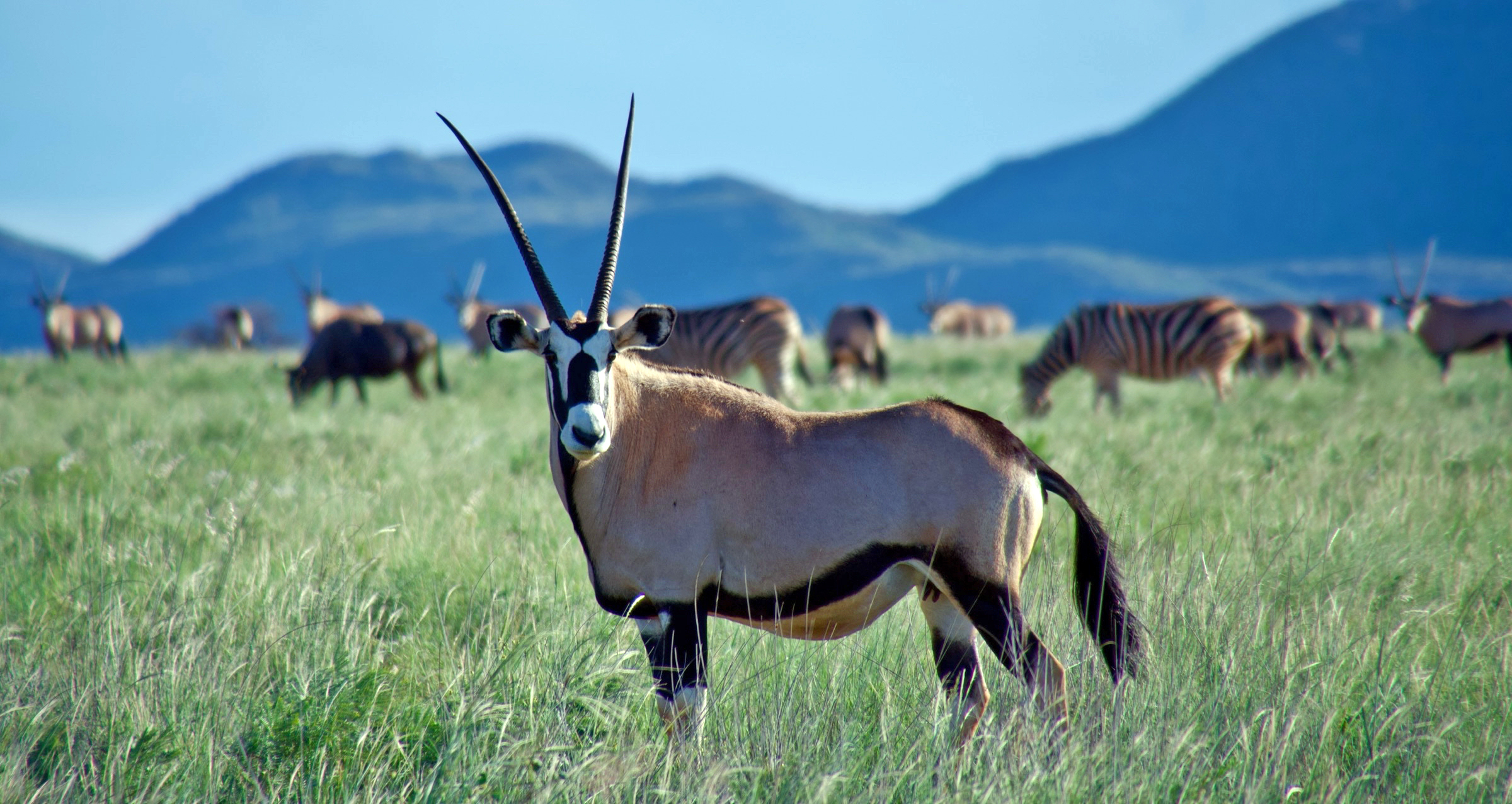
Banner image: A gemsbok (Oryx gazella), also known as the South African oryx, in a mixed herd of herbivores at Tswalu. Image by John Cannon/Mongabay.
John Cannon is a staff features writer with Mongabay. Find him on Bluesky and LinkedIn.
Citations:
Veldman, J. W., Overbeck, G. E., Negreiros, D., Mahy, G., Le Stradic, S., Fernandes, G. W., . . . Bond, W. J. (2015). Where Tree Planting and Forest Expansion are Bad for Biodiversity and Ecosystem Services. BioScience, 65(10), 1011-1018. doi:10.1093/biosci/biv118
Laundré, J. W., Hernández, L., & Ripple, W. J. (2010). The landscape of fear: Ecological implications of being afraid. The Open Ecology Journal, 3(3), 1-7. doi:10.2174/1874213001003030001
Mallick, U., Orrick, K., Masunga, G., & Schmitz, O. (2025). Large herbivore functional guilds and soil carbon storage in a semi-arid southern African landscape. doi:10.21203/rs.3.rs-5375091/v1
Schmitz, O. J., & Leroux, S. J. (2026). Trophic Rewilding to Animate the Carbon Cycle and Mitigate Climate Change. In I. Gordon & A. Manning (Eds.), Trophic Rewilding: Research, Policy and Practice.
Roberts, N. J., Harihar, A., Zhou, X., She, W., & Jiang, G. (2025). Global Tiger Density Linked With Forest Carbon Stock, Top-Down and Bottom-Up. Global Change Biology, 31(5), e70191. doi:10.1111/gcb.70191
Skinner, J. D. & Louw, G. N. (1996). The Springbok: Antidorcas marsupialis (Zimmermann, 1790) Prehistory and historical background, morphology. Transvaal Museum Monographs, 10(1). Retrieved from: https://journals.co.za/doi/abs/10.10520/AJA090799001_49
FEEDBACK: Use this form to send a message to the author of this post. If you want to post a public comment, you can do that at the bottom of the page.

Comments (0)