To understand the tangled economics of the fuel protests, start with green diesel
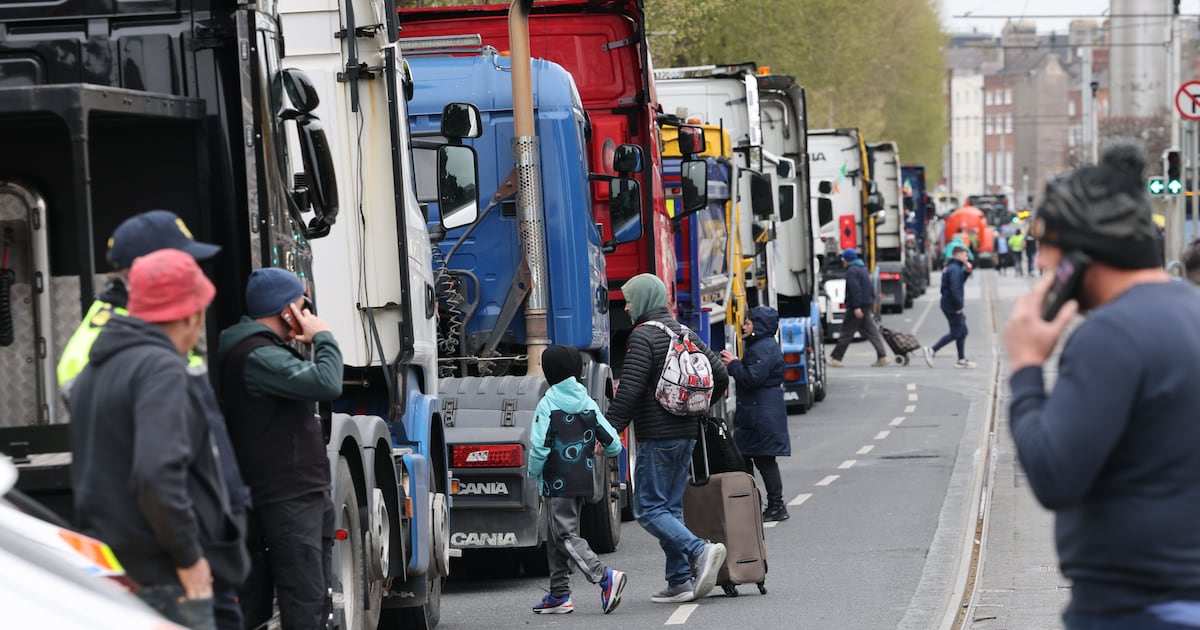
There has been a dangerous economic undercurrent to the fuel protests for the Government: anger over the cost of living and of doing business in Ireland. And an even more concerning political backdrop, as a self-appointed group effectively controls the movement of people and goods in many areas. You would think that the unjustifiably disruptive actions of the protesters lost any wider public support as the week went on – and if this continues, large-scale job lay-offs across the economy will not be far behind. But in the early days, reactions were more mixed. Even some of those angry about the tactics had sympathy with the case being made.One of the Government’s so-called problems in responding is familiar. It is flush with cash at the moment and has already given a lot of it in recent years in household and business supports. In strategic terms, the Cabinet’s initial decision to respond gradually to the hike in fuel costs was understandable and broadly correct – it wanted to have some idea what it was dealing with. Ministers hinted that the initial €250 million package, centred on cuts in excise duties and some welfare measures would, unless the situation quickly improved, be followed by more. So why did the protesters move so quickly? There was certainly anger in some sectors. Hauliers are still under pressure, despite the measures in the first package. Meanwhile, the initial package contained just a 3 cent a litre cut in green diesel, the fuel used in the agricultural sector. This has angered farmers, and also agricultural contractors, who work with large machinery on farms at particular times of the year and are hugely reliant on fuel costs. Three cent wasn’t much of a contribution to their troubles. Hence the many tractors on the streets.READ MOREMultimillion-euro financial package will not be unveiled until nationwide fuel protests cease ‘I love my job, but the loneliness is hard’: Reality of life as a travel influencer‘You know who’s in control’ - How the fuel protests brought the country to a standstill Debt shame: ‘I was going to lose my home ... It was one of the darkest times’ Protests then overtook the negotiations between Government and the representative bodies for hauliers and farmers – reflecting the increased readiness of groups outside the official “system” of officials and representative bodies to resort to militant action, egged on by those on the far-right whose agenda this suits. And so the Government has been faced with dealing with two problems at once. One is responding to the economic issues – through which it will hope to get some of the protesters off the streets. The other is deciding how to deal with those who feel entitled to block vital national services and are taking it upon themselves to rule on who can go where and when. The initial spark was anger in certain sectors, Why was the tax cut on green diesel so small? Because tax on this fuel is different in one key way from that on petrol and diesel – the excise-type element (a charge based on the volume of fuel) is largely made up of carbon tax, compared to the more traditional excise duties which are still a large part of tax on petrol and ordinary diesel. The Government wants to protect the carbon tax partly for environmental policy reasons, but also because the revenues from it are specifically allocated to spending in various areas such as retrofitting, welfare supports and environmental farm programmes. Cut the tax and the money has to come from somewhere else.[ Three reasons why Government refuses to meet the fuel protestersOpens in new window ]Without touching the carbon tax, the scope for green diesel cuts was limited in the initial package and included a temporary cut in the levy applied to fund the national oil reserves. A similar consideration applied to home heating oil, leading to a testy exchange in the Dáil between Minister for Finance Simon Harris and Sinn Féin spokesman Pearse Doherty. Harris argued that there was no excise tax on home heating oil; later the Department of Finance issued a statement saying that the only excise-type charge was the carbon tax. For the Government, this may be an important distinction, but for those filling up their tanks it was dancing-on-the-head-of-a-pin stuff. A package is under construction by Government to try to deal with the key issues and provide wider support to households as higher energy prices look set to drag on. It was described by Minister for Finance, Simon Harris, as “ substantial. ” More talks are to be held at the weekend with the representative bodies.A strong exchequer position and higher VAT receipts as fuel prices rise mean more can be afforded, though Ministers will continue to worry about the unpredictable course of events in the Middle East and the potential implications of this. In terms of the shot-term issues, key is reducing fuel costs for the affected sectors. Cutting carbon tax on various fuels would be one way to do this. The diesel rebate scheme for hauliers could be increased, or even made applicable to some other sectors. In terms of tax moves, EU rules are an issue. It seems all this was discussed at Friday’s meeting, but no political commitments were given. There are longer term issues too, which have raised their head in the tangled economics of the fuel protests. One is the future of the carbon tax and whether it will continue to rise each year, if fossil fuel prices remain high. A key goal of the tax is to cut consumption of more polluting fuels – for now, market prices are already doing this. The theory of gradually upping the price of fossil fuels and encouraging people and businesses to “go green” may have looked straightforward when oil prices were at $60 (€51.18) to $70 a barrel. It now looks a more fraught political exercise, as oil prices linger around $100, there are new questions of security of supply and Ireland continues to lag in developing offshore wind.Carbon tax is also used to raise money to fund certain spending programmes, mainly environmental programmes, green farm supports and welfare spending. The tax raises more than €1.1 billion a year, so abolition, as the protesters demand, will not happen. But its future is now a political issue.Looking at the wider picture, tax on fuel in Ireland is high, though not unusually so compared to most European states. As with other taxes where people are looking for cuts, the question is where the money should be raised instead, or where spending should be cut? If spending is not cut, then tax needs to be found elsewhere to close the gap. And so far there is no big political party standing on the basis of a low tax/low spend agenda. The Government is getting ready to spend some more resources, nonetheless, and will hope that this addresses some of the economic pain which has spurred the protests, as well as give some protections to wider society. There is certainly the scope to present a package meeting the specific needs of the most affected sectors. Whether it satisfies the protestors is another issue. " You can’t negotiate with a WhatsApp group", as one source put it. There is little doubt that if the blockades continue businesses will start to cease operations early next week due to a combination of issues - lack of fuel, staff shortages, inability to move goods in and out and so on. A lot is at stake as talks resume on Saturday.[ How the Government bungled its response to fuel protestsOpens in new window ]






Comments (0)