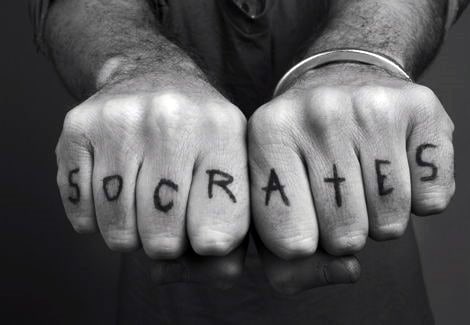
As usual, I have far too much to say here. So, the long story short version is—I love tattoos and connecting them to philosophy. I tend to think of them as a form of visual resistance, akin to graffiti, that fights what Charles Mills called white ignorance.
I have a series of tattoos on my forearms and hands that are meant to express something about my philosophical development.
(1) I have a capital delta with a ‘+’ on my left forearm. Having gotten into philosophy through mathematics, I still sort of did philosophy in a bizarre quasi-mathematical language at first. So, in my mind, this expressed that philosophy was meant to change the world for the better. Starting to show my penchant for the revolutionary, it was important that the delta, representing change, came first. I was in complete disagreement with folks like Kripke (“the intention of philosophy was never to be relevant to life”), Soames (“philosophy done in the analytic tradition aims at truth and knowledge, as opposed to moral and spiritual improvement”) , and Wittgenstein (philosophy “leaves everything as it is”). For these reasons, Peter KJ Park’s work showing that these kinds of views came downstream from an 18th and 19th century white supremacist political project was life-changing (“Africa, Asia, and the History of Philosophy: Racism in the Formation of the Philosophical Canon, 1780–1830”). Charles Mills’ work showing that white ignorance, more generally, was a central part of white supremacist, settler colonial, patriarchal, capitalist systems is basically all my work is about these days.
(2) Surrounding that first tattoo is an Albert Camus quote (well, an English translation of it anyway) “live to the point of tears”. That philosophy was politically relevant was clear to me from jump. This existentialist quote was meant to signal my coming to see how philosophy was also personally relevant. I’d had mental and emotional health challenges my whole life with no guidance or support around them. Rather, I’d mostly just been told to stop having emotions. So, Camus stating that there ain’t no point if we aren’t willing to feel so much that we cry was, again, life-changing. As was Lewis Gordon’s work showing that these personal, existential concerns were connected to those social and political concerns of my first tattoo (“Existence in Black: An Anthology of Black Existential Philosophy” and “Existentia Africana: Understanding Africana Existential Thought”).
(3) On my right forearm is a peace sign with “eye and mind” above it. I switched arms for this one because it felt like it had much more content. The other two were more about the form I thought philosophy should take. The peace sign was meant to signal that I wanted to be a part of revolutionary peace movements. The “eye and mind” part was meant to connect to two things.
The blending of empiricism (eye) and rationalism (mind) that logical empiricism represented for me. This belonged with a peace sign tattoo in my mind because I thought that a rejection of the synthetic a priori was essential for conflict resolution. If you are interested, chapter 5 of my “Race, Gender, and the History of Early Analytic Philosophy”, entitled “Logical Empiricism and the Scientific Worldview” develops this in a bit of detail.
Shannon Hoon, lead singer of Blind Melon, had a tattoo with “eye and mind” in it. It was meant to express that we need an eye to see the horrible things we’re doing to the world and a mind to change them.
(4) My right hand has a LandBack tattoo on it. This is the most recent and significant of my philosophical commitments I’ve gotten tattooed. It takes a stand that the peace committed to in (3) can only be achieved through a decolonial, restorative justice frame that includes truth, reconciliation, reparation, and rematriation projects like those committed to in the LandBack manifesto. (As an aside, I’d love to teach a course on the LandBack and Vienna Circle manifestos. I greatly appreciated that Thomas Uebel’s review of my book called it a manifesto.) My mentor, Dr. Claudia Ford, and I developed these thoughts around the LandBack manifesto, especially in relation to Charles Mills’s work, in “Environmental Radicalism: Talking About a Revolution” and “Climate Justice and Global Development: Outlining a new Framework from the Work of Achille Mbembe and Charles Mills”. We have some new stuff coming out later this year too (“Liberatory Planetary Politics: The Zoetic Entanglement Framework for Transitioning from Governance to Praxis”). Dwight Lewis and I also have a paper coming out connected to all of this work that brings James Baldwin and Myisha Cherry into the conversation (“Racializing the Anthropocene: An Afro-Indigenous Centered Epistemology of Resistance”). Dwight and I are also planning a new season of our podcast where some of the episodes will be on location. I’m trying to convince him that we should record an episode while I’m getting a tattoo at Atomic Tattoo Lounge Minneapolis. We’ll see…





Comments (0)