
Remember me

Here's everything great from the last 30 days, selected by tQ's staffers

This April feels like it passed in the blink of an eye, so much so that wading back through the sea of new releases that accumulated over the last month, it’s striking just how much excellent gear we’ve been left to contend with.
Everything featured below, as well as all the other knockout music we’ve covered at tQ this month, will be compiled into an hours-long playlist exclusive to our subscribers. In addition, subscribers can enjoy exclusive music from some of the world’s most forward-thinking artists, regular deep-dive essays, a monthly podcast, specially-curated ‘Organic Intelligence’ guides to under-the-radar international sub-genres, and much more bonus material besides.
To sign up for all those benefits, and to help us keep bringing you the kind of music featured below, you can click here. Read on below for the best albums and tracks from April 2026.
Eisenberg’s new self-titled album is concerned with memory and meaning. The dreamy and time-shifting sound of pedal steel acts as a Proustian madeleine, as in ‘Another Lifetime Floats Away’, where Eisenberg shifts between half-lost memories, such as their mother making breakfast or motorway drives. In ‘Will You Dare’, a more traditional take on 70s country, Eisenberg sings: “And time is an earless thing, ignoring your cries / It shapes you, and scrapes you, and makes you ask / Why did I try? Did I try?”
Obsessive Black Midi fans will recognise the wide-eyed, exploratory nature of My New Band Believe – Picton’s transient solo vehicle – but that is where the similarities with his old group end. For one thing, this self-titled debut album is entirely acoustic, with a cast of a few dozen collaborators adding a whole arsenal of improvised strings and percussion to Picton’s knotty folk baroque guitar compositions. Meanwhile, the misty-eyed devotional lyrical matter is a far cry from all of the decay and cannibals of his lyrical contribution to Black Midi – subtlety is the order of the day.
Loula Yorke is a fixture in leftfield electronic music now. She’s one of those artists whose name is a watchword for a very particular sound. In her case this means oneiric, immersive patterns created on a modular synthesiser, often blended with field recordings that have a pastoral sensibility – a feeling which she calls luminous. Her music sits somewhere adjacent to the very gentlest works of Steve Hauschildt or Kaitlyn Aurelia Smith and is represented across a hefty and coherent catalogue […] Through a slew of releases and live shows in a dazzling array of venues from churches to bunkers, Yorke has become more comfortable as thinking of herself as an artist. As such, she has increasingly ambitious projects locked in, not least a remarkable new EP called Salix where she plays a broken 140-year-old reed organ alongside electronic oscillators in duet with clarinettist Charlotte Jolly.
Where Jenkinson really amazes is at the intersection of his classic drum’n’bass flavours and the orchestral grandiosity that centres this album. ‘K2 Central’ feels like the musical heart of the record. Beginning with some dastardly bass playing, this track feels like a breakbeat version of Curtis Mayfield’s ‘Pusherman’ from the Superfly (1972) soundtrack. A protagonist’s theme, where crawling brass sections swell, joined by airy flutes over a conglomerate of both programmed and acoustic drums, all resulting in a mesmerising, funky jazz number, not dissimilar to tracks on his previous album Music is Rotted One Note (1998).
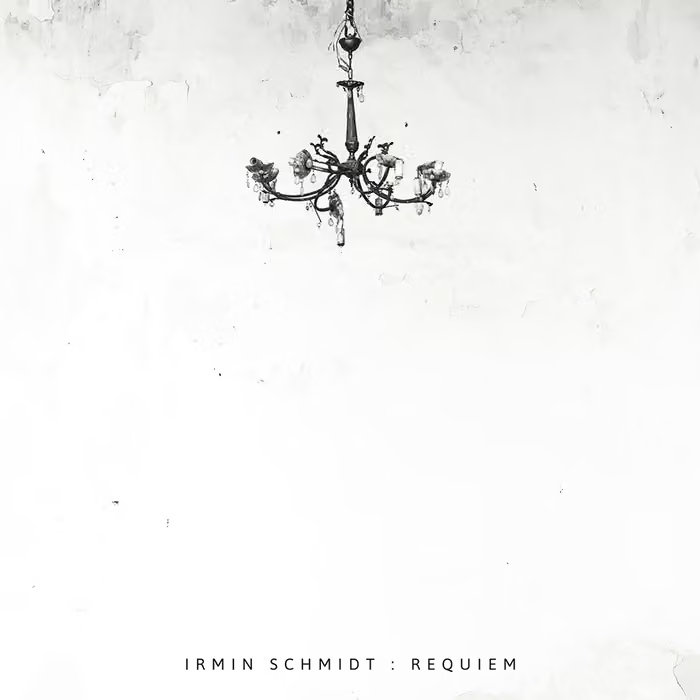
Across the album, rhythms persist with a curious insistence. They suggest a heartbeat, but just as readily the automated continuity of machines. Life here is never singular. It is doubled, distributed across bodies and systems, signals and supports. What emerges is music that is atmospherically close to a monitored state in which bodily presence is partial, mediated, and constantly measured. The hospital – although central to this album’s narrative – is never explicitly depicted, but its logic is everywhere: life as data-flow, tracked and sustained, uncannily prolonged.
‘Soul Berm’, a track from Red Berms, Abigail Snail’s debut album, sounds like three instrumentalists operating in completely different genres. There’s guest reed player James Allsopp, who’s layering messy, Albert Ayler-style skronk. Will Glaser, the band’s drummer, is rattling at his ride tentatively, wading his way around the kit. And, when guitarist Stef Kett isn’t clawing at his guitar, he’s belting out mix-clipping garage rock vocals. Suddenly, Glaser finds a pulse. Allsopp melds his noise into an ostinato – as does Allsopp. Strapped into the experimental jam equivalent of Desert Bus, the trio veer off the road into a propulsive, dusty groove, rhythms flying like shrapnel.
It’s an album that leaves plenty of blank space for the listener’s imagination to flow into. Some of the sounds evoke the churning of hospital respirators, at other moments like a faulty grandfather clock. At times the record sounds like how I can only imagine purgatory might feel. In my mind, I was on a camping holiday with Schmidt, Stockhausen and Cage. None of us were having a particularly pleasant time. Everyone else was dead.
Make your first listen to Seismo a naive one. Don’t think about its makers, and the many excellent projects they have worked on. Don’t think about how exciting it is to hear a bold percussionist like Valentina Magaletti collaborate with a producer who can match her inventiveness and unrestricted approach to form and genre. Try not to think about PAN, the storied label backing it. If you can, forget Moin, Midori Takada, Steve Reich, Nicolas Jaar, Miles Davis, Shackleton, or any other past collaborator or influence you might hear flashes of within its eight songs. Don’t think of its backstory: how it formed out of a commission by Amsterdam’s Rijksmuseum, and what that setting might say about the music. Just listen. It’s a record full of life, texture and newness, where the thing itself offers just as much as an entity separated from the people and contexts that produced it.
As a medium, the ‘collab album’ can be rather polarising. Sure, fans may rejoice that two of their favourite artists are working together, but equally, they might be fearful of a low common denominator outcome. In this case, for hip-hop fan favourites Earl Sweatshirt and MIKE, a joint album would seem an obvious move for artists with similar production, cadence and flows, not to mention previous successful collaborations. Throw into the auditory blender experimental production group SURF GANG, consisting of Harrison, evilgiane, Elipropperr and Flea Diamonds, and this album is undoubtedly an enticing, if controversial prospect.
Kansai duo Hyper Gal have been making some of the most unhinged, freewheeling noise racket on earth since 2019, the kind that’s so brilliantly brutal, so spartan in its overdriven harshness, that it is completely impossible not to get swept all the way up. Fourth LP Our Hyper ups the intensity that little bit more, juxtaposing detached half-sung half-chanted vocals against an absolute tempest of squalling synthesisers, nailgun beats, avalanche drums and chainsaw noise.
Gnod have never been high-volume rockers exclusively, but a sequence of albums where heaviness features heavily – Mirror to Hexen Valley – rank among their most highly rated releases, and if the most recent time I saw them play (about four months ago) is representative, then their gigs retain plenty of red meat for riff enjoyers. Chronicles’ three longest songs are all rock-formatted, though again distinct from one another. On ‘Shadow Mirror’, there’s something of a Thurston Moore feel to both the guitar tone and the vocal mix, though you’d likely not mistake it for Sonic Youth structurally – the song basically runs on the spot for seven minutes – and the melody is undercut by the heaviness of Al Wilson’s bassline. The latter element is also intrinsic to ‘All Tunnel No Light’, the first half of which approximates slowcore (Codeine were one band sloshing around my head here) before a doomier, feedbackier second part, and ‘Ekstasis’, which concludes this album purposefully: rumbling, wiggy psychedelia, and to my ears Gnod at their most Gnodlike.
ADULT., the long-running musical partnership of husband and wife Nicola Kuperus and Adam Lee Miller, have held onto rage with impressive poise for over twenty-five years. Kissing Luck Goodbye is another brutal helping of broken beats and snarling vocals, never curdling into total nihilism or defeat. “The chaos is what they want,” Nicola Kuperus repeats on ‘R U 4 $ALE’ as drum machines blast around the mix. Her shouts, here and elsewhere, are a clear statement to hold your ground. Even chants like “no one is coming to your rescue” on ‘No One Is Coming’ are more about self-reliance and community action than despair, when delivered with such free and exciting energy.
Rhythms become pounding phantasmagorias on Vasco Lé’s These Tears Feel So Eerie. His tracks layer and collide in hallucinatory overlaps, divergent club rhythms intersecting across momentary flashes of skittering free jazz drums and more luminous textures. Vocal loops sound like they’re being churned through a burning cement mixer while spasms of woozy saxophone and strings add to rather than soften the music’s disorientating intensity. It’s overwhelming, as though Lé is aiming jumpcuts and rapid-fire montages at breaking whatever hellish post-capitalist hegemony we’re currently occupying. But it’s more than just pummelling, the music feels like a celebration of friction, the sparks, glints and shrapnel that erupt as rhythms are brushed and scraped over each other, the flashes of combustion as beats and melodies are twisted. The samples typically have a charred fidelity, as though captured directly on an overheating dancefloor rather than a record. At the most distorted you can imagine a mic was being pressed up directly against a subwoofer. Through his mangling, Lé stretches out and amplifies the delirium of club music, the dream of a place outside the tedious rhythm of the quotidian.
On Architectonics, Hoavi builds on the promise of past releases for Peak Oil and Balmat, delivering a collection of mind-boggling cuts that will frequently leave you scratching your head trying to find the ‘1’. Operating somewhere between the blown-out dub techno of producers like T++ and the gamelan-inspired music of Uwalmassa and other acts releasing on Jakarta’s DIVISI62 label, Hoavi also combs the depths of ambient music and IDM across the 11-track record. Early highlight ‘Triad Of Becoming’ sucks you in with its confounding, forceful double-time drums and fluid sound design quirks, the acoustic and electronic joining together in perfect harmony. ‘Shadows Of The Limits’ comes off like a warming sound bath of bass hits and subtle gamelan sounds, while ‘Blue Krait’ recalls the precise, hypnotic tombak-playing of artists like Mohammad Reza Mortazavi.
james K’s new remix album for last year’s outstanding Friend LP is riddled with dazzling reworks of the original record, but this one from Loidis is certainly a standout. Across 14 minutes, the US producer patiently transforms the sorrowful IDM of the source material into a nimble slice of dub techno that you could imagine soundtracking summer pool parties.
‘Twa Sisters’ is a traditional ballad that is simultaneously beautiful and distressingly violent, concerning the murder of one sibling by another. This sinisterness is pushed to the surface by The Standing Stones by the use of audio from news reports describing contemporary events that mirror the circumstances of the songs, a reminder that violence and death are not just the stuff of folklore but of reality, that these narratives are not relics of a less civilised time but reminders of a grim constant truth
A harp starts to twinkle then morphs into a synthesiser in the opening moments of ‘Secret Meadow’, the first track on Mere Of Light’s third album, Heat Of Ritual […] What starts as a sparse folk song beneath McArdle’s soft vocal evolves into something closer to a Hiroshi Yoshimura composition as acoustic and electronics blend into each other.

The latest taste of Fire-Toolz’ forthcoming Warp debut is a track of wonderful push and pull. Inspired, the Chicago producer has said, by moving out of an old home, wandering through the neighbourhood on a bautiful day and embracing mixed emotions –”being afraid, being cozy” – it sets her multicolour maximalism against an intriguing guest performance from classic Americana singer Jennifer Holm.
Three years on from Raven, Kelela marks her return in surprisingly grungey form with the alluring ‘Idea 1’. Signalling a change in direction perhaps after her previous club-centred LP, it’s certainly a curious precursor to whatever else is to come from her this year.
Comments (0)