Hand-printed photography as inheritance: Jurga Ramonaite on Arctic landscapes and memory-keeping
But in this body of work, the darkroom functions as something more than technical infrastructure. “Working in the darkroom – slowly and methodically – feels like a form of conversation,” Ramonaite says. “Each step of the process becomes a sentence and each finished print is a story.” She printed all the works herself, at scale, through repeated test exposures, filtration adjustments, dodging and burning, and hand retouching. “Each print becomes almost like a letter, carrying effort, care and attention.” The hours spent in chemistry and darkness become inseparable from the work’s emotional function – a physical act of memory-keeping.
The exhibition spans three interconnected series. Breath of Air consists of two chemigrams made aboard the ship during the residency, using Arctic seawater, kelp, and light. Ramonaite set up a makeshift darkroom in her cabin’s bathroom and left the organic material on photographic paper for the full two weeks, allowing it to decompose and chemically interact with the emulsion. Some areas became completely bleached; others developed sediment-like traces in greens, yellows, and oranges. “I’m interested in slow processes and in treating time as a collaborator,” she says. “These works engage with the idea of slow violence – forms of harm that unfold gradually and without spectacle, often going unnoticed until their effects become irreversible.”
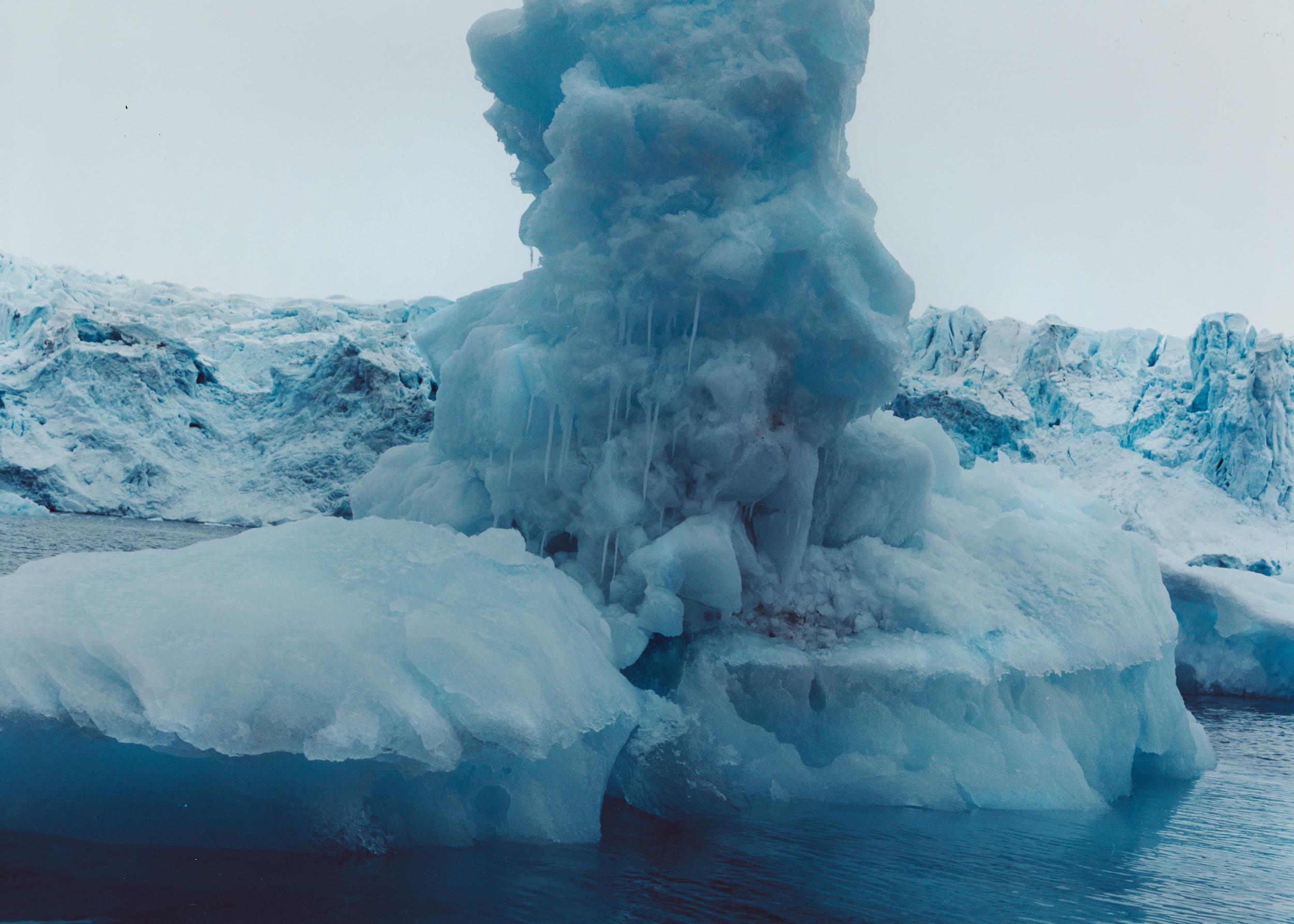
The Glacial Portraits series isolates fragments of ice against black fabric, photographed from a small zodiac boat before the clarity of the ice began to cloud. As glaciers form, air and sediment are trapped; over centuries of compression, air bubbles are forced out, creating remarkable glass-like clarity. “These fragments function as time capsules,” Ramonaite explains, “holding and preserving memories of an environment long past.” Photographing them against black allowed her to capture the moment of clarity before melting made the surface opaque.



Comments (0)