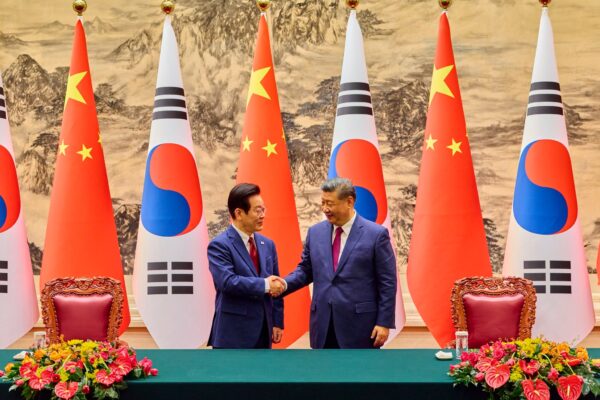
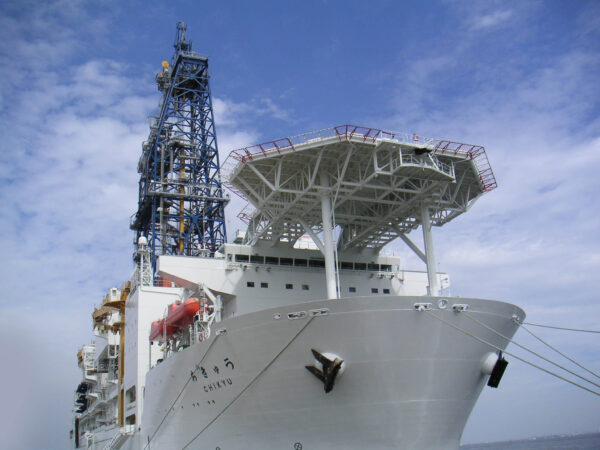
One of the notable achievements of South Korea President Lee Jae Myung’s state visit to Beijing in January 2026 was an understanding reached regarding Chinese maritime platforms in the Yellow Sea. Lee revealed that an understanding had been reached to relocate the Atlantic Amsterdam, a massive management platform located within the Provisional Measures Zone (PMZ), a maritime area jointly managed by China and South Korea pending future boundary delimitation under a 2001 agreement. Less than a month after the summit in Beijing, the platform was confirmed to have been relocated to Weihai, a major port in Shandong province.
This is obviously a diplomatic gesture meant to signal the continuing thaw between Seoul and Beijing. Yet, while the South Korean presidential office welcomed it as “meaningful progress,” the relocation may be less a conclusion than a recalibration of the current status quo. Playing devil’s advocate, we must consider the potential strategic calculations that might have influenced Beijing’s calculus.
The Geopolitical Wedge
The relocation of the Atlantic Amsterdam should be interpreted within the broader strategic context surrounding Seoul’s regional alignments. As these facilities drew attention from Western think tanks and media for the similarities to the maritime grey zone tactics Beijing has employed in the South China Sea, the issue lent momentum to calls for Seoul to align more closely with other democracies, including Washington and Tokyo. It would have been a significant strategic loss for Beijing if Seoul fully endorsed this narrative and formed a coalition to counter its maritime control in the Yellow Sea.
In this context, the relocation of the Atlantic Amsterdam sends a signal to Seoul that Beijing seeks to present itself as a reliable and constructive partner. This message is particularly timely given the increasing unpredictability surrounding Washington’s alliances and trade. By signaling a benevolent gesture, China strengthens the argument of moderates in Seoul that Beijing is a partner rather than an adversary, especially in times of uncertainty. This interpretation also aligns with Beijing’s attempts during the January summit to frame Seoul and Beijing as partners with a shared history of fighting against Japanese imperialism. Given that these developments took place amid heightened tensions between Tokyo and Beijing, it was in China’s interest not to over-expand its frontline.
Lawfare or the Legal Trap
Despite the relocation of the Atlantic Amsterdam, two giant aquaculture cages and 13 buoys remain in the PMZ. Given that the two countries hold different positions regarding the principles for maritime demarcation in the relatively narrow Yellow Sea, this selective retention may represent a tricky legal trap or a form of lawfare.
The 2001 China-South Korea agreement, which established the PMZ pending later boundary delimitation, primarily regulates fishing operations and maintains order. It contains no explicit provisions regarding the installation of maritime platforms or structures. Beijing’s position has been that since aquaculture is a form of fishery, these installations do not violate the agreement. However, considering the general principles of treaty interpretation under the Vienna Convention on the Law of Treaties and maritime delimitation under UNCLOS, which serves as the overarching legal framework for both parties, such an interpretation contradicts the purpose and objective of the agreement.
By maintaining these cages, which reportedly stand as tall as 70 meters, Beijing is effectively giving physical expression to its preferred interpretation of the treaty. Over time, the continued presence of such structures may blur the line between a provisional management arrangement and a de facto sphere of control. This dynamic could complicate future delimitation negotiations, particularly in light of the different positions advanced by Seoul and Beijing. While Seoul favors the equidistance principle, or median line, as the basis for negotiations, Beijing has long maintained that the boundary should lie farther east, pointing to its larger population, longer coastline, and the geographical argument that the continental shelf is a natural prolongation of the Chinese mainland.
The existence of actual, large-scale aquaculture activities may be invoked by Beijing as a purported relevant circumstance to be considered for demarcation. Beijing could claim the PMZ is a critical area upon which the food security and economy of the Chinese people rest, thereby seeking to claim the high ground in negotiations. This is why the relocation of China’s largest platform in the PMZ may not be the conclusion of the dispute – other critical facilities remain.
The Domestic Wedge
Last but not least, viewed through the lens of Robert Putnam’s two-level game theory, this move threatens to erode the South Korean government’s domestic negotiating leverage. In diplomatic negotiations, the strength of a government is often derived from the strong support or backlash of domestic public opinion. In East Asia, where nationalistic fervor remains a potent force, conflicts over territory and territorial waters can be explosive. Consequently, concerns regarding China’s intentions in the Yellow Sea have been a major source of anti-China sentiment in South Korea, cutting across the political spectrum. This public pressure provided the political momentum for the government to consider strong countermeasures, even matching China’s construction efforts. However, as a partial measure with strategic ambiguity, China’s move may significantly weaken this momentum.
By removing the platform assessed to have the highest potential for military diversion, Beijing may aim to alleviate public pressure. It also sends a signal that China keeps its promises and is open to dialogue. Paradoxically, because this relocation is framed as a key achievement of the summit, the South Korean government faces structural pressure to endorse the move officially, thereby validating China’s goodwill. Beijing may weaponize this acknowledgement if divergences arise over boundary delimitation or the remaining facilities, framing the situation to suggest that while it has shown maximum sincerity, South Korea is refusing dialogue or compromise. Once the public outside the government believes the problem is resolved because the platform is gone, South Korea’s domestic leverage could evaporate significantly.
Undoubtedly, this relocation marks a step forward. However, the full implications of the current measure and China’s potential, albeit latent, intentions remain uncertain. This is why South Korea should not be content with the movement of the Atlantic Amsterdam but must continue to pay close attention to the remaining facilities and buoys. Such vigilance is required not only of the government but also of the general public.
Rather than viewing the relocation as the end of the story, Seoul would be better served by treating it as a reminder of the need for continued cooperation on risk management and boundary negotiations. In many security disputes, the most perilous moment comes not during confrontation, but when vigilance erodes under the impression that an issue has been settled. It remains unclear whether Beijing’s actions ultimately reflect genuine goodwill.