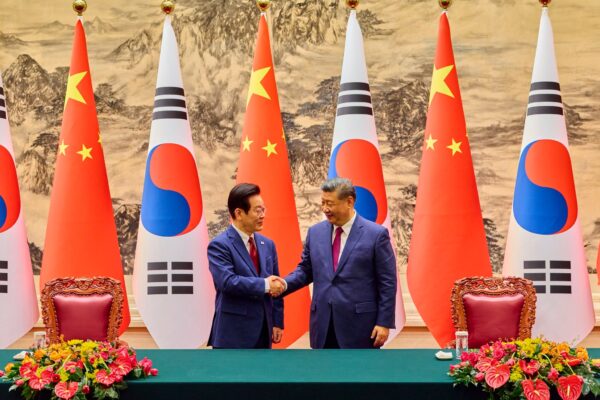
In a late January post on Truth Social, U.S. President Donald Trump signaled his intent to raise tariffs on South Korea to 25 percent, claiming Seoul had not lived up to its end of the South Korea-U.S. trade agreement reached last year. While Trump suggested that this was because the South Korean National Assembly had not yet passed needed legislation, there has been speculation that he might have other motives.
Some analysts have pointed to a dispute between the United States and South Korea over the U.S. firm Coupang. Last year, Coupang suffered a data breach that potentially compromised the data of 33.7 million South Korean accounts. Coupang’s initial delay in revealing the breach and the subsequent investigation by the Korean government have increased tensions between the two governments.
The U.S. concern is centered on a cross-government investigation that goes beyond the investigation of a breach of similar scale at SK Telecom last year, which exposed the Universal Subscriber Identity Module info of 27 million accounts.
The more extensive investigation into Coupang has drawn scrutiny from investors and U.S. officials. Foreign investors have begun to question South Korea as an investment destination, while two U.S. investment firms with a stake in Coupang have filed for arbitration under the KORUS FTA, citing discrimination against the firm by South Korea.
Congress has played a role as well. In a January 13 House Ways and Means Trade Subcommittee hearing, bipartisan concern was expressed over Coupang’s treatment during the investigation. In addition, former Trump White House Chief of Staff Mick Mulvaney wrote an op-ed arguing that South Korea is trying to put Coupang out of business.
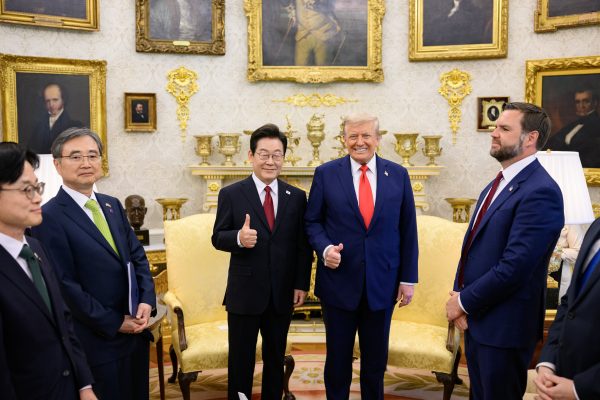
The issue was significant enough that U.S. Vice President J.D. Vance reportedly told South Korean Prime Minister Kim Min-seok that the investigation was discriminatory and warned against penalizing Coupang.
All of this has led to speculation that South Korea’s investigation into Coupang is behind the tariff increase. This speculation was given more credence when the official House Judiciary Committee account on X (formerly Twitter) posted, “This is what happens when you unfairly target American companies like Coupang” shortly after the tariff announcement.
While the concerns surrounding the investigation into Coupang have the potential to become an irritant in the relationship, speculation that they are an unstated reason for increasing South Korea’s tariffs miss a key fact about Trump. He does not do coy; he is nothing if not direct.
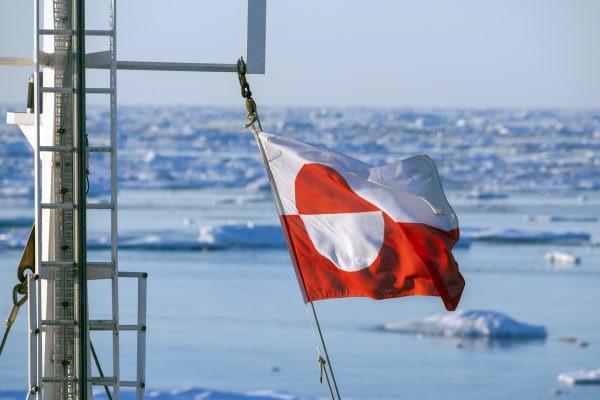
Consider each of the other tariff threats Trump has issued recently. The tariff threats against Denmark and seven other European countries were explicitly designed to convince them to recognize U.S. sovereignty over Greenland. The tariff threat against French wine was to express displeasure with French President Emannuel Macron refusing to join the Board of Peace. The recent threat against Canadian aircraft is tied to the certification of U.S. aircraft in Canada. The tariff threats targeting countries that trade with Iran and sell Cuba oil were also very specific. In each of these cases it is clear what Trump wants and the cost to others of defying him. There is no hidden agenda in these cases.
There is good reason to believe Trump means what he says on the tariff issue. Under the trade agreement, South Korea committed to investing $20 billion in the United States in 2026. In recent weeks, a Bloomberg report suggested that South Korea would not fulfill that investment pledge due to concern over the continuing weakness of the South Korean won. South Korean Finance Minister Koo Yun-cheol later clarified that Seoul is not delaying its investment, but is still in the process of selecting projects and taking procedural steps. He mentioned that any investment in the first half of the year, however, was unlikely.
This contrasts sharply with Japan, which has a similar investment agreement as part of its trade deal with the Trump administration. In October, the United States and Japan announced a series of commitments by Japanese companies to invest in projects in the United States under Japan’s investment pledge, including up to $332 billion expected to support energy infrastructure. The U.S. and Japan have also held three consultative investment committee meetings under the agreement, with three initial projects believed to be ready for consideration by Trump.
While some Japan’s projects of interest may ultimately not be pursued, Tokyo has taken tangible steps to fulfill its investment pledge and is seen by the U.S. as moving forward with its agreement. In contrast with the uncertainty surrounding when South Korea will be ready to put forward projects for Trump’s approval, it is not surprising he’d be looking for leverage to push Seoul to move more quickly.
The public statements from Trump officials also suggest that the tariff threat is about what Trump has said it is. U.S. Treasury Secretary Scott Bessent referenced the need for passage of legislation in the National Assembly as the reason for the tariff increase, while U.S. Trade Representative Jamieson Greer has also referred to the failure of South Korea to implement their end of the trade deal.
While the speculation around Coupang is understandable given the ongoing investigation into its data breach, it is more likely that there is an effort by some outside parties to link the issue of Coupang to Trump’s tariff threat. The promised investment by South Korea, Japan, and the EU was the main deliverable from Trump’s trade deals. That is his priority, which is why he is signaling displeasure with the pace of Seoul’s efforts to keep their end of the bargain.