By Yang Tianzi, Vision Times
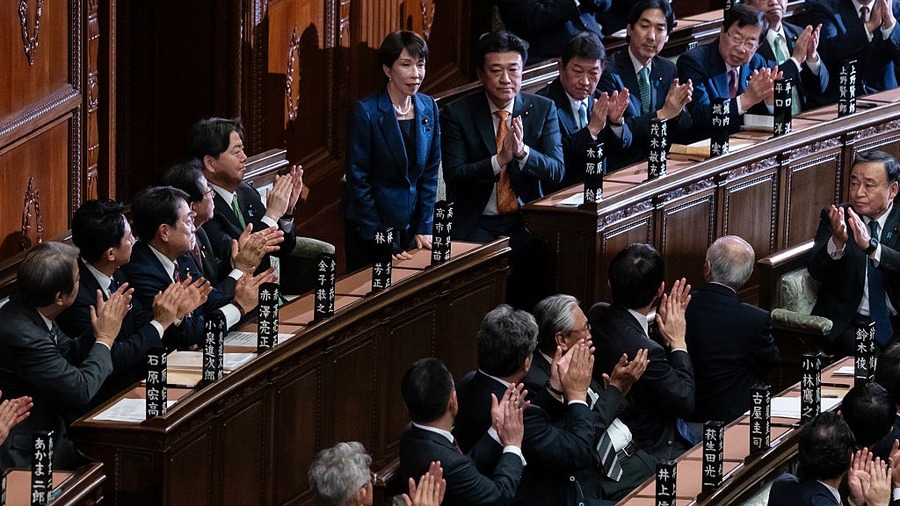
On Feb. 19, Japanese Prime Minister Sanae Takaichi delivered a decisive policy address before the House of Representatives, declaring that Japan now faces “the most severe security environment since the end of World War II.” She noted that Japan must counteract China’s rising influence in the region.
In a speech that signals a historic shift in Japan’s postwar posture, Takaichi warned of escalating “coercion” by the Chinese Communist Party (CCP) and unveiled a sweeping national security reform agenda spanning defense strategy, intelligence restructuring, arms exports, economic security, and supply chain resilience. Her remarks mark one of the most assertive security pivots in modern Japanese political history.
RELATED: Second Takaichi Cabinet Marks New Stage in Japanese Politics, Balances Reform with Democratic Oversight
Shifting gears
Takaichi identified three primary threats driving the overhaul: China’s military expansion, deepening China–Russia strategic cooperation, and North Korea’s advancing nuclear and missile capabilities.
Success
You are now signed up for our newsletter
Success
Check your email to complete sign up
She directly criticized Beijing, stating that China is “intensifying attempts to unilaterally change the status quo in the East China Sea and South China Sea by force or coercion.” Such blunt language is rare in Japanese diplomatic rhetoric and underscores Tokyo’s growing alarm over Chinese activities near the Senkaku Islands and in the broader Indo-Pacific region.
RELATED: Takaichi Era Begins: LDP Achieves Two-Thirds Majority, Paving Way for Constitutional Reform
Takaichi also highlighted the increasing frequency of joint Chinese–Russian military operations near Japan’s airspace and waters, noting that these coordinated exercises have intensified since the outbreak of the war in Ukraine. Meanwhile, North Korea’s continued ballistic missile launches, some passing over Japanese territory or landing within its exclusive economic zone, constitute what she described as a “direct and real threat” to Japan’s sovereignty.
Taken together, these developments form what she portrayed as a rapidly tightening security environment demanding decisive action.
Defense spending to reach 2% of GDP
Central to the reforms is a revision of Japan’s foundational security documents, including the National Security Strategy and related defense guidelines. Takaichi pledged to accelerate military expansion plans launched in 2023 and raise defense spending to 2 percent of GDP by the end of March.
For a country that for decades capped military expenditures at roughly 1 percent of GDP, the move represents a profound shift in strategic thinking. Achieving the 2 percent threshold would place Japan among the world’s top defense spenders.
RELATED: Japan’s Takaichi Signals Tough Stance on Taiwan, Vows Alliance Support
Organizational changes are also underway. Takaichi announced that the Air Self-Defense Force will be renamed the Air and Space Self-Defense Force, accompanied by the creation of a new Space Operations Group. The move reflects the growing importance of satellite communications, surveillance systems, and space-based capabilities in modern warfare.
In addition, the government plans to loosen restrictions on weapons exports and strengthen Japan’s domestic defense industry, another significant departure from decades of postwar caution.
Intelligence and economic security
One of the most consequential proposals in Takaichi’s speech concerns intelligence reform. Unlike the United States or United Kingdom, Japan lacks a centralized intelligence agency comparable to the CIA or MI5.
To address this gap, Takaichi announced plans to establish a National Intelligence Council chaired by the prime minister and to upgrade the Cabinet Intelligence and Research Office into a National Intelligence Bureau. The goal is to better coordinate intelligence resources across ministries, including police and defense agencies, and to guard against foreign interference.
In the economic sphere, Takaichi proposed creating a Japanese version of the U.S. Committee on Foreign Investment (CFIUS) to review foreign investments in sensitive sectors such as semiconductors, artificial intelligence, and quantum computing. She also pledged to review regulations governing foreign land purchases in strategically sensitive areas.
Securing supply chains and energy
Takaichi emphasized reducing dependence on “specific countries” in critical supply chains, a phrase widely interpreted by analysts as referring to China. The vulnerabilities exposed during the COVID-19 pandemic have reinforced Tokyo’s determination to diversify supply sources.
She also announced cooperation with allies to secure rare earth resources near the remote Pacific island of Minamitorishima. Rare earth elements are essential for high-tech manufacturing, and China currently dominates global production.
On energy policy, Takaichi pledged to accelerate the restart of nuclear reactors idled after the 2011 Fukushima disaster. While controversial domestically, the move reflects Tokyo’s push to balance energy security with decarbonization goals.
Political mandate for change
Takaichi’s reform agenda is backed by a strong political mandate. Following a decisive election victory in February, the ruling coalition now holds more than two-thirds of the lower house, providing significant legislative leverage.
In her concluding remarks, Takaichi declared: “A nation that does not embrace challenges has no future. Politics that seeks only to preserve the status quo cannot bring hope.”
Her sweeping proposals suggest Japan is entering a new strategic era, one defined not by passive defense, but by proactive security engagement in response to mounting regional pressures.




Comments (0)