
Remember me






China enters 2026 under what observers describe as a rare systemic strain. Public unease has lingered since the Lunar New Year.
In that climate, an essay titled “China’s Economy in My Eyes in 2026” spread rapidly on the X platform, drawing more than 5 million views. Writing under the name “Little Deer Master,” the author assessed China’s prospects from the standpoint of an engineer, framing current turbulence as part of a structural upgrade.
Wen Zhao, a prominent independent commentator, rejected that reading. He described the essay as a refined version of the “East rising, West declining” narrative, arguing that it reflects optimism untethered from macroeconomic realities and insufficiently addresses geopolitical risk and China’s dependence on external markets.
Two other economists have raised related concerns. Peking University professor Zhou Qiren, in his book Seeking a Path: Finding Appropriate Nodes in the Global Network and in recent speeches, has argued that China’s fading cost advantages and rising institutional costs now represent central constraints. Economist Xiang Songzuo, analyzing the renminbi, has warned that in an environment of restricted information, the public can easily be “harvested,” and he has criticized sensational exchange-rate forecasts.
Though their emphases differ, all three suggest that China’s earlier model of high-speed growth has reached its limits, while geopolitical headwinds and domestic structural tensions intensify.
 This photo taken on July 12, 2022, shows workers at the construction site of the city metro in Shenzhen, in China’s southern Guangdong province. (Image: JADE GAO/AFP via Getty Images)
Success
This photo taken on July 12, 2022, shows workers at the construction site of the city metro in Shenzhen, in China’s southern Guangdong province. (Image: JADE GAO/AFP via Getty Images)
Success
You are now signed up for our newsletter
SuccessCheck your email to complete sign up
Geopolitics as structural constraintWen Zhao contends that China’s growth remains deeply intertwined with the international system. If “others stop playing with you,” he said, the consequences would be systemic.
From 2001 to 2015, China was among the largest beneficiaries of globalization. Expanding trade surpluses helped drive industrialization and capital accumulation. That environment, he argues, has fundamentally shifted.
He questioned the credibility of record trade surplus figures reported in 2025, comparing them to official publicity surrounding “comprehensive poverty alleviation indicators.” Ordinary citizens struggle to verify such claims, he said, and trade data are inherently malleable. The issue, in his view, is not simply statistical transparency but structural imbalance.
Persistent surpluses build foreign exchange reserves, yet also fuel domestic money issuance, asset bubbles and leveraged land speculation. The imbalance, he argues, has been embedded in the growth model itself.
He identifies deteriorating China-U.S. relations as the decisive turning point. International institutions warned as early as 2002 that global imbalances posed systemic risks, he noted, but China prioritized expansion over adjustment.
The United States, meanwhile, accumulated deficits that contributed to domestic strain, including manufacturing job losses and public debt reaching $36 trillion, with annual interest payments exceeding military spending. Tariffs from President Donald Trump’s first term, escalating technology restrictions, and the Biden administration’s “de-risking” strategy have reshaped supply chains and heightened uncertainty.
According to Wen Zhao, tariff barriers, export controls and the gradual relocation of industrial chains away from China in Europe and North America will persist. Underestimating geopolitical risk, he said, is a critical misjudgment.
He contrasts China’s position with that of the United States, which anchors economic relationships through security alliances such as NATO and the U.S.-Japan arrangement. China lacks a comparable international security framework, he argues, leaving its external economic ties more exposed.
He points to Venezuela’s debt being “reset to zero” after Nicolás Maduro’s arrest, losses following Syria’s regime change, potential exposure related to Iran, and reports that Canada’s electric vehicle quota for China could face cancellation threats from Trump. Export achievements, he said, resemble “a castle on the beach, destroyed by a single wave.”
On currency expectations, Xiang Songzuo dismissed predictions of sharp renminbi appreciation as “sensationalism.” He attributed rising vulnerability to the lag in renminbi internationalization and forecast exchange-rate fluctuations between 6.8 and 7.1.
Wen Zhao estimates that geopolitical shocks in 2026 could cut exports by 10% to 15%, placing hundreds of millions of jobs under pressure.
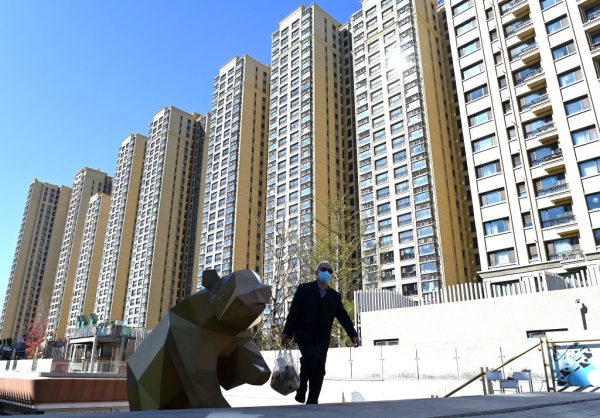 A man walks in front of a housing complex by Chinese property developer Evergrande in Beijing on Oct. 21, 2021. (Image: NOEL CELIS/AFP via Getty Images)
Real estate and balance sheet stress
A man walks in front of a housing complex by Chinese property developer Evergrande in Beijing on Oct. 21, 2021. (Image: NOEL CELIS/AFP via Getty Images)
Real estate and balance sheet stress
Domestically, Wen Zhao characterizes the property downturn as systemic rather than cyclical.
Since the 2018 trade war with the United States, both real estate and low- to mid-end manufacturing have faced mounting headwinds. The 2021 “three red lines” policy triggered a liquidity squeeze in the property sector. By 2023 and 2024, falling prices, unfinished projects and declining household wealth had become widespread.
Real estate, he notes, accounts for roughly 20% to 30% of GDP and is deeply embedded in upstream industries such as steel and cement, downstream sectors including home appliances and decoration, and the mortgage-based financial system. Between 50% and 60% of bank lending is secured by property.
Property also underpins local government finances and represents about 70% of household wealth in China. As prices fall, collateral values weaken, financial risks rise and corporate financing costs remain elevated.
Claims that other traditional industries have stabilized while real estate alone drags on growth ignore the sector’s centrality, Wen Zhao argues. Without stabilizing property, he says, it is difficult to conclude that the broader economy has reached a trough.
Zhou Qiren frames the issue in terms of institutional cost. China’s earlier acceleration stemmed from reforms that lowered such costs. Now, he argues, the cost curve has turned upward in a U-shaped pattern.
Under a system in which the state monopolizes land supply, rural land is expropriated at low prices and auctioned at higher prices, pushing land costs up multiple times. Rural homesteads remain idle and cannot circulate freely. “Expensive land,” in this reading, is not a market accident but a structural outcome.
As institutional costs accumulate, Zhou warns, vested interests expand and reform incentives weaken. Complacency during periods of rapid growth obscured productivity constraints.
Wen Zhao identifies balance sheet contraction as the macroeconomic core. Central bank liquidity injections have not translated into sustained credit expansion. Base money growth has stalled. Declining property values and falling corporate valuations have raised debt burdens.
Expectations have deteriorated. Businesses report that without price cuts, products fail to sell; with price cuts, profits evaporate. Banks prefer government bonds yielding around 2.5% over lending at 6% to small and medium-sized enterprises.
In this environment, he argues, the price mechanism has lost traction and the interest-rate channel is impaired. Wen Zhao links part of this to political uncertainty. Sudden regulatory moves, including crackdowns on private tutoring and technology platforms, have heightened institutional caution. International turbulence amplifies risk, but he says China’s exposure is compounded by its close linkage between economic outcomes and political decisions.
 A general view of the skyline of the central business district in Beijing, China during sunset on October 13, 2020. (Image: Lintao Zhang/Getty Images)
Demand, employment and structural imbalance
A general view of the skyline of the central business district in Beijing, China during sunset on October 13, 2020. (Image: Lintao Zhang/Getty Images)
Demand, employment and structural imbalance
Wen Zhao describes weak domestic demand as a fundamental constraint.
Industrial upgrading, he argues, does not automatically restore consumption. The income of a single chip engineer may equal that of one million construction workers, yet those workers collectively generate broader demand for basic goods and services.
He sees the viral essay as shaped by an engineering mindset that emphasizes technological progress while sidelining macro-level demand dynamics. Technology enhances productivity, he said, but it does not resolve distributional imbalances.
Historical precedents reinforce his concern. During the Soviet Union’s Second Five-Year Plan, heavy industry advanced while livelihood sectors lagged, contributing to domestic demand weakness. In Latin America between 1940 and 1980, industrialization proceeded alongside labor surpluses and consumption stagnation, followed by deindustrialization after 2000.
China, he argues, now faces similar patterns: urban population inflows outpace industrial absorption, competition intensifies and basic consumption weakens. Real estate and infrastructure together account for roughly 35% of GDP, and their downward momentum can offset gains in emerging industries.
Employment structure distortions, he says, risk expanding urban impoverishment and eroding demand for essential goods and services.
 A man checks shoes at an Anta shop that belongs to major Chinese sportswear company Anta Sports Products Limited, which is listed on the Hong Kong Stock Exchange, in Beijing on June 5, 2025. (Image: ADEK BERRY / AFP) (Photo by ADEK BERRY/AFP via Getty Images)
A dispute over analytical method
A man checks shoes at an Anta shop that belongs to major Chinese sportswear company Anta Sports Products Limited, which is listed on the Hong Kong Stock Exchange, in Beijing on June 5, 2025. (Image: ADEK BERRY / AFP) (Photo by ADEK BERRY/AFP via Getty Images)
A dispute over analytical method
At the center of Wen Zhao’s critique is methodology.
“Little Deer Master” acknowledged economic strain but described it as transitional pain in shifting from old to new growth drivers. In that framing, the old economy is losing blood while the new economy generates it, and the problem lies in reconnecting the pipeline.
Wen Zhao argues that this interpretation sidesteps the role of political uncertainty and policy unpredictability. Three years of strict zero-COVID controls, the abrupt closure of the private tutoring industry and sudden regulatory action against digital platforms were not organic adjustments, he said, but top-level decisions.
Treating these shocks as a natural stage of industrial upgrading, he contends, constitutes a cognitive distortion.
He likens the approach to diagnosing heart disease with a blood pressure monitor. The wrong instrument, he argues, produces misplaced confidence.
From an industrial vantage point, supply chain advances, rallies in new energy sectors and rising copper prices may suggest recovery. From a macroeconomic perspective, Wen Zhao sees contraction of the overall social balance sheet, restrained household spending, compressed corporate margins, bank liquidity retreating to safe assets and simultaneous breakdowns in price and interest-rate signaling.
These forces, he argues, shape sentiment and direction more decisively than sectoral breakthroughs.
He also challenges what he calls “technology omnipotence theory.” Latin American countries achieved full industrialization in the mid-20th century, yet subsequently endured decades marked by urban impoverishment, weak consumption and deindustrialization.
China’s excess capacity, intensified competition, fragile basic consumption and elevated youth unemployment, he says, show comparable features.
If observers remain focused on industrial progress narratives while overlooking balance sheet stress, fragile demand and accumulating financial risk, Wen Zhao warns, optimism will obscure judgment and delay adjustment, increasing the eventual cost of correction.
By Li Ting
Comments (0)