
Remember me

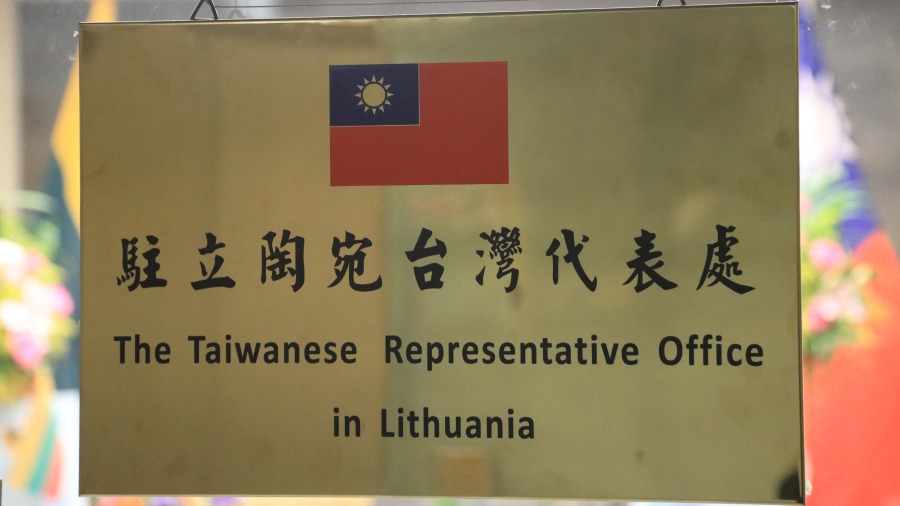


Lithuania’s diplomatic relationship with Taiwan has once again become an international focal point. In response to reports within the Lithuanian government about possible discussions to rename the “Taiwan Representative Office” as the “Taipei Representative Office,” Lithuanian President Gitanas Nausėda publicly opposed the idea, emphasizing that the office’s name involves mutual consensus and Taiwan’s wishes, and should not be decided unilaterally by Lithuania. He stressed that Taiwan’s position should be respected, rather than altered unilaterally by another country.
Lithuanian Prime Minister Inga Ruginiene recently stated that Lithuania’s 2021 approval to establish a “Taiwan” representative office was rushed and did not rule out renaming it as the “Taipei Representative Office,” sparking public discussion and attention. In response, President Nausėda directly contradicted this view, stating on February 19 after a high-level diplomatic and security meeting, “That is Taiwan’s representative office; its name is decided by Taiwan.”
Nausėda noted that the office’s name carries political symbolism and is an important symbol of bilateral cooperation. While some voices within the Lithuanian government believe the original decision to establish the office was hasty and had even discussed a possible renaming, he emphasized that any changes should be based on bilateral consultation, not handled hastily under external pressure. His remarks are seen as reflecting the presidential office’s stance on maintaining Lithuania’s existing policy toward Taiwan amid differing internal diplomatic approaches.
 A guard raises Taiwan’s national flag along Democracy Boulevard at Taipei’s Chiang Kai-shek Memorial Hall. (Image: I-HWA CHENG/AFP via Getty Images)
Taiwan Ministry of Foreign Affairs: Cooperation will continue, unaffected by renaming discussions
A guard raises Taiwan’s national flag along Democracy Boulevard at Taipei’s Chiang Kai-shek Memorial Hall. (Image: I-HWA CHENG/AFP via Getty Images)
Taiwan Ministry of Foreign Affairs: Cooperation will continue, unaffected by renaming discussions
In response, Taiwan’s Ministry of Foreign Affairs stated that cooperation with Lithuania is driven by shared values such as democracy, freedom, and the rule of law, and has already produced tangible results in trade, technology, and the semiconductor sector. The ministry emphasized that communication channels between the two sides are smooth, that the naming issue is a bilateral matter, and dialogue will continue based on mutual trust.
The ministry also pointed out that the naming issue has been discussed multiple times with the Lithuanian government, emphasizing that it is the result of bilateral negotiation under the framework of international law, not a unilateral decision. They called on the public not to overinterpret the discussions to avoid affecting friendly interactions.
SuccessYou are now signed up for our newsletter
SuccessCheck your email to complete sign up
The ministry reiterated that Lithuania’s allowance of a “Taiwan” representative office is based on mutual consensus and is an important milestone in Taiwan-Europe relations. Currently, there is no discussion of changing the office’s name, and future bilateral cooperation will deepen based on existing foundations, without being influenced by external debates.
 The Chinese flag hangs outside the Chinese Embassy on April 22, 2024 in Berlin, Germany. (Image: Sean Gallup/Getty Images)
Potential Chinese response: Diplomatic and trade pressure reemerges?
The Chinese flag hangs outside the Chinese Embassy on April 22, 2024 in Berlin, Germany. (Image: Sean Gallup/Getty Images)
Potential Chinese response: Diplomatic and trade pressure reemerges?
Although Beijing has not issued a new statement on this discussion, it has repeatedly expressed strong dissatisfaction with Lithuania’s approval of a “Taiwan Representative Office” in the past. The Ministry of Foreign Affairs of the People’s Republic of China has stated that the move violates the “One China Principle” and has responded with diplomatic downgrades and trade restrictions.
Observers note that if Lithuania maintains the current name, China may continue to exert pressure through diplomatic or economic means; if Lithuania adjusts its policy, Beijing may view it as a diplomatic success. However, within the EU framework, Lithuania’s foreign trade strategy must also consider the EU’s overall position, adding complexity to the situation.
Within Lithuania, there are differing voices on how to manage relations with Taiwan and China. Some officials advocate a more cautious approach in facing Chinese pressure, including possibly revisiting details like the representative office’s name to maintain space for dialogue with Beijing. President Nausėda’s statements, however, reflect a position of upholding independent foreign policy and not yielding to pressure.
Analysts believe Lithuania’s diplomatic actions are both symbolic and strategic, signaling support for Taiwan and democratic systems, while facing potential diplomatic or economic pressure from Beijing. In this context, how the parties balance trilateral relations with China remains an important focus for international observers.
Comments (0)