
Remember me








Dozens of women and children were collectively rounded up before being bludgeoned and stabbed to death 2,800 years ago, new findings suggest.
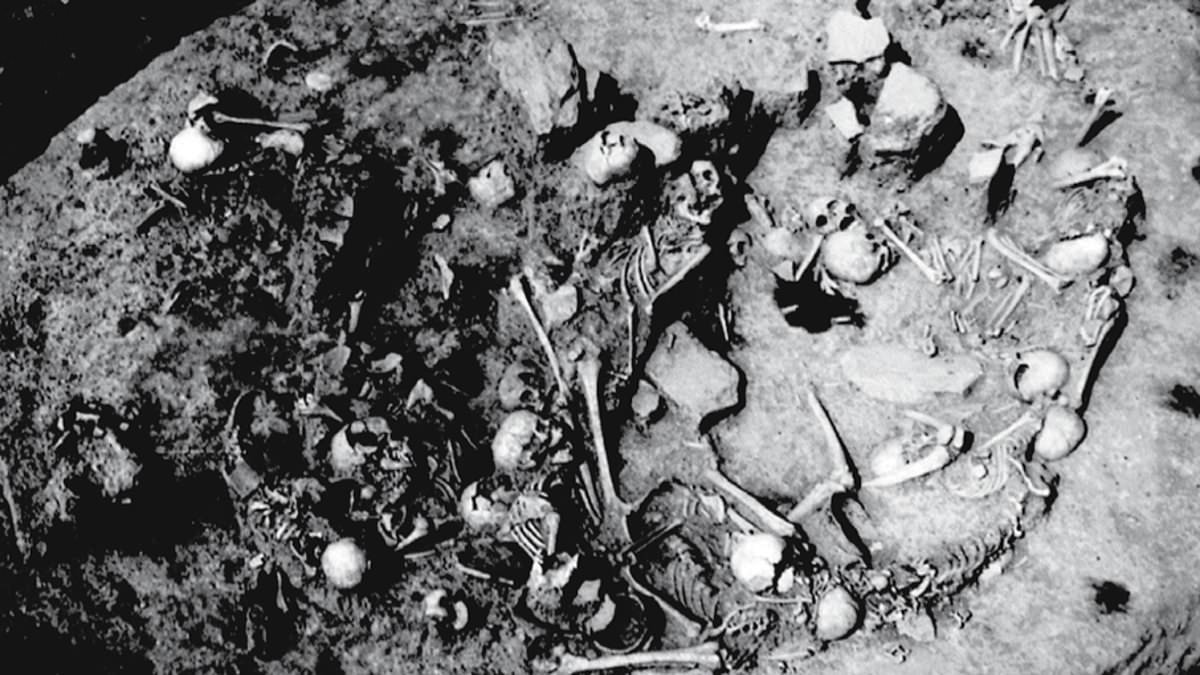
Excavations of a mass grave in Gomolava, Serbia, which dates back to the 9th century BC, has revealed evidence of lethal violence and brutal murders.
Experts have uncovered the remains of more than 77 individuals – most of whom were women and children – in the Iron Age burial site.
Analysis of their injuries reveals there was 'extensive evidence for intentional, violent and frequently lethal trauma, mostly to the head'.
This involved close contact and especially blunt force, which could have been caused by weapons including maces (bludgeons) and war hammers or projectiles including a sling shot.
In most cases, the attacker and victim were not engaged in face–to–face confrontation and the location of injuries suggests some of the attackers may have been on horseback.
However, there was some evidence of defensive injuries, indicating that some of the victims fought back.
'Overall, the patterning reveals severe violence that was brutal, deliberate and efficient,' the study, published in the journal Nature Human Behaviour, reads.

This photograph shows the Gomolava mass burial site in Serbia, which contained the remains of at leats 77 individuals

Examples of cranial injuries documented at the site. Scientists said they found 'extensive evidence for intentional, violent and frequently lethal trauma, mostly to the head'
Analysis showed that of the 77 individuals, 40 were aged between one and 12, while 12 of them were adolescents.
A total of 24 were adults – 87 per cent of which were female – and the only baby that was found was male.
Genetic analysis of the remains revealed that very few victims were related to each other and had different diets – suggesting that most grew up in different areas entirely.
The team said the massacre took place at an unsettled time when communities were becoming less mobile and creating new enclosed settlements.
This early collective violence was most likely from targeted killing as part of a systemic and large–scale conflict that many settlements got caught up in, they added.
The study was carried out by teams from the University of Edinburgh, University College Dublin and the University of Copenhagen.
Dr Linda Fibiger, who co–led the research said: 'The brutal killings and subsequent commemorating of the event can both be read as a powerful bid to balance power relations and assert dominance over land and resources.
'The study sheds new light on targeted gender and age selective killings as a way of enacting mass violence and assertion of power in prehistoric Europe.'

The injuries may have been caused by blunt weapons or from projectiles such as this Iron Age sling shot

The blunt head of a war hammer, like this one pictured, could have also been used to kill the women and children
How old were the individuals in the mass burial pit?Infant (0-1 years): 1
Juvenile (1-12 years): 40
Adolescent (13-17 years): 12
Young adult (18-25 years): 5
Young middle adult (26-35 years): 10
Old middle adult (36-45 years): 8
Mature adult (45+ years): 1
In contrast to other mass graves of the time period, the site showed evidence that time and effort had been put into preparing the burial area.
Individuals were buried with their personal items, including jewellery, while the grave was in a protected location with evidence of bronze ornaments, ceramic drinking vessels and the bones of up to 100 animals.
Analysis reveals that the individuals were buried soon after their death, indicating they were all killed near the grave site.
Some animals were evidently slaughtered or butchered for the burial event, including the skeletal remains of a calf found at the bottom of the grave pit.
Evidence of broken quern stones – remnants of ancient grinding tools used for milling grain – and concentrations of burnt seeds were found on top of the grave.
The investment in its presentation reveals the importance of the burial event prior to covering the dead with soil and stone, the researchers said.
Dr Barry Molloy, the Principal Investigator of the research, said: 'By drawing together a suite of cutting–edge analyses not available when this grave was excavated, we are now able to tell the story not simply of their violent deaths, but also the circumstances leading up to that event.
'This shines new light on the nature of conflict and its aftermath at this time, particularly as their burial was staged on the settlement mound at Gomolava, transforming it into a lasting monument to these people and witnessed by their community.'

An artist's impression of the burial event at Gomolava. The dead can be seen in a pile within a pit, while others prepare food and butcher animals nearby
The paper argues that the demographics of those killed at Gomolava accentuate the sense that this was a 'purposeful, calculated act' that would have had a wide–ranging impact on other communities.
'Taken together the killing event, the mortuary event and the resulting monument signal a chain of actions intended to forcibly resolve or eradicate conflict and rebalance power within or between communities,' the researchers said.
They explained that learning about the victims of these events is key for understanding the evolution of violent behaviour.
To conclude, they said: 'The killing presents striking evidence for an episode of cross–regional conflict and an underlying aggressive shift in power, violence and gender relations in the region.'
WHAT DO WE KNOW ABOUT IRON AGE BRITAIN?The Iron Age in Britain started as the Bronze Age finished.
It started around 800BC and finished in 43AD when the Romans invaded.
As suggested by the name, this period saw large-scale changes thanks to the introduction of iron working technology.
During this period the population of Britain probably exceeded one million.
This was made possible by new forms of farming, such as the introduction of new varieties of barley and wheat.
The invention of the iron-tipped plough made cultivating crops in heavy clay soils possible for the first time.
Some of the major advances during included the introduction of the potter's wheel, the lathe (used for woodworking) and rotary quern for grinding grain.
There are nearly 3,000 Iron Age hill forts in the UK. Some were used as permanent settlements, others were used as sites for gatherings, trade and religious activities.
At the time most people were living in small farmsteads with extended families.
The standard house was a roundhouse, made of timber or stone with a thatch or turf roof.
Burial practices were varied but it seems most people were disposed of by 'excarnation' - meaning they were left deliberately exposed.
There are also some bog bodies preserved from this period, which show evidence of violent deaths in the form of ritual and sacrificial killing.
Towards the end of this period there was increasing Roman influence from the western Mediterranean and southern France.
It seems that before the Roman conquest of England in 43AD they had already established connections with lots of tribes and could have exerted a degree of political influence.
After 43AD all of Wales and England below Hadrian's Wall became part of the Roman empire, while Iron Age life in Scotland and Ireland continued for longer.
Comments (0)