
Remember me








Climate change could determine the sex of your child, a new study has revealed.
Scientists from the University of Oxford have uncovered new evidence that higher temperatures can influence the sex ratio at birth.
The team analysed more than five million births across 33 sub–Saharan African countries and India.
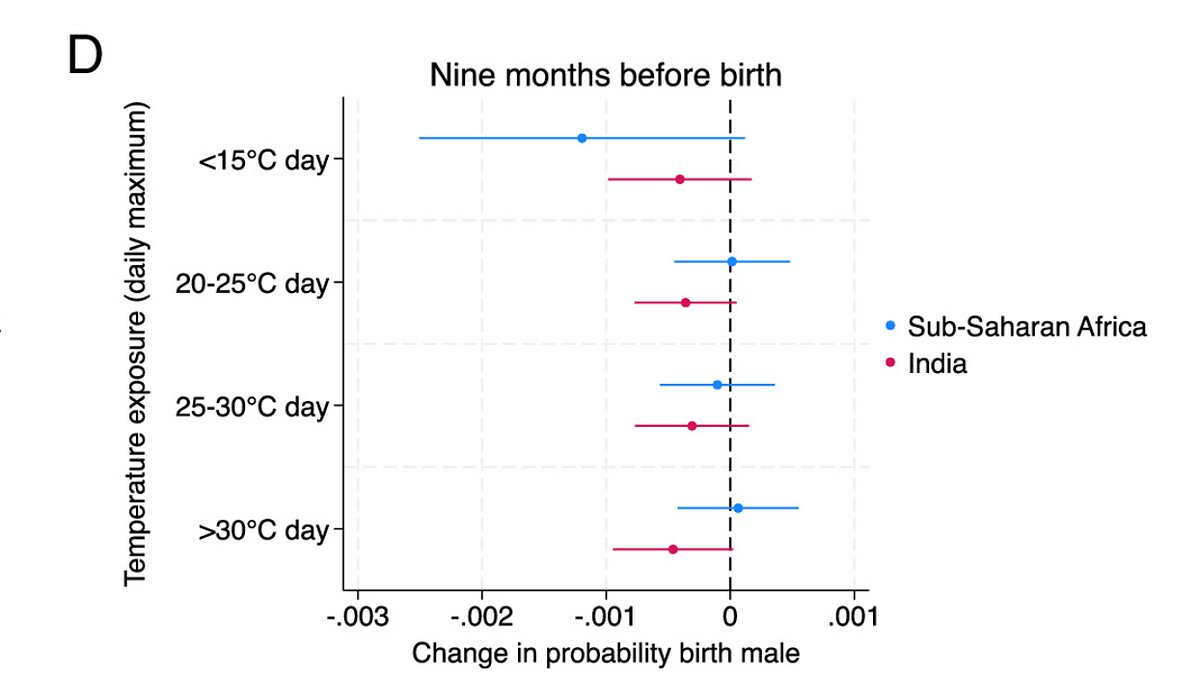
The results showed that in both regions, temperatures above 20°C were consistently associated with more girls being born.
Dr Abdel Ghany, lead author of the study, said: 'Extreme heat is not only a major public health threat.
'We show that temperature fundamentally shapes human reproduction by influencing who is born and who is not born.
'Our findings indicate that temperature has measurable consequences for foetal survival and family planning behaviour, with implications for population composition and gender balance.
'Understanding these processes is essential for anticipating how the environment affects societies in a warming climate.'

In sub–Saharan Africa, the decline in male births was linked to prenatal mortality driven by maternal heat stress. Over in India, however, the effects were found to appear later in pregnancy
The human sex ratio is the ratio of males to females in a population.
While most of us think of this as 1:1, the global population actually has slightly more men, with approximately 101 to 102 males for every 100 females.
In their new study, the team set out to understand how climate change will impact the global sex ratio.
'[Sex ratios] reflect underlying patterns of maternal health, prenatal survival, and, in some contexts, gender discrimination,' the team explained.
'In recent decades, skewed sex ratios have raised concerns in several regions, particularly where son preference and sex–selective abortion are prevalent.'
Across five million births in 33 sub–Saharan African countries and India, the researchers found that temperatures above 20°C were associated with fewer male births.
However, this was through different mechanisms.
In sub–Saharan Africa, the decline in male births was linked to prenatal mortality driven by maternal heat stress.

The study found that temperatures above 20°C were consistently associated with more girls being born (stock image)
Over in India, however, the effects were found to appear later in pregnancy.
'Higher temperatures during the second trimester are associated with fewer male births, especially among older mothers, high–parity births, and women without sons in northern states,' the researchers explained.
Overall, the findings suggest that global warming could have an impact on the global sex ratio.
'This study demonstrates that there is a sex–specific response to temperature before birth driven by both biological and behavioral responses that lead to substantial impacts on reproduction and population composition,' the researchers concluded.
At the same time, scientists from the University of Manchester have uncovered a link between seasonality and male fertility.
The team enlisted more than 15,500 men in Denmark and Florida – two countries with very different climates – whose semen was analysed.
Surprisingly, the researchers found the same pattern in both countries - the quality of sperm is highest in the summer and lowest in the winter
Professor Allan Pacey, co-author of the study, said: 'We were struck by how similar the seasonal pattern was in two completely different climates.
'Even in Florida, where temperatures stay warm, sperm motility still peaked in summer and dipped in winter, which tells us that ambient temperature alone is unlikely to explain these changes.'
WHAT IS THE DIFFERENCE IN MALE AND FEMALE BIRTH RATES?There is an existing quirk of nature which means for every 200 births, 105 will likely be male.
This ratio has long puzzled population scientists who muse over the deep-rooted cause of it.
A prevailing theory is that more males are born to balance out the superior longevity of females.
Women have a greater life expectancy in most countries. In the UK, the Office for National Statistics reveals a newborn baby boy could expect to live 79.2 years and a newborn baby girl 82.9 years
And for every male that reaches the age of 100 - there are four women who also become centenarians.
A conclusive answer has yet to be widely accepted.
Modern pressures in some societies has worsened this ratio up to 118:100 following.
Added pressure of China's single-child policy and the desire of parents to have a boy compounded the problem.
Comments (0)