
Remember me








Hundreds of thousands of people could benefit from a 'smart T–shirt' that can detect hidden heart conditions, scientists have announced.
Currently, people suffering from symptoms like chest pain or dizziness take home a portable device that measures their heart's electrical signals.
This test involves precisely positioned sticky electrodes, connected with leads to a waist–worn monitor, which needs to be carefully removed and reattached whenever someone has a shower.
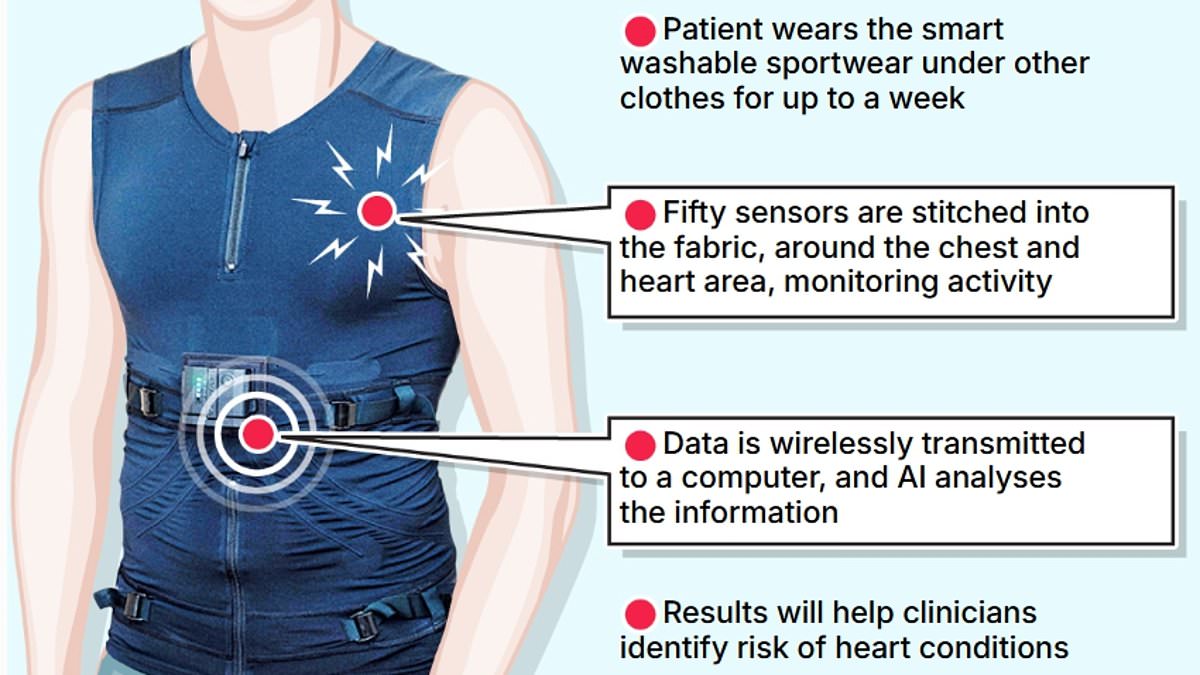
Now, researchers have developed a shirt with up to 50 sensors stitched into the fabric – and it could be far simpler to use.
The shirt, the result of a conjunction between the British Heart Foundation and Imperial College London, is designed to detect rare, inherited heart conditions.
It can be worn for up to a week, giving it longer to pick up issues compared to portable ECGs, which are typically used for one to two days at a time.
The device sends data to a computer which uses a specially–designed AI system to analyse the information and flag any issues to a doctor.
It could benefit around 340,000 people in the UK, who have an inherited heart condition which could put them at risk of dying from a dangerous heart rhythm.

Dr Keenan Saleh, Clinical Research Fellow at Imperial College London, holds up the 'smart T–shirt' that will soon be tested on hundreds of people
These inherited conditions can increase someone's risk of sudden cardiac death if not spotted and treated.
They are estimated to claim the lives of 12 young people under 35 in the UK each week.
Inherited heart conditions can also cause symptoms such as breathlessness or fainting during day–to–day activities like driving or exercising.
However, diagnosing these conditions in hospital can be difficult, as heart rhythm tests and heart scans often appear completely normal.
Zachary Whinnett, Professor of Cardiology at Imperial College London, said: 'Far too many people die from inherited heart conditions which could be treated if they were identified earlier.
'One of the challenges of diagnosis today is that irregular heart rhythms may not always occur during routine 10– minute hospital ECGs or even 48–hour ECG monitoring at home.
'We hope our AI–assisted T–shirt will provide a practical and comfortable solution, allowing us to carry out longer–term scanning that could improve diagnosis.
'By harnessing the power of AI, we hope our research can transform doctors' abilities to spot these conditions and improve the lives of those who are unknowingly living with a genetic heart condition.'

Dr Saleh wears the 'smart T–shirt' on a treadmill. It contains up to 50 sensors that monitor electric signals from the heart

The heart data is transmitted to a computer, where artificial intelligence (AI) analyses it for anything concerning to flag to a doctor
How it works The T–shirt is made of sportswear–style clothing and can fit comfortably underneath other clothes50 sensors are stitched into the fabric of the shirt, around the chest and heart areaThese work like an ECG, constantly monitoring the heart's electrical signals throughout the dayPatients wear the T–shirt, which can be washed as normal, for up to a weekThe sensors wirelessly transmit the data to a computer, where AI analyses the informationIt will help clinicians identify patients at risk of heart conditionsThe T–shirt is being developed with the help of Carly Benge, a 38–year–old teacher from Watford.
Ms Benge has Brugada syndrome, which is a dangerous heart rhythm disorder that researchers are hoping the T–shirt can detect.
Because the condition runs in families, her two children, seven–year–old Imogen and Jake, aged 10 are also at risk.
Children like Imogen and Jake could access earlier treatment if they were identified early using the smart T–shirt.
Early diagnosis is vital for conditions like Brugada syndrome because, if they're not spotted and treated, they can increase someone's risk of sudden cardiac death.
A prototype of the T–shirt will be given to 200 patients and volunteers attending Hammersmith Hospital's Peart–Rose Research Unit.
The study participants will wear the T–shirt continuously for up to three months, to measure how well it picks up serious heart conditions.
The T–shirt will be designed using comfortable sportswear–style material which can be worn underneath clothes during daily activities, like sleeping, eating and working.

The T–shirt is being developed with the help of Carly Benge, pictured here with her children Jake and Imogen
It will have wires within the fabric to measure electrical signals, allowing patients to be monitored for longer periods of time.
The researchers hope the technology will be available for doctors to use in roughly five years.
While the T–shirt will initially be developed and trialled on adults, if found to be effective, it could provide a new way to make heart monitoring more comfortable for children in future.
Researchers also hope to make it available to help identify people with other heart rhythm conditions, such as atrial fibrillation, more easily.
SADS: The invisible killer that claims 500 lives a year in BritainSudden adult death syndrome (SADS) is caused by a 'ventricular arrhythmia', a disturbance in the heart's rhythm.
It can strike at any age and can even affect those who are fit and athletic.
Sometimes there are no warning signs, but in other cases victims can experience dizziness or fainting spells. It is often triggered by physical or emotional stress.
In some cases it may be caused by an underlying genetic disorder which runs in families, while in others it may be caused by a condition which is acquired.
Around one in four cases is thought to be caused by a set of conditions called ion channelopathies.
These affect the electrical functioning of the heart without affecting its structure, meaning they can only be detected in life rather than after death.
The prevalence of SADS is not fully known as many sudden deaths are put down to accidents, but research suggests it claims around 500 lives a year in Britain.
It was first noted in 1977 among Hmong refugees in the US. It was then reported again in Singapore when medics looked through records which showed 230 healthy Thai men died suddenly between 1982 and 1990.
Comments (0)