Scientists are teaching AI how to understand slang words such as 'chuck' and 'nowt' so that automated phone lines can understand local callers.
Councils across the UK are turning to artificial intelligence to man their phones, helping people with enquiries such as when to put their bins out or how to pay their council tax.
But the technology struggles to understand variations in accent and the use of slang words.
Now, researchers are leading a study to make AI better able to understand the different terms and tones.
'Many people across the UK may have found themselves in a situation where they've tried to phone their local council but the AI that first handles their call struggles to understand them,' Dr Chris Montgomery, from the University of Sheffield, said.
'This may have led to them having to repeat themselves several times or being routed to the wrong service, which can be frustrating and time consuming.'
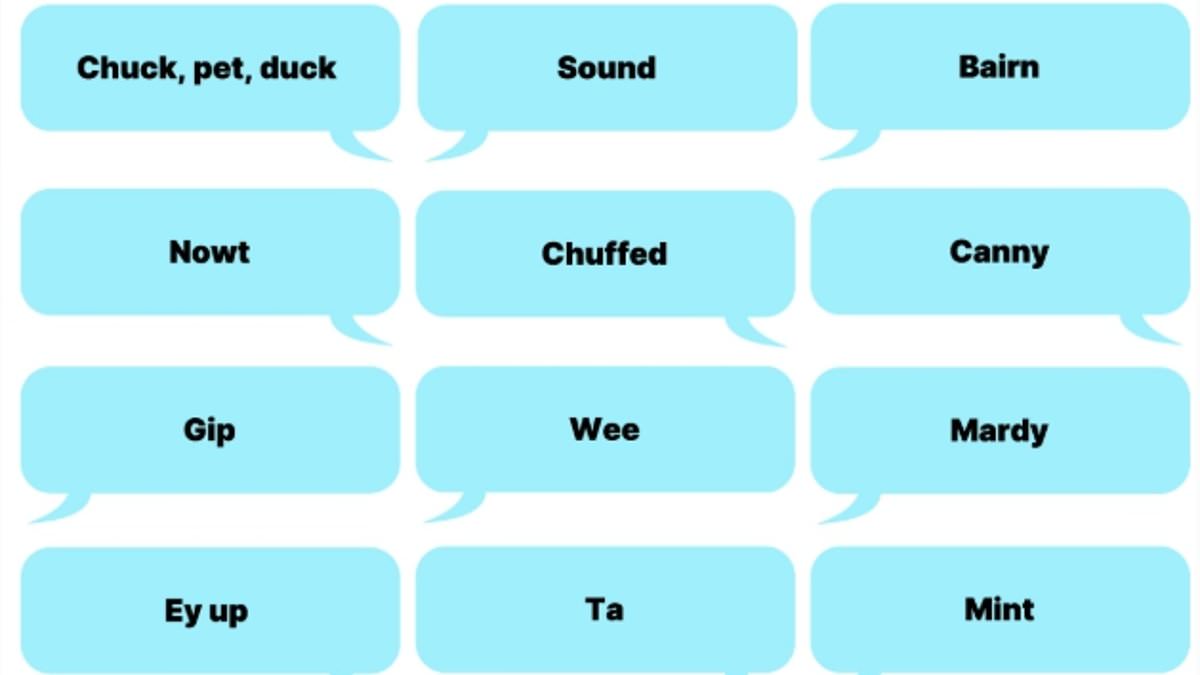
Some of the words the AI may struggle to comprehend include 'pet', 'canny', 'chuffed' and 'gip'.
But how many of these regional terms do you know?
The words 'chuck', 'pet' and 'duck' are all colloquial terms of endearment common to the north of England and the Midlands.
They all roughly translate to an affectionate term of address, such as 'dear'.
However, they could all 'cause problems' for AI as they are typically used in other contexts – for example, 'chuck' also means 'to throw' and 'duck' can mean to crouch down.
The word 'canny', meanwhile, is a widely used slang term in the Geordie dialect, generally meaning something is nice or good. It can sometimes also mean 'very'.
Using the word 'sound' to describe something also has positive connotations. It is also commonly used to describe a reliable person.
'Nowt' is a common northern English slang word that means 'nothing', while 'chuffed' is used to indicate you're pleased.
If someone in Scotland or northern England refers to a 'bairn', they're talking about a child or baby.
And giving someone 'gip' means something is painful or nagging, while 'wee' means small.
As part of his work, Dr Montgomery is collaborating with ICS.AI, a company that delivers AI platforms for the public sector.
Last year, the company launched its first generative AI phone–answering voice agent, called Darcie, with Derby city council.
However, it struggled with the Midlands accent.
Dr Montgomery said the next stage of the project involves working out how to make sure that the AI technology reflects the range in accents and dialects across the UK 'so that no one's at a disadvantage because of how they speak'.
'As AI is frequently used to direct calls across public services, we need to ensure the technology can understand the range of accents and dialects it may be faced with,' he said.
'Similar to when you learn a new language, you are often taught about how that language can vary throughout the regions where it is spoken, so we need to apply that same approach when developing AI.'
Dr Crispin Bloomfield, Chief Education Solutions Officer at ICS.AI, added: 'Public sector AI has to work for everyone, not just for people whose voices or speech patterns are easiest for systems to process.'
It follows a recent survey which revealed that over half of UK residents are concerned that AI may struggle to understand accents or dialects. This increases to 57 per cent in Wales, 67 per cent in Northern Ireland and 71 per cent in Scotland.
The slang words decoded
Chuck, pet, duck = Terms of endearment
Example: Alright chuck? (Alright love?)
Canny = Nice/good or Very
Example: He's a canny lad (He's a nice guy)
Example 2: Canny good (Very good)
Nowt = Nothing
Example: I've got nowt to do (I've got nothing to do)
Chuffed = Pleased
Example: I'm chuffed with how that went (I'm pleased with what happened)
Sound = Excellent or a Reliable Person
Example: That's sound (That's good)
Example 2: She's sound (She's cool)
Bairn = Child or Baby
Example: Is this your first bairn? (Is this your first child?)
Gip = Painful or Nagging
Example: My knee is giving me gip (My knee is annoying me/hurting)
Wee = Small
Example: Look at that wee dog (Look at that tiny dog)
Ey up = Hello
Example: Ey up pal (Hello friend)
Mardy = Moody
Example: He’s acting like a mardy teenager (He’s acting like a moody teen)
Ta = Thank you
Example: Ta very much (Thanks a lot)
Mint = Excellent
Example: That car is in mint condition (That car is in good condition)





Comments (0)