
Remember me





Daily Mail journalists select and curate the products that feature on our site. If you make a purchase via links on this page we will earn commission - learn more
I'll admit it – I'm obsessed with tracking my health.
Ever since the Apple Watch first came out I've religiously checked my daily step count, how many calories I burn during an exercise class and, most importantly, my sleep.
But there's a new gadget on the market – and if you haven't noticed it yet, you soon will.
The Oura Ring 4 is a smart device that uses high–tech sensors to track health metrics such as sleep, heart rate, activity, body temperature and stress.
It can tell you how ready your body is for the day, how to recover from your workouts, whether you're showing the first signs of illness and how well rested you truly are.
Even better, it looks like a fancy piece of jewellery and has a charge that lasts for days.
For the past six weeks I've been testing the latest model, wearing it day and night as it collects data and provides me with regular 'insights'.
Even though it's a tad expensive – with prices starting from £349 – it's a brilliant investment for someone who really wants to take their biometrics seriously.
Oura Ring 4
For the past 6 weeks I've been testing the latest Oura Ring 4 model, which I ordered in this gold colour
 Oura Ring 4
The Oura Ring is a smart device that uses high-tech sensors to track health metrics such as sleep, heart rate, activity, body temperature and stress.
£499
Product SpecsDimensionsWidth: 7.90 mmWeight3.3– 5.2 g for full range of sizes (4–15 Sizes)Thickness2.88mmWhat we loveSizeIt looks nice and after a while you forget you're wearing it
FeaturesIt uses high-tech sensors to track health metrics such as sleep, heart rate, activity, body temperature and stress. These can be monitored through the app
BatteryLasts between five to eight days on a single charge
What could be betterFitness trackingWearing the ring at the gym isn't practical, so it doesn't capture your exercise
PriceWith prices starting at £349, it's not cheap. It also requires an ongoing subscription to access the full data
£499
Our verdictAs someone who loves tracking their health, the Oura Ring has given me unprecedented insight into what’s going on with my sleep, stress levels and daily activity.
It provides real-time, accurate updates on my wellbeing, along with tips to improve my scores. It would be great for anyone keen to really understand their biometrics.
I think it looks great as a piece of jewellery and the battery life is incredibly impressive. For its size, it really is a remarkable device.
However, it’s quite a big initial investment and also requires an ongoing subscription, so it’s worth taking that into consideration as the cost does really rack up.
How we testAs with any fitness gadget, it was important that I tested the Oura Ring thoroughly. When testing tech devices we try them across multiple real–world settings, including the office, our homes, the gym and out and about.
We evaluate the technology across a range of measures including design, comfort, price and application.
Each device goes through at least several days of hands–on testing or int he case of the Oura Ring, several weeks, allowing us to provide an in–depth review to help consumers make informed decisions.
I wore this Oura Ring consistently for six weeks, only taking it off to shower, charge it up or when at the gym.
I also kept it on while I travelled abroad, to see how it would cope with changing time zones and during high levels of physiological stress.
Oura Ring 4 review
The Oura Ring is a smart device that uses high–tech sensors to track health metrics such as sleep, heart rate, activity, body temperature and stress
What colours are available? Size and comfortBefore I was sent the device, I received a 'ring sizer' in the post to make sure I ordered the correct size.
Oura recommend wearing the ring on your index finger, although the middle or ring finger also work well.
The key is to ensure a snug, comfortable fit with the sensor bumps positioned on the palm side of your finger.
After carefully submitting my size – an 11 for anyone interested – I ordered the gold version. Other colours include silver, rose gold and black.
When it first arrived, I was a bit worried as the ring felt highly unusual on my index finger. I've never worn jewellery on that finger before, and it felt a rather bulky and odd.
Now? I forget I'm wearing it. It's amazing how quickly you get used to the feeling – and it actually now feels weird when I don't have it on.
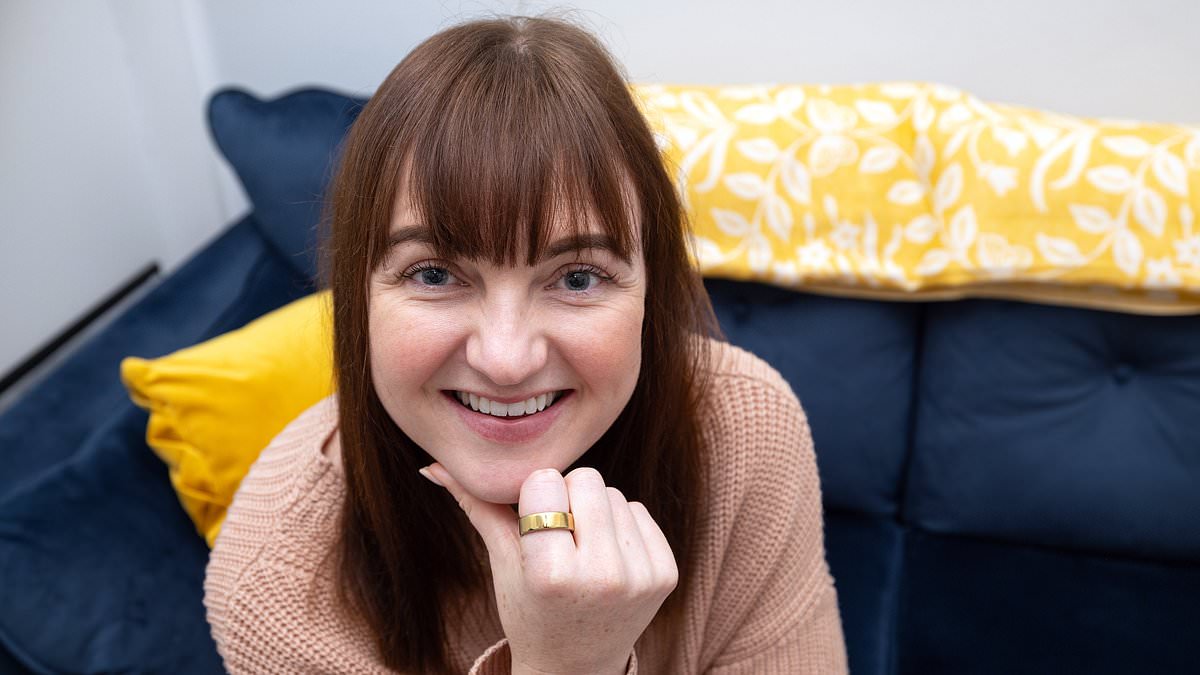
I also absolutely love how it looks – like an expensive piece of jewellery that compliments the rest of my gold trinkets.

The Oura Ring 4 comes in a range of colours and finishes including silver, black, gold and rose gold

Oura recommend using their ring sizer to make sure you get an accurate fit. The company recommend wearing the ring on your index finger, although the middle or ring finger also work well
Biometrics – SleepWhen it comes to gathering your health data, Oura Rings are a cut above other technologies currently on the market.
Like many other devices it tells me how well I sleep each night, indicating my overall sleep alongside how much of that was 'deep' sleep and how much was in the dreamy realms of REM.
But every morning it also spells out how efficiently I slumbered – which is the percentage of time spent asleep compared to the time spent awake while in bed.
The ring tracks my wake–ups, excessive movement and getting up from bed during the night. If it thinks my sleep isn't restful enough, it will provide tips on how to improve it (such as making sure my bedroom is the right temperature).
It also keeps track of how long it takes me fall asleep each night, and ranks the timing of my bedtime and early morning alarm.
I can easily check my 'sleep debt' – which inevitably ends up high on a Friday but restored by Monday morning, my oxygen saturation, my breathing regularity and heart rate.
Why would I want to know all of this? Sleep is the main driver of how I feel and function throughout the week, and any insight into why I might not be making the most of it is helpful. Knowing what my daily 'sleep need' is, (7 hours and 9 minutes, apparently) helps reassure me that I am getting enough, and knowing I've caught up on my sleep debt with a big Saturday lie–in makes me feel better about the following week.


On this night (left), when I struggled to get enough sleep, the app assured me that I've still scored well for 'restfulness'. Meanwhile despite sleeping for less than seven hours on one night (right), I was told that I got a good amount of restorative deep sleep

I wore this Oura Ring consistently for six weeks, only taking it off to shower, charge it up or when at the gym
Biometrics – ReadinessI recently went on a big trip abroad that involved lots of flights, freezing cold weather and a plunge into the sea surrounded by floating ice.
Unsurprisingly, I started to feel a little bit rubbish on the way home – and this is when my Oura Ring really started talking to me.
What started out with a 'minor signs' alert, warning me that my body was experiencing some issues, soon turned into a full–blown 'major signs' notification.
'Your biometrics show major signs of something straining your body,' my Oura app told me. 'Take care today and rest if you're feeling low on energy.'
It also revealed that my resting heart rate and breathing rate were elevated, and that my average body temperature was raised.
Never have I felt so validated. Most of us don't like to cause a fuss when we're ill and simply try and plough through it. But I did feel pretty rotten and at least I knew I wasn't being dramatic.
I also think this 'readiness' score is super reassuring when I don't think I've had a good sleep. Even if I wake up feeling tired, it can reassure me that my body is, overall, still 'ready' to take on the day, which makes me feel better about staying up late the night before.

What started out with a 'minor signs' alert, warning me that my body was experiencing some issues, soon turned into a full–blown 'major signs' notification

The Oura Ring recommends tips to help you get better sleep, including drinking less coffee in the afternoon
Biometrics – ActivityAs much as I love the Oura Ring, when it comes to tracking activity and exercise I do think my Apple Watch is better.
While it's fine at keeping tally of my step count or whether I'm sitting down for too long, wearing a ring at the gym simply isn't practical.
Oura says you can wear your ring for cardio, but it is generally recommended to remove it during heavy weightlifting.
It means that I rely on my Apple Watch during weightlifting sessions and exercise classes.
Since the Oura Ring does not track swim–specific metrics like strokes or laps, I also take it off for swimming in case it slips off.
What is handy, however, is that exercise data collected from your Apple Watch is transferred to your Oura app.
This means that your workout is logged and taken into account when it works out long–term trends to your activity, training volume and recovery time.

The device tracks my step count and calorie burn throughout the day – but I do think fitness watches are better for proper workouts

Oura say you can wear your ring for cardio, but it is generally recommended to remove it during heavy weightlifting
Other featuresIt might sound unnecessary, but your Oura Ring can also let you know when you're stressed. While this might feel intuitive, it also comes up with prompts to boost your 'restorative time', such as breathing exercises, which are scientifically proven to improve stress but are likely forgotten about by the majority of us.
The smart ring can also help women track their ovulation by monitoring metrics like their daily skin temperature trends.
And an AI 'advisor' is always on hand to answer questions. For example, you can ask what time is best for you to go to sleep and it will analyse your previous data to come up with actionable advice.
BatteryThe Oura Ring's battery life is phenomenal. As someone who has to charge their iPhone twice a day, and put their watch on charge every morning, it's so nice to go days at a time without a 'low battery' warning.
On a full charge, the battery typically lasts between five to eight days. There's a handy monitor on the app to let you know how much battery it has left, and an alert lets you know when it needs plugging in.
Regular, short charges, for example while showering, are recommended to maintain longevity, rather than running down the battery completely before recharging.

On a full charge, the battery typically lasts between five to eight days. Oura recommend charging it in short bursts
PriceWe can't ignore the cost of the Oura Ring, which currently starts at £349.
But while it's more expensive than a fitness Watch, the level of detail and insight it provides is second–to–none.
I really do think it's worth the money for a busy professional who wants to give their body the best chance at not being utterly exhausted.
Some might be concerned that they will become governed by their biometrics, with low sleep scores fuelling a generation of already–anxious poor sleepers.
But I've discovered that, if anything, it provides calm reassurance and helpful tips – rather than outright alarm – when you don't manage to hit your goals.
A friend who got her Oura Ring about six months ago says it's 'changed her life' because she's made a conscious effort to listen to what the advice says. She has since bought one for her boyfriend – and I do think it makes a really special gift for a birthday, anniversary or even Christmas.
Alongside the original cost, the Oura Ring requires a subscription to access the full data, costing £5.99 a month or £69.99 a year in the UK.

The health tracker looks like a nice piece of jewellery – and after a while you forget you're even wearing it
How does it compare to similar productsOverall, the Oura Ring is what you need if you want holistic health monitoring that emphasizes recovery and sleep quality. If you're prone to feeling tired, run down or generally unwell, it really could help you understand your body and take steps to improve.
However, if you're really after fitness tracking and monitoring how many calories your exercise class burned, it's best to stick to a traditional fitness watch such as the Apple Watch SE3.
Ideally? It might sound like overkill, but having both a smart ring and smart watch can give you the best of both worlds.
'The main difference between Oura Rings and other wearable technology is their compact design and form,' Kirstie Thorley Mitchell, Head of Wellness at Boots, said. 'Most wearables are often worn on the wrist or chest, whereas Oura Rings, are usually worn on the index finger.'
Oura Ring 4The Oura Ring is a smart device that uses high-tech sensors to track health metrics such as sleep, heart rate, activity, body temperature and stress.
£499
Why trust us
Xantha Leatham is the Executive Science Editor at the Daily Mail and has worked at the newspaper for nine years. She completed a Master's degree in Print Journalism at the University of Sheffield in 2014 and previously worked at Deadline News in Edinburgh.
She has carried out several technology reviews including for headphones, power banks and vacuums.

Alongside the original cost, the Oura Ring requires a subscription to access the full data, costing £5.99 a month or £69.99 a year in the UK
How does it rate onlineThe Oura Ring 4 is highly rated online, with 5,626 people on Amazon giving it an overall rating of 4.3 stars.
Customers said they found it excellent for sleep and activity tracking, with accurate biometric readings.
One wrote: 'What I love most is the accuracy and depth of insight. It doesn't just give you only the minimal data, like Deep, Light and REM sleep, but also things like how long it takes you to get to sleep (latency) and how restless you are —it then translates this into genuinely helpful feedback, like sleep and recovery scores, body temperature trends, and guided breathing for stress.'
Another said: 'The quality is great, it tracks my sleep, my meals, my daily activity and it looks elegant and sleek. You can wear it for days and the battery lasts a lot.'
However, value for money gets mixed reviews – with some saying the ring is 'costly enough without an ongoing subscription'.
'To pay a huge price for the ring and then have to pay a monthly subscription for an app…they're asking too much,' one person said.
Another complained that it 'scratches way too easily'.
Oura Ring FAQsHow does the Oura Ring differ from other wearable technology?
The main difference between Oura Rings and other wearable technology is their compact design and form.
Most wearables are often worn on the wrist or chest, whereas Oura Rings, are usually worn on the index finger. Oura Rings prioritise rest, recovery and passive tracking over activity goals, like running or gym workouts.
The Oura Ring monitors biometrics including resting heart rates, skin temperature, blood oxygen and sleep.
Does it matter what finger I wear my Oura Ring on?
You can wear your Oura Ring on any finger of either hand, but for the most accurate sensor readings, Oura recommend wearing it on your index finger. It also performs well on your middle or ring finger.
The key is a snug, comfortable fit that ensures consistent contact with your skin – tight enough to stay in place, but not too tight to cause discomfort. Oura suggest trying different fingers for at least 24 hours with your free sizing kit to find the best fit for both comfort and performance.
Can you shower wearing the ring?
Yes, Oura Ring is water–resistant up to 100 metres (~330 feet), meaning you can also wear it swimming and for recreational diving (e.g. snorkeling).
What do doctors think about it?
Oura Ring is widely used by clinicians and in research. Around 1 in 9 Oura Members are healthcare providers, and Oura has been used in more than 150–170 peer‑reviewed studies with partners like Stanford, Mayo Clinic, Brigham and Women's Hospital, and others.
Oura's Medical Advisory Board includes cardiologists, sleep physicians, reproductive endocrinologists, and stress/mental health experts who review the science and help guide features.
Oura's Shareable Report features also enables members to share their sleep and menstrual health data securely with trusted healthcare professionals. Sharing your health data with a trusted healthcare partner can provide greater insights into overall wellbeing, behaviours and habits which can be impacting health outcomes.
Does it have a monthly fee?
Oura Membership is £5.99 per month/£69.99 annually.
Comments (0)