The strategic geography of the Western Pacific is returning to the center of U.S. national security thinking. The recent National Security and National Defense Strategies both reaffirmed defense of the First Island Chain (FIC) – stretching from Northern Japan through Taiwan to the Philippines – as the organizing principle of U.S. force posture in the Indo-Pacific. Yet denial defense along the FIC hinges on the broader Northern Pacific arc linking Hawai‘i, Guam, and Micronesia, given FIC countries’ vulnerability to China’s short and medium-range missiles.
China’s expanding naval footprint underscores that the contest now extends across the wider Pacific. The Chinese People’s Liberation Army Navy’s dual aircraft carrier deployments in June 2025, Chinese and Russian strategic bombers’ joint patrols around Japan, and a Chinese carrier-based aircraft locking fire-control radar on a Japanese aircraft in December 2025 all occurred beyond the FIC. The Western Pacific north of the equator – cornerstone of U.S. command, logistics, and strike capabilities – is no longer a safety zone.
Micronesia’s Strategic Value and Vulnerability
Micronesia occupies a pivotal position. The subregion – including the Federated States of Micronesia (FSM), the Republic of the Marshall Islands, Palau, and the Commonwealth of the Northern Mariana Islands (CNMI), a U.S. territory – sits mostly beyond the 1,000-km range of China’s short-range ballistic missiles. As State Department official Tony Greubel testified, “This is a region that is increasingly central to United States security and global stability.”
The United States maintains military base access through its Compacts of Free Association (COFAs) with the FSM, Palau, and the Marshal Islands, with the U.S. providing approximately $2.3 billion, $3.3 billion, and $0.9 billion respectively to these partners for FY2024-FY2043. In exchange, the COFAs grants U.S. forces unrestricted military access to an area of open ocean approximately the size of the continental United States. Over 1,000 COFA citizens serve in the U.S. Armed Forces. In January 2026, Secretary of Defense Pete Hegseth and FSM President Wesley Simina announced infrastructure projects in Yap State exceeding $2 billion.
Yet Micronesia faces persistent economic constraints. Nominal GDP per capita varies dramatically: $23,800 in the CNMI, $2,900 in the FSM, $7,700 in the Marshall Islands, and $15,600 in Palau. Youth unemployment in the FSM often exceeds 15-20 percent, and outward migration hollows out domestic capacity.
Implementation gaps undermine U.S. credibility. Joint Task Force Micronesia acknowledged falling short on local contracts. The Department of Veterans Affairs has yet to implement extended benefits for COFA veterans despite congressional pressure. Trump administration deportations of Marshallese individuals have generated anxiety about COFA migration provisions.
China’s Strategic Positioning
China has exploited these gaps through concessional loans, construction projects, and fisheries agreements – and more nefarious schemes. As Palau’s anti-corruption prosecutor Tamara Hutzler explained: “We’ve seen the playbook over and over again throughout the region. Get in with predatory investment, corrupt officials through elite capture, and try to destabilize the society through drug and human trafficking and other crime.”
Chinese nationals using forged IDs for drug trafficking in the CNMI highlighted these governance vulnerabilities.
Beijing targets the FSM, which recognizes the People’s Republic of China, through infrastructure loans and casino investments. Palau and the Marshall Islands, which recognize the Republic of China (Taiwan), face diplomatic pressures. In 2018, Beijing banned Chinese tourists from visiting Palau in an unsuccessful attempt to pressure a diplomatic switch from Taiwan.
Should economic fragility erode the reliability of access arrangements, the United States’ entire Pacific posture would be compromised. Micronesia constitutes the connective tissue between the American homeland and the FIC. Guam hosts air and naval facilities central to any East Asian contingency. The Reagan Test Site at Kwajalein in the Marshall Islands underpins missile defense development. Hawai‘i anchors Indo-Pacific Command.
As Chinese naval and air units demonstrate increasing capacity to operate beyond the FIC, the space east of Taiwan and the Philippines becomes strategically consequential. A contested or politically divided Micronesia would complicate reinforcement flows, dispersal strategies, and maritime domain awareness. Vulnerabilities in Micronesia could reverberate directly into the defense of Japan and the wider FIC – transforming what should be strategic depth into a liability.
Japan’s Evolution From Reluctance to Engagement
Japan has a direct stake in Micronesian stability but has historically maintained distance from the region. Following its 1947 loss of the South Seas Mandate, postwar Japan pursued security through the U.S. alliance framework, relying on American military presence in Micronesia. As Japan reintegrated into the international community as a peaceful nation, it avoided actions that might evoke imperialism. From Tokyo’s perspective, Micronesia, which represented the United States’ “spoils of war won through bloodshed” from Imperial Japan, has been best left undisturbed.
However, during the Cold War, Soviet naval advances into the Pacific led Japan to recognize the importance of sea lane defense. The Japan Maritime Self-Defense Force participated in RIMPAC exercises for the first time in 1980. In the 21st century, Japan has emerged as a significant geopolitical actor advancing the idea of a free and open Indo-Pacific.
That includes increased outreach to the Pacific Island countries. Japan has hosted the Pacific Islands Leaders Meeting (PALM) since 1997, and it has recently established embassies across the Pacific – including in the FSM (2008), the Marshall Islands (2015), the Solomon Islands (2016), Vanuatu (2020), and Kiribati (2023). Japan now stands as the third-largest development partner in the Pacific Islands region.
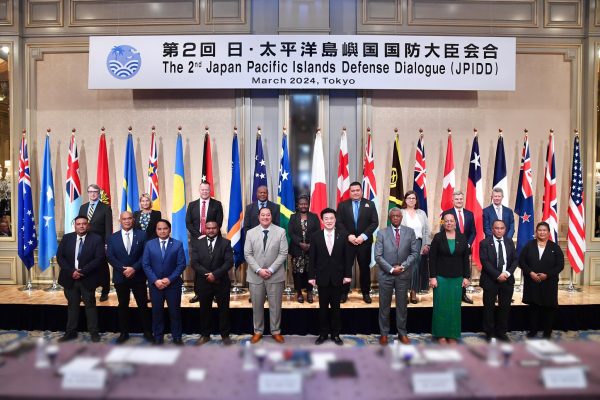
The Japan-Pacific Islands Defense Dialogue (JPIDD), initiated in 2021, proposed a “Cooperation Concept for United Security Efforts.” Official Security Assistance (OSA) now enables Japan to provide security-related equipment to Pacific partners.
Japan’s comparative advantages lie in political-economic stabilization and capacity building – infrastructure, disaster resilience, fisheries management, and climate adaptation – complementing U.S. deterrence by strengthening governance and economic resilience.
A Structured Partnership Framework
Washington should proactively invite Japan – and partners like Australia and Taiwan – into a structured division of labor: The United States anchors defense and high-end deterrence; Japan leads on infrastructure, renewable energy, sustainable fishery, digital connectivity, and capacity building for law enforcement and good governance.
This requires holding a dialogue on Micronesia in bilateral and minilateral platforms. Because of the Pacific Island countries’ determination to be a “friend to all,” partners should emphasize economic development, climate resilience, and social stabilization as intrinsic goods rather than framing cooperation solely as countering China.
The U.S. and Japanese governments should include a basic concept of “Japan-U.S. partnership in Micronesia” in the agenda for Japanese Prime Minister Takaichi Sanae’s upcoming visit to Washington. Then, based on the summitry declaration, both governments can advance the formulation of specific projects. This would involve identifying the local needs of Micronesia and the CNMI and synchronizing allies’ defense planning with economic and governance support through 2026-27.
This policy aligns with not only the Trump administration’s demand for allies to “assume responsibility for their regions and contribute far more to our collective defense” but also the Pacific Defense concept, which will be included in the upcoming review of Japan’s security and defense strategies.
The Path Forward
The defense of the FIC ultimately depends on the resilience of Micronesia’s communities, ports, and atolls. Economic resilience, governance capacity, and alliance coordination are essential components of deterrence itself.
The challenge is not a lack of U.S. commitment but inconsistent follow-through. Trump administration policies seeking to defend the FIC should be timely and realistic, but rhetoric and actions that ignore small nations’ voices – as well as his preoccupation with the Western Hemisphere – risk fostering anti-American sentiment in the Indo-Pacific. Solely emphasizing Micronesia’s strategic importance creates a vacuum that authoritarian states exploit through covert economic positioning targeting governance weaknesses.
Never before has Japan’s role been so crucial. The Trump administration’s call for allies to shoulder more regional responsibility aligns perfectly with enhancing Japan’s role in Micronesia. Secretary of State Marco Rubio just made it clear that “we do not want our allies to be shackled by guilt and shame.” Rather than dwelling on Japan’s mandate rule history or the United States’ exclusive monopolization of “war spoils,” both nations should view Micronesia as a frontier for coordinated, respectful partnership reinforcing a resilient Pacific order.





Comments (0)