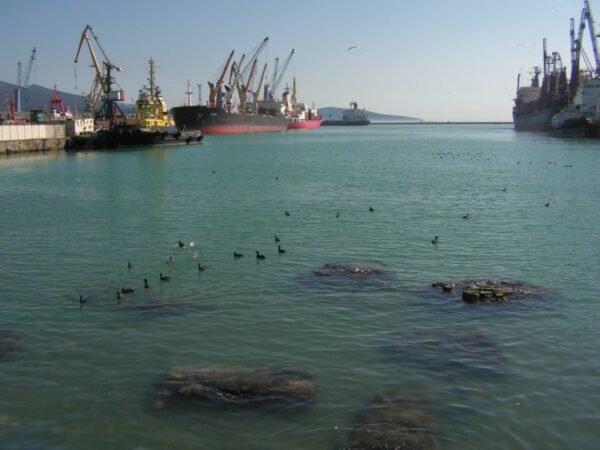
Days after Kazakh President Kassym-Jomart Tokayev traveled to Washington to participating the in inaugural meeting of U.S. President Donald Trump’s Board of Peace, the Ukrainian ambassador to the United States said that Kyiv had received a formal demarche from the United States related to its attacks on the Caspian Pipeline Consortium’s oil terminal at Novorossiysk, a Russian city on the Black Sea.
Ambassador Olga Stefanishyna, speaking on February 24 – the fourth anniversary of the Russia’s full-scale invasion of Ukraine – specified that the U.S. complaint cited the risks posed to “American investments which are being performed through Kazakhstan.”
Stefanishyna did not state when she received the demarche, but the timing of her comments – as the war enters its fifth year and just after the Kazakh president came through Washington for the second time in four months – can’t be missed.
Around 80 percent of Kazakhstan’s oil exports pass through the Caspian Pipeline Consortium, which connects to the global market through Russia’s Novorossiysk port. As an important node in Russia’s energy business, the CPC has become a target of Ukrainian strikes over the last few years.
Most recently, in January two oil tankers were the target of Ukrainian drone strikes. According to a Reuters, one of the vessels was scheduled to load oil from Tengizchevroil, while the other was scheduled to take on oil from the Karachaganak field.
Tengizchevroil is a joint venture between the American oil giants Chevron (50 percent), ExxonMobil (25 percent), Kazakhstan’s KazMunayGas (20 percent), and Russia’s Lukoil (5 percent.)
In November 2025, Kazakhstan issued a rare formal protest following a strike on the CPC, characterizing them as an “act of aggression against a purely civilian facility,” and warning that such strikes could damage relations with Ukraine.
They could also, apparently, damage relations with the United States.
Stefanishyna clarified that the U.S. demarche did not entail Kyiv halting attacks on “Russian military and energy infrastructure.” Instead, she said, “It was related to the very fact that American economic interest was affected there. We have taken the note on that.”
In response to Kazakhstan’s November rebuke, the Ukrainian Ministry of Foreign Affairs issued a statement stressing that its attacks targeted Russian interests.
“Ukraine is responding to the aggressor’s strikes and attacks,” the statement noted. It went on to essentially criticize Kazakhstan for staying silent in the face of Russian attacks Ukrainian civilian infrastructure.
Ukraine repeated that complaint in January 2026 when Russia claimed to have thwarted a Ukrainian drone attack on one of Russian President Vladimir Putin’s residences. Central Asian governments moved quickly to condemn an attack that hadn’t even happened.
“We believe that attempts to play along with Russian propaganda — driven by short-term interests in their current relations with Russia — run counter to the centuries-long history and traditions of the Central Asian nations in their own struggle for independence and self-determination,” the Ukrainian statement concluded.
Kazakhstan has made distinct efforts to align with Trump’s agendas, whether joining the Abraham Accords, signing on to the Board of Peace and even pledging to send troops to Gaza under the board. This growing closeness, in addition to the presence of U.S. companies in the CPC, may have motivated the demarche tendered to Ukraine.






Comments (0)