The Diplomat author Mercy Kuo regularly engages subject-matter experts, policy practitioners, and strategic thinkers across the globe for their diverse insights into U.S. Asia policy. This conversation with Dr. Maria Shagina – Diamond-Brown Senior Fellow for Economic Sanctions, Standards, and Strategy in the Geoeconomics and Strategy Program at the International Institute for Strategic Studies in London and author of “U.S. Critical Minerals Diplomacy: From America First Deals to Pax Silica” (IISS 2026) – is the 497th in “The Trans-Pacific View Insight Series.”
Explain the U.S. administration’s state-capitalist approach to U.S. critical minerals diplomacy.
The current U.S. administration has pivoted toward a state-capitalist framework for critical minerals diplomacy, characterized by a direct government role in steering investment, market outcomes, and supply chain architecture. This shift accelerated following Beijing’s April 2025 export controls, which signaled that global supply chains are no longer neutral and that market forces alone cannot mitigate the strategic leverage held by the adversary.
Unlike the reactive, crisis-driven interventions of the past, Washington now employs a proactive three-track strategy: prioritizing “America First” domestic projects through state-led deals, expanding bilateral agreements supported by government-backed finance, and spearheading the Pax Silica initiative to align capital, reserves, and processing expertise among allied nations. Central to this evolution is a new model of strategic partnerships with the private sector; rather than providing bottomless subsidies, the government uses targeted incentives to de-risk commercial ventures, effectively tethering private capital to national security objectives to ensure a resilient and reliable mineral supply.
Identify the key components of “America First” deals and bilateral dealmaking.
To secure critical mineral supply chains, the U.S. government has transitioned into an active market architect, leveraging tools such as accelerated permitting, direct equity stakes, offtake agreements, and price floors to stabilize volatile sectors. Domestically, “America First” deals aim to reshore production by centralizing decision-making within the White House and national security institutions, utilizing defense funding and initiatives like Project Vault – a state-led stockpiling mechanism – to de-risk projects that would otherwise struggle to attract private capital.
Internationally, bilateral dealmaking extends this logic by forging public-private partnerships and joint ventures that decouple supply chains from Chinese-controlled nodes. By deploying public finance institutions like EXIM and the DFC [Development Finance Corporation] to tie financing to strict offtake commitments and integrating these arrangements into broader foreign policy and security agendas, the administration ensures that both domestic capacity and global resource access are steered by strategic state priorities rather than market forces alone.
Examine the main objectives of the U.S.-led Pax Silica initiative vis-à-vis China-U.S. competition over critical minerals.
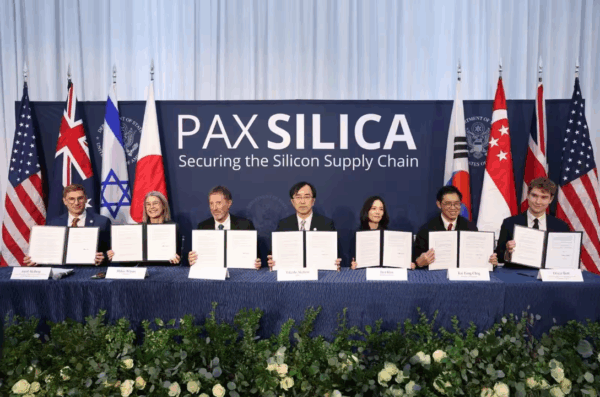
Pax Silica is best understood as an economic-security framework designed to build a full-spectrum ecosystem of secure and resilient supply chains required to compete in the AI era. Its objective is not limited to critical minerals alone, but spans what U.S. officials describe as “strategic stacks” of the global technology supply chain. These include software platforms, frontier AI models, connectivity and network infrastructure, semiconductors, advanced manufacturing, minerals refining and processing, and energy. In this architecture, critical minerals are one element – but a foundational one – because they underpin the hardware, infrastructure and energy systems that advanced technologies rely on.
Vis-à-vis China, Pax Silica seeks to reduce structural dependencies and dilute Beijing’s leverage across these interconnected layers. The logic is that leadership in AI and advanced technologies cannot be secured by controlling a single chokepoint; it requires coordination across the entire value chain. Pax Silica therefore aims to build a coalition of capabilities – to align allied capital, industrial capacity and technological innovation into a coordinated ecosystem that can rival China’s vertically integrated model.
However, its long-term success hinges on execution: Washington must sustain this global coalition while navigating the friction caused by unilateral tools like tariffs that can strain allied trust.
What is at stake for Pax Silica’s Indo-Pacific members – including Australia, Japan, Singapore, and South Korea – in joining this “coalition of capabilities” to secure supply chains?
For Indo-Pacific partners such as Australia, Japan, Singapore, and South Korea, Pax Silica represents a strategic trade-off between opportunity and constraint. On the opportunity side, participation anchors these countries more firmly in next-generation technology supply chains linked to AI, semiconductors, and advanced manufacturing. Access to U.S.-backed finance, long-term demand signals, and joint projects can strengthen their industrial bases and lock in roles as key suppliers of minerals, processing capacity, components, or high-value manufacturing. In a context of intensifying China-U.S. technology competition, being inside the coalition reduces the risk of exclusion from U.S.-centric technology ecosystems and can provide some collective insulation against Chinese coercion.
What is at stake, however, is not only economic gain but strategic positioning. Pax Silica implicitly pulls members closer to the U.S. technological and security orbit, which can narrow room for maneuver vis-à-vis China. For many Indo-Pacific states, China remains a top trading partner and a major source of demand. Deeper alignment with a U.S.-led supply-chain bloc therefore raises exposure to political or commercial retaliation from Beijing.
The stakes, then, are dual – securing a place in future AI-driven value chains while managing the geopolitical and economic risks that come with tighter alignment.
Assess the risks and rewards of Pax Silica for all contributing states in hedging against unpredictable U.S. leadership.
Pax Silica offers tangible rewards for participating states. It spreads risk in volatile commodity markets, enables cost-sharing in capital-intensive projects and creates a collective shield vis-à-vis China. Participants can access finance, technology and guaranteed demand that might otherwise be unavailable. Over time, this can translate into more secure and diversified supply chains and a stronger industrial base among members.
Yet the initiative also carries structural risks. The initiative is inherently hierarchical, with Washington acting as the primary architect – defining priorities and calibrating access. Partners are often relegated to “capability nodes” tasked with specific functions like resource extraction or high-end manufacturing. Support is often conditional on alignment with U.S. national security expectations, which may change with domestic political shifts. Opaque deal structures and political linkages can complicate long-term planning. Conflicting tools such as the renewed tariff threats risk undermining Pax Silica’s coalition-building process. The initiative’s durability will depend on whether participants view it as a stable framework rather than a transactional instrument tied to short-term political objectives.







Comments (0)