On February 18, 2026, the Peruvian Congress censured and removed transitional President Jose Jeri and replaced him with Jose Maria Balcazar, a lawyer expelled in 2024 by Peru’s legal association with a long list of corruption allegations against him and controversial for his public advocacy of child marriage and sexual relations by teachers and other adults with minors.
Balcazar is a member of the far-left Peru Libre party, which is tied to Cuba-trained communist Vladimir Cerron, who is wanted by Peru for corruption, and former President Pedro Castillo, who was jailed for trying to dissolve Peru’s Congress.
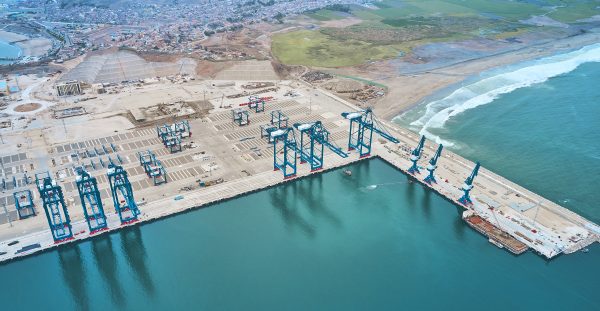
The appointment of Balcazar by Peru’s Congress came only a week after another critical event that received less international attention: a finding by a Peruvian court that, pursuant to a change by the government to its own laws in 2024, the nation’s investment oversight organization, Ositran, had no legal authority to oversee the Port of Chancay, operated under the exclusive control of China’s state-owned logistics giant COSCO.
These two otherwise unrelated events highlight a significant strategic risk in Peru for the United States and the region. Despite a sincere commitment by most Peruvians to the contrary, in time of war, the Port of Chancay could be used to resupply Chinese People’s Liberation Army Navy (PLAN) warships operating in the Eastern Pacific, presenting a direct threat to the U.S. homeland, as well as to the militaries of U.S.-aligned neighboring countries. In the context of a major war in the Indo-Pacific, a political crisis in Peru could create a situation where the Peruvian Armed Forces lack the knowledge, or clear mandate, to stop COSCO from using the port that it exclusively controls for anti-U.S. military purposes.
For over 17 years, I have had the privilege to interact with Peru’s Armed Forces in different capacities. I have been impressed by their professionalism and their commitment to remain apolitical in political crises and to follow the orders of the nation’s civilian leaders. That is a very good thing, but it is ironically also part of the present grave risk.
Among those Peruvian officers whom I consider colleagues and friends, none would knowingly support allowing the Chinese to use Chancay for military action against the United States, and many would find speculation that could occur to be a professional affront. Yet the risk has nothing to do with their intentions and is actually magnified by their professionalism and democratic commitment.
The real possibility of the PLAN exploiting Chancay against the United States in time of war comes from the near absolute physical control of Chancay operations by COSCO, in combination with a Peruvian system in which a highly transactional Congress can – and frequently does – remove Presidents. Jose Maria Balcazar is Peru’s ninth president in 10 years. The removal of Jose Jeri, as a transitional president, required only a majority vote of the unicameral legislature, although the move to a bicameral body this July will make it somewhat more difficult to remove a president.
Still, votes in Peru’s Congress are notably subject to a negotiation of future benefits – and some would say “purchase” – rather than matters of party ideology or principle. For the leftist Balcazar to obtain the 64 votes that elected him president by secret ballot, when the Peruvian left has only about 40 members in the 130-member body, required some of the Congress’ most right-wing members to vote for him. Their possible motives have received much speculation in Peru.
This dynamic suggests that in a future conflict, Beijing may be able to influence who is president in Peru – the extent to which China is able to use Peru as a platform to enable their military operations.
In fact, China is deeply entrenched in Peru, not only through investment in the port, mining, telecommunication and other sectors, but also through networks of personal influence. Peruvian Congresspersons regularly travel to China as guests of the the Chinese state.
More concerning is China’s regular involvement in corruption involving Peruvian government personnel and politicians. A widespread bribery racket for winning infrastructure projects in Peru was known as the “China Construction Club.” A $20,000 sack of cash that was found in the bathroom of the Presidential Palace, leading to the downfall of prior President Pedro Castillo, was believed to be tied to China-based companies.
The most recent high-level scandal, called “Chifagate” (an allusion to Chinese-Peruvian cuisine) caught Jeri on camera, disguised in a hooded sweatshirt and holding a secret meeting with Chinese businessman Zhihua Yang, who has links to China’s government.
The combination of political instability and penetration of Beijing’s influence into Peru’s economy and politics makes it entirely plausible that Chinese money and other influence could secure enough votes in Peru’s Congress to fabricate a government crisis concurrent with a war in the Indo-Pacific. In the combined uncertainty of war and paralysis of Peru’s government, without significant Peruvian on-site supervision of the Port of Chancay and its associated logistics yard, it may not be immediately clear if COSCO or other China-based shipping companies are smuggling containers of missiles, ordinance, or other military supplies into the port, staging them to support China’s military activities elsewhere in the region.
Even if the U.S. or Peru’s intelligence service, DINI, tells its government about such operations, a China-friendly, U.S.-skeptical interim president, elected during the crisis by a seemingly legitimate processes, could command the military not to act and stop suspected COSCO military use of Chancay.
In a situation of ambiguity, it would be tempting for the military to refrain from acting, to avoid disobeying a plausibly legitimate civilian president – even if doing so facilitated PLAN resupply from Chancay, ultimately costing U.S. lives and attacks on the U.S. homeland.
The United States has made clear that it will act to deny the presence of extra-hemispheric actors such as China in infrastructure that could be exploited against the U.S. in time of war. The new U.S. National Security Strategy states, “We want a hemisphere that remains free of hostile incursion or ownership of key assets.” The National Defense Strategy vows to “restore American military dominance in the Western Hemisphere… [and] deny adversaries’ ability to position forces or other threatening capabilities in our hemisphere.” This is also made clear by the United States’ recent actions in Venezuela and the Caribbean, and in its attention to the Panama Canal,
Peru’s government does not necessarily have to forgo Chinese investment or expel COSCO from the Port of Chancay. Rather, in the context of such risks, it is reasonable to expect whoever occupies Peru’s next government – or the next ten governments – to work in good faith to ensure that the country has adequate presence and control to exercise national sovereignty over Chancay. Peru must be ready to comply with the nation’s obligations – which are also a matter of “due diligence” in international law – to ensure that its territory is not exploited by China against Peru’s partners in time of war.


Comments (0)