
Remember me








Summary: User panels can deteriorate in predictable ways, introducing bias and reducing their effectiveness for ongoing research.
Internal research panels are often seen as a perfect solution to the participant-recruiting challenges. And in many cases, they are. Well-designed panels can accelerate studies, save money, and yield higher-quality participants. However, managing a panel requires ongoing effort beyond initial setup.
This article discusses how and why participant panels deteriorate and how to prevent it.
Failure 1: The Static-Database ProblemA panel is more than a list of potential participants; this list needs to be continuously updated and refreshed – otherwise it becomes stale, and the panel loses effectiveness over time.
Panels often generate enthusiasm when they are first created, but lose momentum over time. As a result, necessary panel-maintenance tasks get neglected.
When that happens, researchers have to rely on additional screening because they no longer fully trust the data on file. All of a sudden, the panel isn’t saving as much time.
Healthy panels assign explicit responsibility for:
Maintaining participant data Reviewing response rates Refreshing segments on a regular cadenceEven a quarterly audit of participation patterns or outdated attributes can prevent that slow decay.
Failure 2: Panel-Sampling BiasCustomers who join company panels often have an affinity towards the company and its products. They can positively skew the feedback that you gather through a study.
For example, participants who are highly engaged with your brand may know too much about your product, or be too close to your “ideal” customer, preventing you from studying new users or edge cases. Their feedback, while valuable, is not neutral and can create an echo chamber that amplifies positive perspectives while overshadowing those from new users, churned customers, or those who rarely engage.
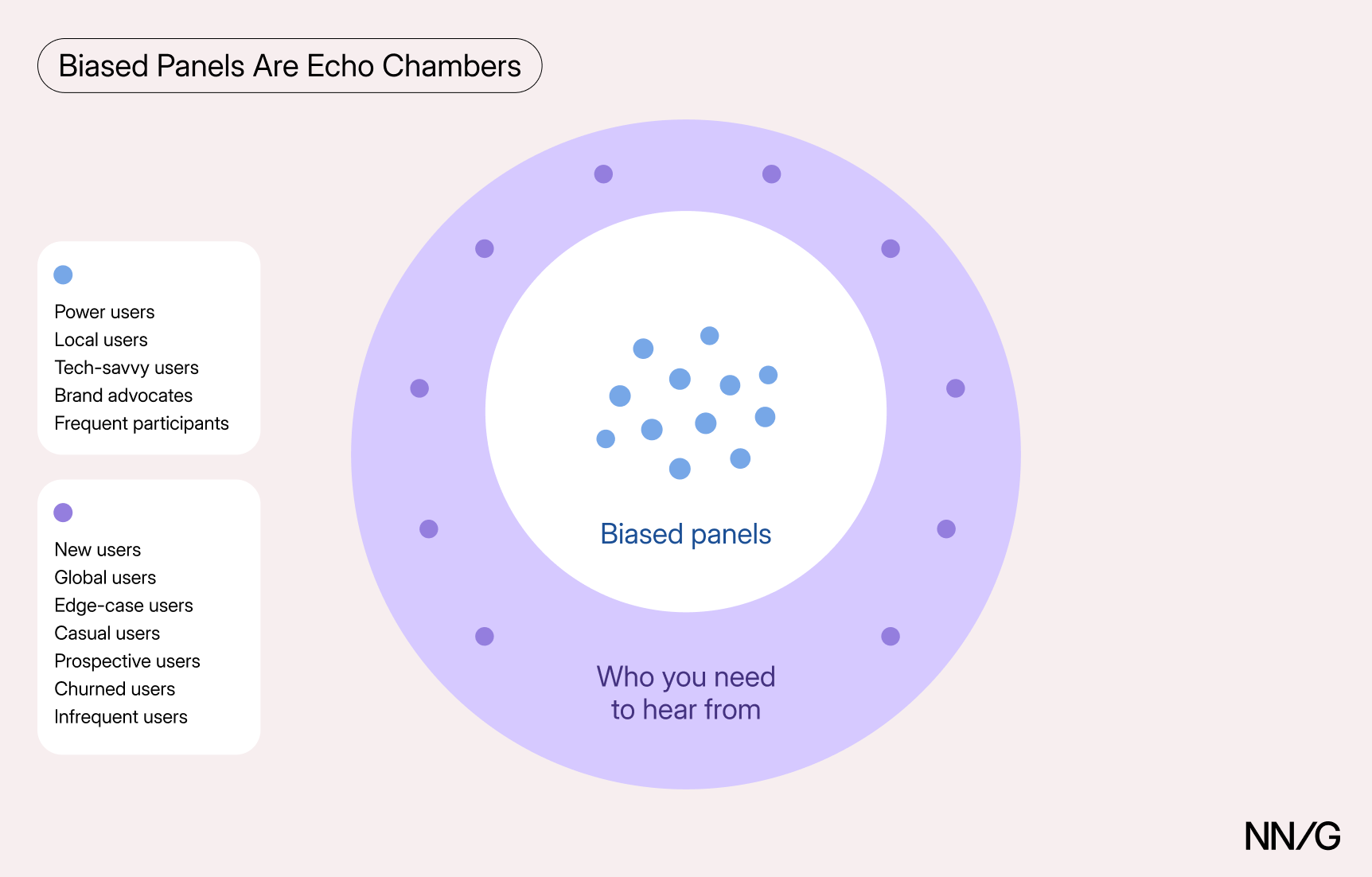 Convenience sampling can slowly reshape a panel’s composition, amplifying loyalty and familiarity while reducing diversity of perspective.
Clear rotation practices and contact-frequency guidelines reduce this risk. Tracking participation history, setting soft limits on study frequency, and occasionally recruiting with methods beyond the panel help preserve representation.
Failure 3: Deviation from Business RealitiesPanels are not static assets. As companies expand into new markets, introduce new products, or shift customer segments, the panel must grow and evolve with them. When it doesn’t, it reflects yesterday’s audience. For example, a company expanding internationally may still rely primarily on participants from its original domestic base. A product moving from small businesses to enterprise clients may continue studying long-time power users rather than procurement stakeholders or administrators. When it’s time to do recruiting, these audiences can’t be found.
Panels reflect the moment in which they were built. Without periodic strategic review, they slowly drift out of alignment with evolving product priorities. Panel managers need to continuously audit whether new markets, personas, or lifecycle stages are represented and adjust recruitment efforts accordingly.
Self-Diagnose Your PanelPanel breakdown rarely happens all at once. More often, small warning signs accumulate until confidence in the system erodes.
The table below outlines common symptoms, what they often indicate, and the underlying structural issues that typically drive them.
Symptom
What It Signals
Possible Root Cause
Declining response rates
Participants are disengaged, or outreach is poorly targeted.
Failure 1: Static database
Repetitive or overly positive insights
Narrow perspectives dominate feedback.
Failure 2: Panel- sampling bias
Difficulty finding matches for your screening requirements
The panel was never expanded to match business growth.
Failure 3: Deviation from business realities
ConclusionPanels deteriorate for predictable reasons. Fortunately, they stay healthy for predictable reasons as well. They require active ownership, governance, and regular monitoring and maintenance.
The presence of a panel is not what signals maturity. The discipline with which it is managed does. When teams treat panels as long-term systems rather than short-term recruiting shortcuts, they protect the integrity of the research that follows.
Sign Up for the NN/G UX-Practitioner Research PanelWe have our own panel! If you’re interested in contributing to future NN/g research with UX practitioners, you can join our participant community. Your input helps shape the guidance and frameworks we create for the UX field. If you are interested in participating in research with us in the future, please sign up here.
Comments (0)