
Remember me





Summary: Information seeking in China is driven by mobile social-media apps. But how users prompt and engage with genAI mirrors what we've seen in the West.
Our recent research on information-seeking behavior found that generative AI (genAI) is meaningfully reshaping how people search — cutting through the friction of keyword foraging, accelerating habit change, and exposing a wide spectrum of AI literacy among everyday users. But those studies focused mainly on English-speaking participants from North America. A natural question follows: do these patterns hold elsewhere?
To find out, we conducted a remote study with 6 participants in China. Our sample included a mix of ages, occupations, locations, and levels of familiarity with AI. We found that the patterns we documented in the West — how people prompt, which genAI outputs they trust, and how AI literacy shapes their experience — also showed up consistently in China. But the way those patterns play out looks quite different, shaped by a mobile-first culture and a much stronger reliance on social platforms over search.
How Information Seeking Differs in China vs. North AmericaChina's information-seeking ecosystem looks quite different from the West. Many search engines and genAI apps used in the West are not available in China.
In China, Baidu is the dominant search engine, though usage has dipped in recent years. (Publicly available stats show that Baidu’s market share has steadily dropped from 85% in Dec 2021 to just over 50% in recent months.)
On the genAI side, major Western tools like ChatGPT, Claude, and Gemini are unavailable, so users rely on a range of homegrown alternatives, most notably DeepSeek and Doubao. Finally, social media apps play a large role in information seeking. In our study, many participants used apps like Douyin (the Chinese version of TikTok) and Rednote, a photo and discussion-based platform that sits somewhere between Instagram and Reddit.
The table below highlights the apps that were used by participants in this study.
Search engines
Baidu
GenAI chatbots
DeepSeek (first Chinese genAI model)
Doubao
Qwen Yuanbao
Social apps
Douyin (Chinese TikTok)
Kuai (main competitor of Douyin)
Rednote (photo and community-sharing app)
Bilibili (Chinese YouTube)
To illustrate how these apps were used together, here’s the information-seeking process of a 23-year-old study participant who planned his upcoming vacation to the ancient Chinese town of Wuzhen.
He first came across short videos of the town on Douyin, which sparked his interest. He then used Baidu (the search engine) to find out where it was, before switching to Deepseek to plan a rough itinerary, determine how many days to spend, and get a sense of his budget. Throughout the process, he jumped to Rednote multiple times to check posts about Wuzhen — a hand-drawn map of must-sees, photos of local food he'd heard about from Deepseek, pictures of nearby attractions he could fold into the same trip. The entire process happened on his phone.
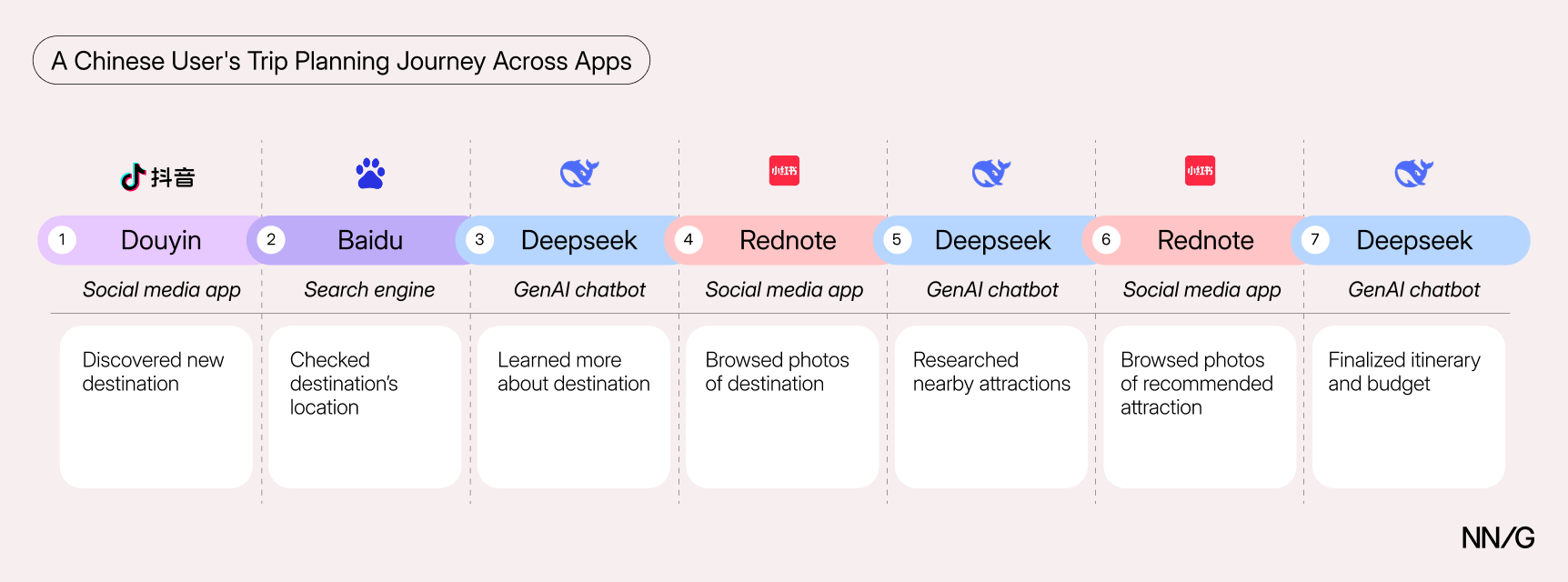 Information seeking in action: one study participant's trip-planning journey reconstructed across platforms, from a social-channel discovery (Douyin) to a finalized itinerary on the genAI chatbot Deepseek.
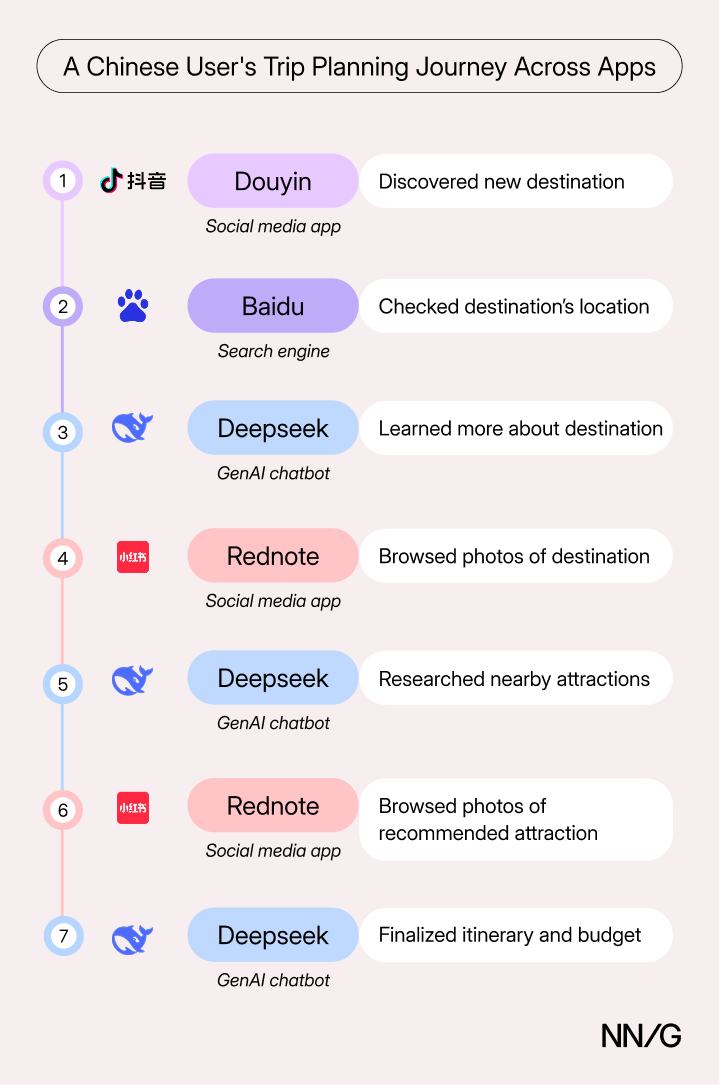 Information seeking in action: one study participant's trip-planning journey reconstructed across platforms, from a social-channel discovery (Douyin) to a finalized itinerary on the genAI chatbot Deepseek.
This single session captured the key patterns we observed consistently across our China study. First, information seeking happened entirely on mobile: all our participants chose to use their phones for their information-seeking tasks. This behavior mirrors findings from our previous ecommerce studies with Chinese users and data from the China Internet Network Information Center, which shows that 99.7% of internet users in China access the web via their phones. Desktop use, when it occurs, tends to be a reluctant concession to the workplace rather than a genuine preference.
Second, search played a minor role; instead, users relied on a mixture of genAI and social apps, which were used to validate and delve deeper into information acquired from genAI chatbots.
Want more world-wide AI design guidelnes? Why Chinese Users Are Abandoning SearchIn our study, very few participants used search engines such as Baidu during their information-seeking tasks, even when looking up a simple fact, such as “How tall is Eileen Gu?” When users did use them, it was because they didn’t trust AI or because they wanted to quickly check a fact. This differed from our Western study, where Google remained the go-to tool for validating genAI results.
Part of what's driven Chinese users toward genAI and social apps is a growing frustration with the amount of promoted content on Baidu. Five of our 6 participants complained that Baidu was full of ads. As a participant commented,
“In recent years, no matter what I searched [on Baidu], the results were mostly ads. I was fooled by them and clicked on them a few times, but not anymore. Now I generally use Deepseek because it’s more efficient.”
While promoted content also exists on social apps, Baidu ads often take up so much real estate that users need to scroll multiple times to find organic search results.
In our study, the participant searching for travel information about Wuzhen encountered four screens of promoted results before reaching a single piece of organic content. He scrolled through briefly, concluded it wasn't worth his time, and switched to Deepseek instead.
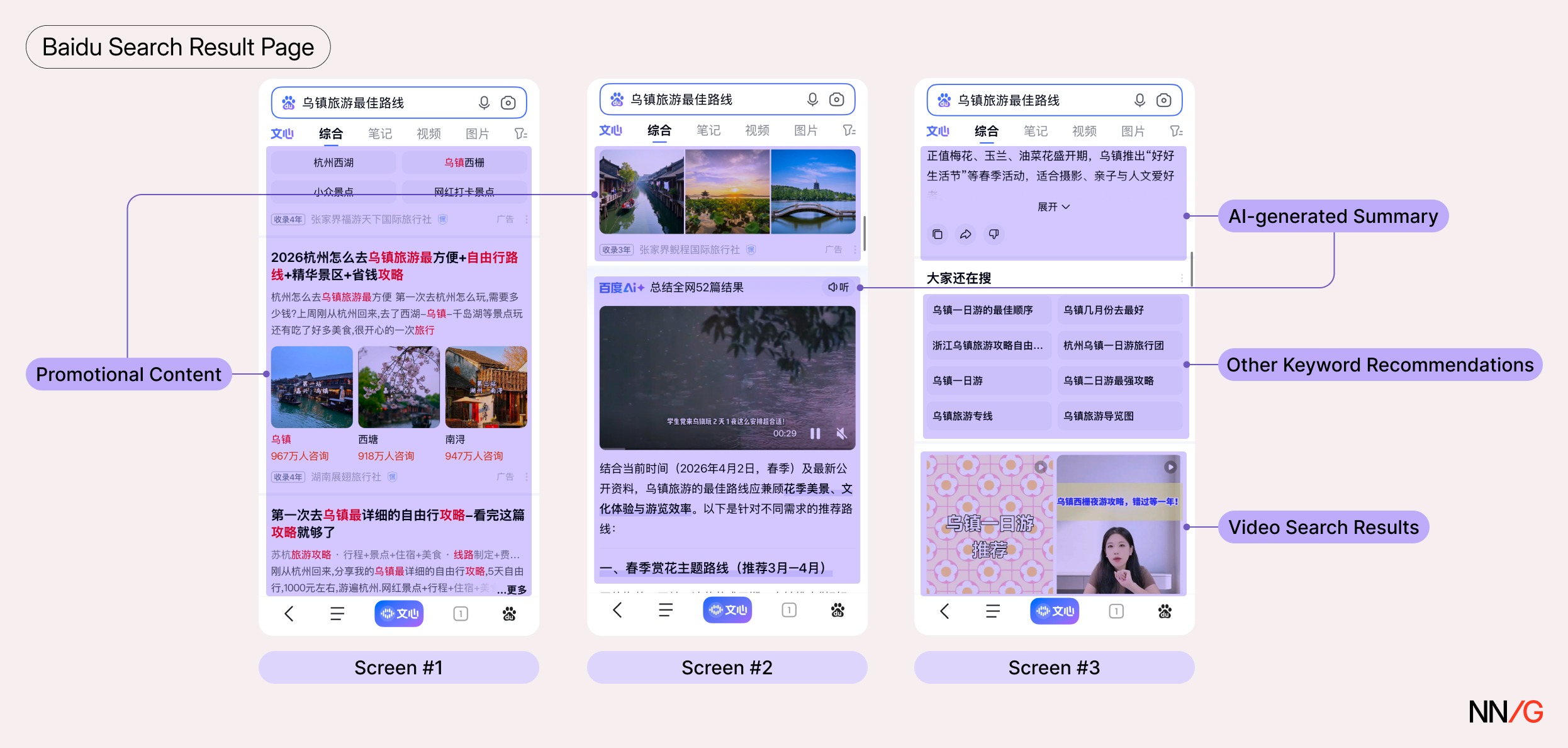
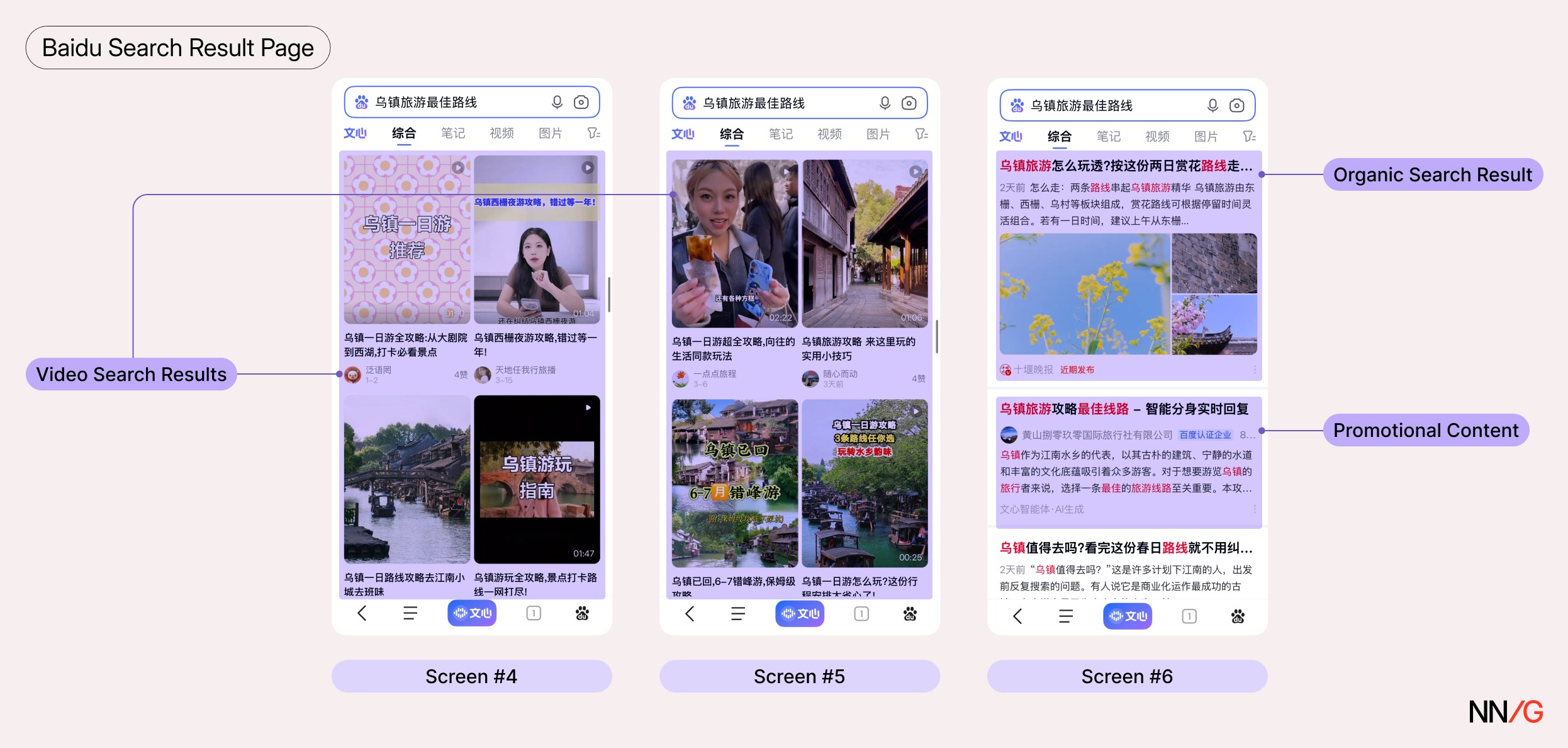 The first few screens of Baidu’s search results for best travel itinerary for Wuzhen included mostly promotional content. With extended results like AI-generated summary and video-search results, the first organic search result showed up on the 6th screen.
Our participant didn't try another search engine — he abandoned search instead. Chinese users have tolerated ad-heavy experiences for years because search engines were the only efficient option available. Now that genAI offers a convenient alternative, that tolerance has evaporated.
Social Apps Over Search for Validating GenAI ResultsIn our previous study with North American participants, users frequently paired genAI with other sources to validate results — building confidence before committing to a decision. Search engines were the most common crosscheck tool. Our Chinese participants also started with genAI, then turned to other sources to validate what they'd found. But instead of relying on search engines for validation, Chinese participants consistently resorted to social apps, where people post photos or videos about everything from food and products to lifestyles and tourist spots.
In many tasks, users wanted to know what others thought. Would this work for a real person?
For example, one participant researched how to clean a stained white hoodie. She started with a genAI chatbot (Qwen), which offered several possible methods. But she wanted more than a list of suggestions — she wanted to see real outcomes. She went to Rednote, where she could see before-and-after photos from real people. When asked why she went to Rednote, she said:
"I actually found things like life hacks on Rednote more reliable (...) because there are so many other people on Rednote and I can see the outcomes of the methods they shared."
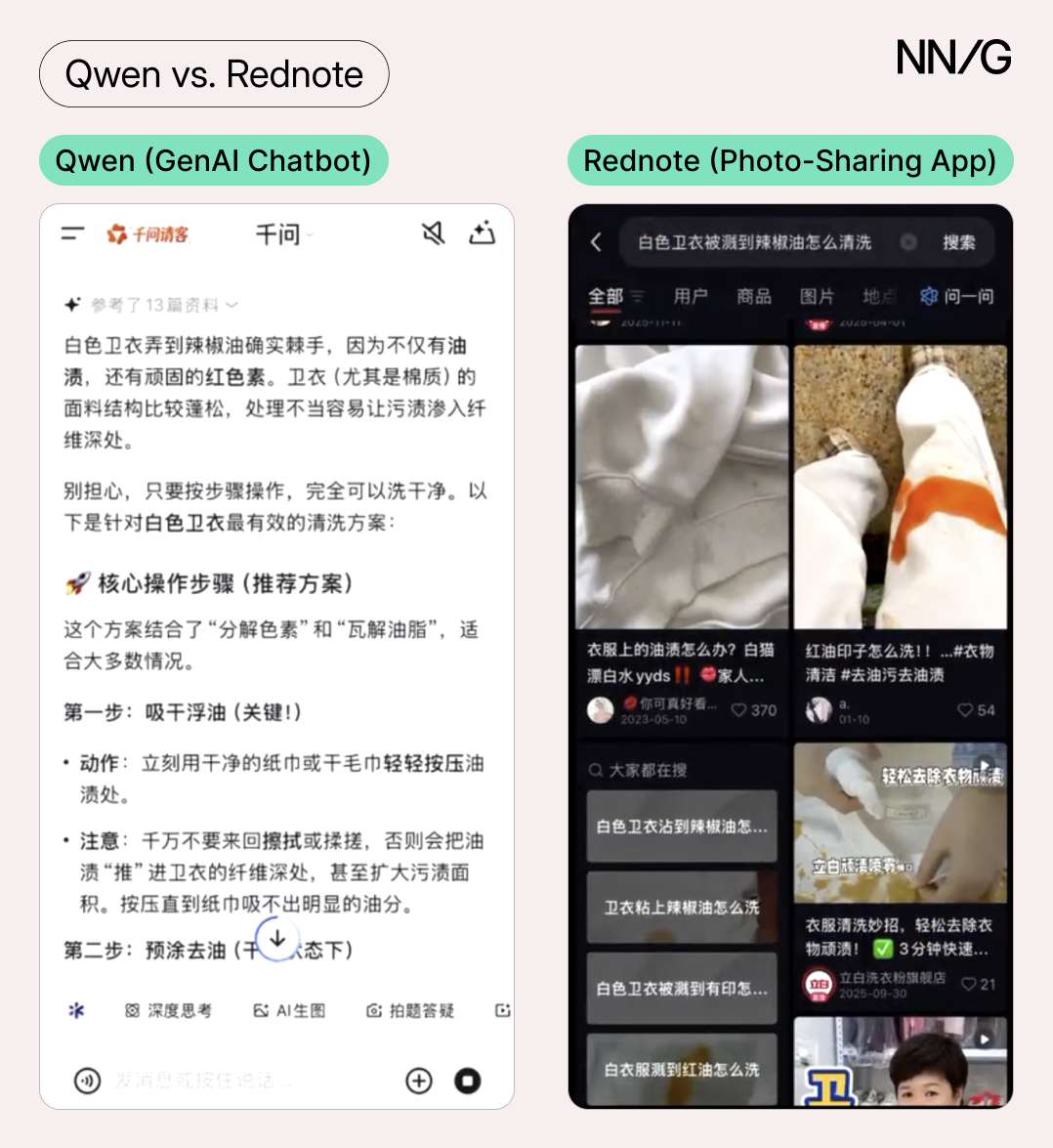 Responses from genAI like Qwen (left) are typically in plain text; a study participant preferred seeing before-and-after photos on Rednote (right) when learning how to remove oil stains from white clothes.
This behavior has a cultural dimension worth acknowledging. Unlike the US, China is a collectivist society, and other people's experiences carry particular weight in decision making; they're not just useful anecdotes, they're a form of trusted shared knowledge. Social apps don't just supplement the research process in China; they validate it.
In our study, participants frequently turned to social apps, such as Rednote, Douyin, and Bilibili, to learn about other people’s experiences or to see the things they were interested in documented by others.
Similar Behaviors and Literacy PatternsWhile our Chinese users chose to use different devices and apps in the information-seeking process, the way they used genAI chatbots mirrored patterns we've documented in our studies with English-speaking users.
In our study, we had participants at various AI-literacy stages. Like in our studies with Western participants, those with high prompt fluency wrote detailed, context-rich prompts and actively shaped the conversation; they followed up on partial answers, replying to the chatbot's suggested followup questions, and iterating until they got what they needed.
In contrast, our 2 participants with low prompt fluency typed short phrases and keywords, treating the chatbot like a search engine — the same behavior we saw in our North American studies. They rarely followed up, and when the first response fell short, they were more likely to give up on the tool entirely.
For instance, a participant who had never used genAI apps used the same keywords from a Douyin search to prompt the genAI chatbot in Qunar (a travel-booking app) to plan a trip.
Prompt: Nanjing Fuzimiao one-day trip recommendation
Since his prompt lacked context, the answer was generic and unhelpful, so he told us he wouldn’t use it again.
Trust patterns were also consistent. Some participants displayed the same unquestioningl trust we've observed elsewhere — assuming that, because genAI draws from vast amounts of data, it must be accurate. As one participant put it, "It's big data, so it doesn't make mistakes." These users rarely questioned or verified AI-generated answers.
Meanwhile, expert users treated genAI outputs as a starting point rather than a final answer. They crosschecked results against social apps like Rednote or ran the same query through a second chatbot to see if the answers aligned — the same cross-validation behavior we've observed among expert users in other countries.
For example, one participant shared that she would ask across multiple genAI apps for high-stakes tasks.
“The last time I did so [cross-validate with multiple genAI apps] was to check if the insurance company could prepay medical expenses in car accidents instead of relying on ad-hoc hospital-bill statements, and all AI models confirmed that this worked. And that’s why I went on with that approach.”
People Still Don't Think of AI as Human — with One Interesting ExceptionFinally, Chinese participants generally did not anthropomorphize genAI chatbots. They treated them as tools, not conversational partners.
One small but interesting exception stood out, though. We observed one participant address the genAI chatbot, Doubao, by name when he started a new conversation. He typed:
Prompt: Doubao, I want to start working out. Do you have any advice?
Doubao's design probably plays a role: its app icon features a cartoonish female character, making it feel more like a personal assistant — think Siri or Alexa — than a chatbot.
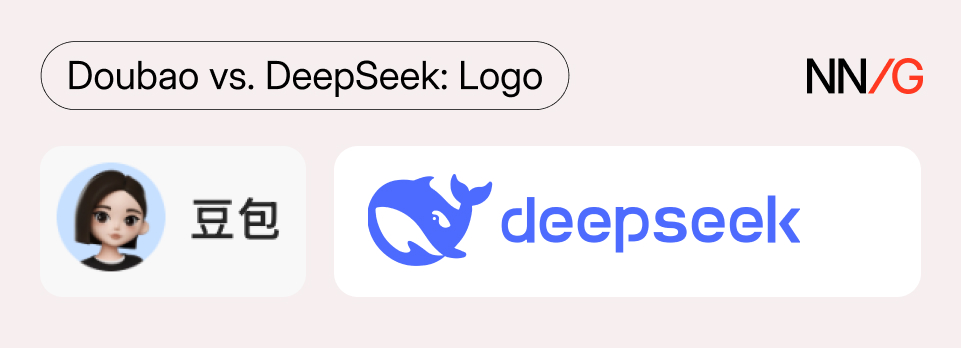 Doubao’s icon (left) is a cartoonish female character. Participants used its name before making their request. This didn’t happen with Deepseek (right), whose icon was a blue whale.
The other factor may be cultural: viral videos on Chinese social media show people video-calling Doubao for outfit recommendations and addressing it by name — a pattern that could normalize this kind of interaction for everyday users.
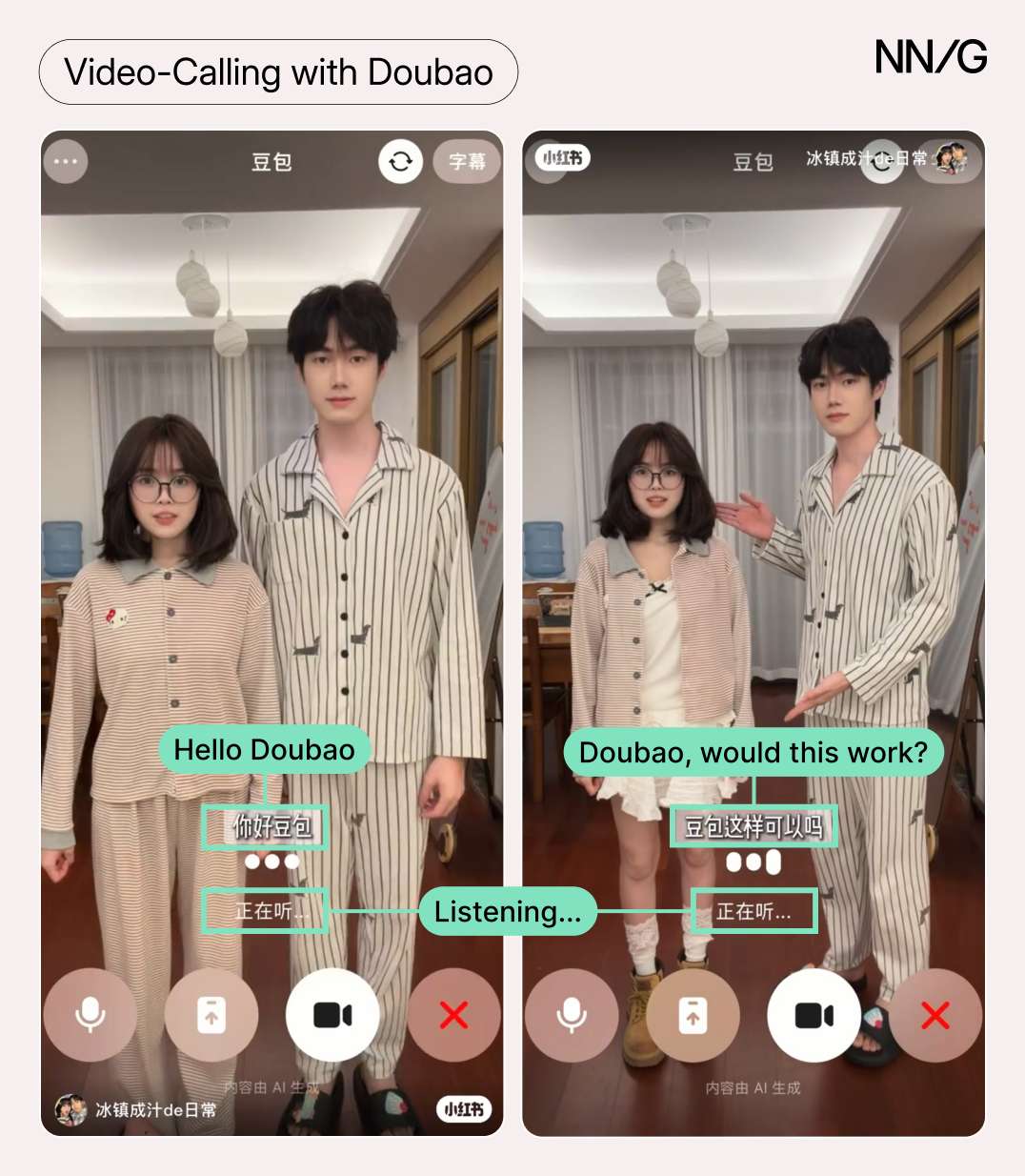 An example of a viral video on Rednote: A couple calls Doubao, the genAI chatbot, to get feedback on an outfit.
Popular GenAI Chatbots in China
An example of a viral video on Rednote: A couple calls Doubao, the genAI chatbot, to get feedback on an outfit.
Popular GenAI Chatbots in China
Chinese users have developed strong preferences across a range of homegrown genAI apps. And much like we observed in the West — where early familiarity with ChatGPT or Gemini often drove continued use — early habit played a significant role here, too. DeepSeek and Doubao were the most commonly used tools among our participants, largely because they were the first genAI chatbots on the scene.
But early exposure isn't the whole story. In a market with several capable, free options, functional differentiation matters. For example, Doubao had become the go-to app for anything image-related. Four of our participants, who had all tried multiple genAI apps, reported they would use Doubao for image-related tasks because it better recognizes text in images and allows users to annotate specific parts of an image.
For instance, a participant took a photo of the task instructions we gave him and sent it to genAI for help, because he didn’t want to type or dictate the question. He mentioned he used this feature a lot in his daily life, such as when his daughter asked him a math problem. Doubao allowed him to circle the exact part of the image that he needed help with (for example, one specific problem out of a list) –– a feature he failed to find or discover on other genAI chatbots.
Another participant, a doctor pursuing a higher degree, used both Doubao and DeepSeek in his daily information-seeking tasks. However, he preferred Doubao for imagery-related tasks. When he needed to answer medical-exam questions from a textbook, he would take a photo of the question in the Doubao app. He found this easier than typing the question into the DeepSeek chat.
Perceptions Shaped by the Parent Company’s Brand ImageFinally, some of our participants chose or stuck with a particular genAI tool because of their perception of the parent company's brand.
For instance, one study participant preferred using Doubao (created by ByteDance, the same company who owned Douyin, the Chinese equivalent to TikTok) because he thought ByteDance had access to more data, since it owned Douyin. He argued,
“After all, it’s a Douyin company. Compared to other apps, I think it has access to a lot more data (...) I think the size of the databases integrated into Douyin is far larger than the databases other apps can use.”
Another participant trusted Qwen more because she had been using other products from Alibaba (Qwen's parent company) and considered it a reliable brand.
This captures a familiar behavior we’ve observed over many ecommerce studies: users don't evaluate a product in isolation — they evaluate it as part of a broader brand relationship. Trust and reputation built in one context transfer naturally to another, even when the products themselves are quite different.
ConclusionOn the surface, China's information-seeking landscape looks quite different from the North American one: mobile-first, app-centric, powered by local genAI chatbots, and deeply intertwined with social platforms like Rednote and Douyin. Traditional search engines like Baidu have lost significant ground — pushed out not just by better alternatives, but by a degraded experience that finally exhausted users' patience.
Despite these differences, how users engaged with genAI in the information-seeking process was consistent with what we’ve seen in studies with North American participants. For example, people treat genAI as a tool; some struggle with the same prompt-articulation challenges and overtrust genAI outputs, while others crosscheck genAI results using other platforms.
Regardless of the market, information seeking is becoming increasingly distributed. In China, we observed users moving fluidly between genAI and social apps, turning to each for what it does best — broad synthesis from genAI, real human experience from social platforms. The specific tools vary by market, but the underlying pattern of users assembling information from multiple sources, rather than relying on a single channel, is worth paying attention to.
If you design for East Asian audiences, pay attention to the ecosystem, not just the product. Your users are likely mobile-first, moving fluidly between genAI chatbots and social apps rather than relying on search engines. Peer-generated content on platforms like Rednote and Douyin may carry more weight than your own marketing — meeting users where they already are means investing in those spaces.
For designers working beyond Western audiences, the broader lesson is this: understanding how people interact with AI provides a foundation, but it doesn't tell the whole story. The devices people reach for, the platforms they trust, and the cultural factors that shape how they seek validation from others are just as important. China is a vivid example of how much that context can differ, even when the underlying behavior is familiar.
Comments (0)