
Remember me




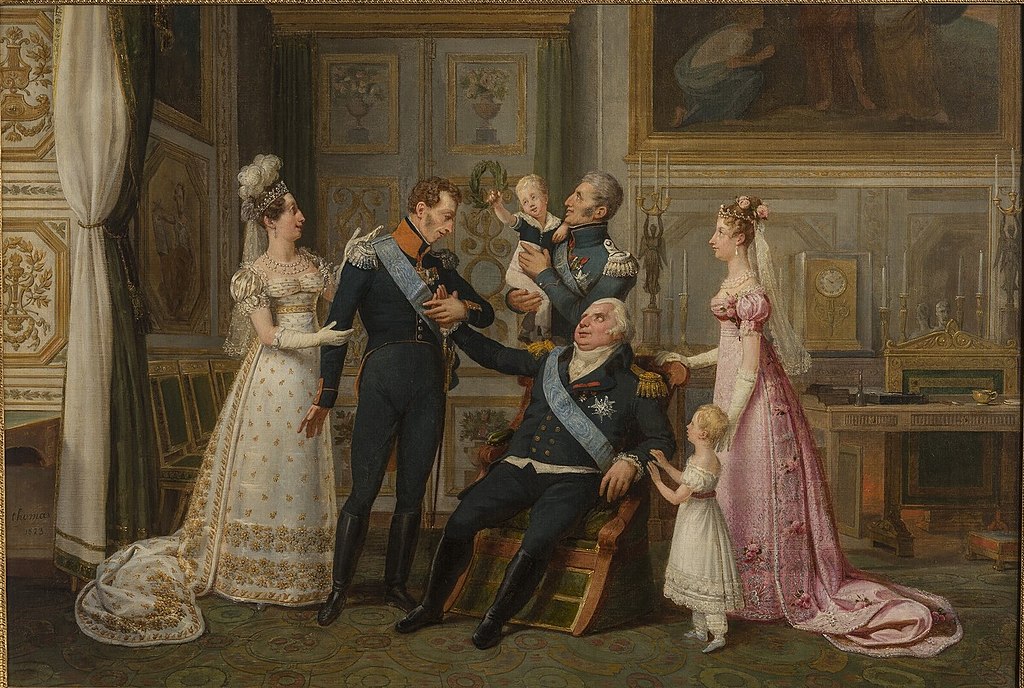

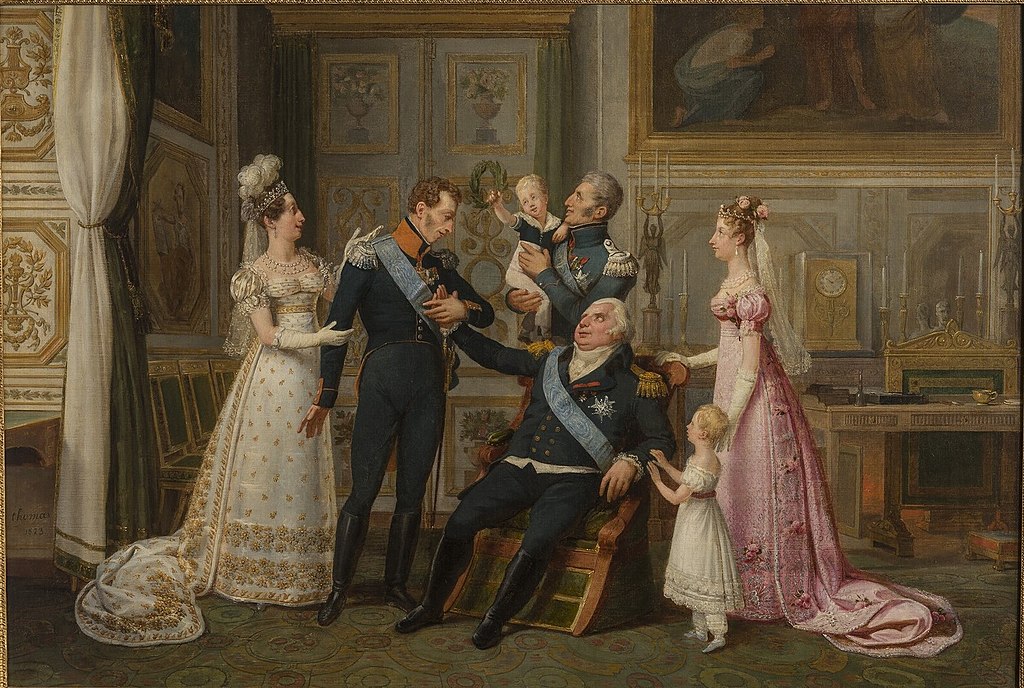
Antoine-Jean-Baptiste Thomas, Louis XVIII Receiving the Duc d’Angoulême on His Return from the Spanish Campaign, December 2, 1823, 1823, oil on canvas, 30.1 x 42.7″. Public domain, via Wikimedia Commons.
François-René de Chateaubriand (1768–1848) was born in Saint-Malo, on the northern coast of Brittany, the youngest son of an aristocratic family. After an isolated adolescence spent largely in his father’s castle, he moved to Paris not long before the French Revolution. In 1791, he sailed for America but quickly returned to his home country, where he was wounded as a counterrevolutionary soldier, and then emigrated to England. The novellas Atala and René, published shortly after his return to France in 1800, made him a literary celebrity and brought him to the attention of Napoleon—a leader whom he at first admired and then, once he saw the dark side of his despotism, came to despise and criticize in print. In the excerpts below, from the third volume of his Memoirs from Beyond the Grave, Chateaubriand recalls the arrival of yet another new political order in the form of the Bourbon Restoration. He had long advocated restoring the Bourbons to power, but the reality of their rule—above all the continued suppression of civil rights and government censorship of the free press—incurred Chateaubriand’s wrath.
—Alex Andriesse
CHANGING OF THE WORLD
Paris, 1839
To descend from Bonaparte and the Empire into what followed is to descend from a mountain into an abyss. Didn’t everything end with Napoleon? Should I even speak of anything else? What character can be as interesting as he? Who and what are worth considering after such a man? Only Dante had the right to associate with the great poets he met in the regions of the other world. How can I be expected to speak of Louis XVIII in lieu of the emperor? I blush to think that I am now obliged to drone on about a throng of scrawny creatures, to whose species I belong—dubious nocturnal beings who played their parts on a stage from which broad daylight had fled.
The Bonapartists themselves had withered. Their limbs had shriveled and shrunk. No sooner did Bonaparte withdraw his breath than the soul went out of the new universe. Objects faded the moment that the source of their light, which had given them depth and color, disappeared. At the start of these Memoirs I had to speak only of myself, and, you might say, there is always a sort of primacy in man’s individual solitude. Later I was surrounded by miracles, and these miracles gave me a reason to sing. But now there will be no more conquest of Egypt, no more battles of Marengo, Austerlitz, and Jena, no retreat from Russia, no invasion of France, no taking of Paris, no return from the Isle of Elba, no Waterloo, and no funeral on Saint Helena. What will there be then? Portraits that only Molière could lend the gravity of comedy!
In writing about our worthlessness, I have examined my conscience closely. I have asked myself whether I was not slyly enrolling myself in the nullity of these times in order to claim the right to condemn others, persuaded though I was in petto that my name would remain legible amid a welter of erasures. But no, I am convinced that we will all vanish—first, because we are not vital enough; second, because the age in which we begin or end our days is itself not vital enough to warrant our survival. Generations mutilated, exhausted, disdainful, and faithless, vowed to the nothingness they adore, cannot bestow immortality; they have no power to create renown. When you press your ear to their mouths, you will hear nothing. No noise issues from the innards of the dead.
One thing, however, strikes me. The small-scale world into which I am now about to enter was superior to the world that came after it, in 1830. We were giants in comparison with the society of mites that have been begotten since then.
The Restoration represents a point in time whose importance is at least discernible. After the dignity of a single man, once this man had gone, the dignity of men was reborn. If despotism has been replaced by liberty, if we understand anything of independence, if we have lost the habit of groveling, we owe it to the Restoration. Thus I threw myself into the fray in an effort to revive, as best I could, the species, now that the individual was dead.
Come, let us pursue our task! Let us stoop down, with a groan, to my colleagues and me. You have seen me in the thick of my dreams; you are now going to see me in the thick of realities. If interest diminishes, if I stumble, reader, be fair. Make allowances for my subject.
THE MONARCHY ACCORDING TO THE CHARTER
My work was not limited to the rostrum, which was then so new to me. Appalled by the systems that were being embraced, and by France’s ignorance of the principles of representative government, I wrote and published The Monarchy According to the Charter. The publication of this work marked one of the major moments in my political life: it gave me a place among the jurists, and it helped shape public opinion on the nature of our government. The English newspapers praised this little book to the skies. In France, not even Abbé Morellet could get over the change in my style and the intellectual precision of the truths I expressed.
The Monarchy According to the Charter is a constitutional catechism. It is the source of most of the proposals that are today being presented as “new.” The principle, for example, that the king reigns but does not govern is found fully articulated in chapters four, five, six, and seven, regarding royal prerogative.
Having laid down constitutional principles in the first part of The Monarchy According to the Charter, in the second I examined the systems of the three ministries that, at that time, had succeeded one another, from 1814 to 1816. In this part, we find predictions that have since been all too well borne out as well as expositions of doctrines that in those days were still unspoken. In chapter 26 of the second part, one reads these words: “It is well accepted, in a certain party, that a revolution such as ours can only be brought to an end by a change of dynasty; others, more moderate, say by a change in the order of succession to the crown.”
As I was finishing my book, the ordinance of September 5, 1816, appeared. This measure dispersed the few royalists who had assembled to rebuild the Legitimate monarchy. I hastened to write a postscript that provoked the ire of M. le Duc de Richelieu and Louis XVIII’s favorite, M. Decazes.
Having added this postscript, I ran to M. Le Normant, my publisher. When I arrived, I found a police commissioner and two officers of the law drawing up a formal document. They had seized parcels and affixed seals. I had not defied Bonaparte in order to be intimidated by M. Decazes: I objected to the seizure; I declared, as a free Frenchman and a peer of France, that I would yield only to force. Force arrived, and I withdrew. I went to see M. Louis-Marthe Mesnier and his colleague, both royal notaries; I protested in their office and demanded that they take down my statement regarding the confiscation of my work, wishing to ensure the rights of French citizens with this protest. M. Baude imitated me in 1830.
I then found myself engaged in a rather lengthy correspondence with the chancellor, the Minister of Police, and the attorney general Bellart. This lasted until November 9, when the chancellor informed me of the decision made in my favor by the court of first instance, which returned my confiscated work to me. In one of his letters, the chancellor told me he had been chagrined to see that the king had publicly expressed his displeasure with my work. This displeasure derived from the chapters in which I protested the establishment of a Director General of Police in a country governed by a constitution.
LOUIS XVIII
In my account of our voyage to Ghent, you saw what Louis XVIII was worth as the son of Hugues Capet. In my pamphlet The King is Dead: Long Live the King! I have spoken of the real qualities of this prince. But the man is neither simple nor of a piece. Why are there so few faithful portraits of him? Because the model had been posed at such-and-such a time of life. Ten years would go by, and by then the portrait no longer resembled him.
Louis XVIII did not see the things around him with any depth. All seemed fair or foul to him according to his angle of approach. He was a creature of his era, and it is to be feared that religion was, for the “most Christian King,” merely an elixir essential to the amalgam of drugs that make up royalty. The libertine imagination he had inherited from his grandfather might have inspired some distrust of his undertakings, but he knew his own character, and when he spoke self-assuredly he laughed at himself as he boasted. I mentioned to him one day the need of a new marriage for the Duc de Bourbon if there was any hope of reviving the Condé line. He firmly approved of this idea, though he did not much care about its revival. But in this connection he spoke to me of the Comte d’Artois. “My brother,” he said, “might remarry without changing anything in the succession to the throne; he would have nothing but cadets. As for me, all my sons would be eldest sons. I would not wish to disinherit M. le Duc d’Angoulême.” And he puffed himself up, wearing a look of pride and careful self-mockery. But I had no intention of disputing any power of the king’s.
Egotistical and unprejudiced, Louis XVIII wanted tranquility at all costs. He supported his ministers as long as they had the majority; he dismissed them as soon as this majority was shaken and his peace of mind threatened to be disturbed. He did not hesitate to fall back when, to obtain a victory, he would have needed to take a step forward. His greatness was his patience. He did not go to events; events came to him.
Though not cruel, he was also not humane. Tragic catastrophes neither shocked nor affected him. He was satisfied with saying to the Duc de Berry, who apologized for having had the misfortune to disturb the king’s sleep with his death: “I was already up.” Yet when this quiet man was upset, he flew into horrible rages. And—it must be added—this prince who could be so cold and insensitive formed attachments that were very much like passions. He allowed himself to confide, successively, in the Comte d’Avaray, M. de Blacas, M. Decazes; Madame de Balbi, and Madame du Cayla. All of these beloved men and women were favorites for a time. Unfortunately, they have far too many letters in their possession.
Louis XVIII appeared to us in all the raiment of historical tradition; he displayed the favoritism of the old royals. Is there a void in the hearts of isolated monarchs that they must fill with the first object they find? Is it sympathy, the affinity of a nature analogous to their own? Is it friendship that drops down from the skies to console them in their grandeur? Is it some fondness for slaves who give themselves over body and soul, and before whom nothing is concealed—slaves who become an appendage, a plaything, a fixed idea bound up with every feeling, taste, and whim of the man they have now subdued and captivated beyond reason? The baser and more intimate a favorite has been, the less easily he can be dismissed, for he is in possession of secrets that would put a man to shame were they divulged. Such a favorite derives a twofold strength—from his own turpitude and from the weaknesses of his master.
When the favorite happens to be a great man, like the beleaguering Richelieu or the undismissible Mazarin, the nations, even as they detest him, profit from his glory or his power; they simply exchange a miserable de jure king for an illustrious de facto one.
M. DECAZES
As soon as M. Decazes was made a minister, you could not go down the Quai Malaquais at night, it was so clogged with carriages delivering the noblest of the Faubourg Saint-Germain to the parvenu’s salon. No matter what a Frenchman may do, he will always be paying court to somebody, so long as that somebody is in power.
A coalition of formidable stupidities was soon formed on behalf of the new favorite. In democratic society, chat a bit about liberty, say you see the progress of the human race and the future of things, rounding out your speeches with a few Légion d’honneur crosses, and you can be sure of your place; in an aristocratic society, play whist, reel off commonplaces and carefully prepared witticisms as gravely as possible, and your success is likewise assured.
A countryman of Murat, but Murat without a kingdom, M. Decazes had come to us by way of Napoleon’s mother.[i] He was familiar, obliging, never insolent; he wished me well, and I don’t know why I didn’t care. My indifference brought about my fall from grace. I learned that one must never disrespect a favorite. The king showered him with gifts and praise and later married him to a very well-born woman, the daughter of M. de Saint-Aulaire. But it is true that M. Decazes served the royalty too well; it was he who unearthed Marshal Ney in the mountains of Auvergne, where he had been hiding.[ii]
Loyal to the inspirations of his throne, Louis XVIII said of M. Decazes, “I will raise him so high that he will be the envy of the greatest lords.” This phrase, borrowed from another king, was no more than an anachronism. When raising others up, one must take care not to lower oneself. What, in the days of Louis XVIII, were monarchs? If they could still make a man rich, they could no longer make him great. They had become merely the bankers of their favorites.
M. Decazes’s sister, Madame Princeteau, was a pleasant, modest, and most distinguished person. The king had already become enamored of her. However, M. Decazes’s father—whom I saw in the throne room in full regalia, sword at his side, hat under his arm—had no success.
Finally, the Duc de Berry’s death exacerbated enmities on both sides and brought about the favorite’s fall. I have said that “his feet slipped in the blood”—which does not mean, God forbid, that he was guilty of the murder, but that he lost his balance in the reddish pool that formed beneath Louvel’s knife.
GATHERING AT PIET’S
Because of the resemblance between their opinions, which were then quite lively, a camaraderie developed between the minorities of the two Chambers. France was learning representative government. As I was foolish enough to take it literally—and to make it, to my torment, a genuine passion, I supported those who adopted it without troubling my head about whether their opposition was prompted by human motives rather than by a pure love, such as I felt, for the Charter. I was not exactly a fool, but I idolized my lady, and I would have walked through fire to hold her in my arms. It was during this constitutional fit of mine, in 1816, that I met M. de Villèle. He was cooler-headed and could control his ardor. He, too, wished to take possession of liberty, but he laid siege to it in an orderly fashion. He dug the trench methodically, while I, who was all for storming the place, climbed the ladder up the wall and was knocked down repeatedly into the ditch.
I met M. de Villèle for the first time at the home of Madame la Duchesse de Lévis. He became the leader of the royalist opposition in the Chamber of Deputies, as I was in the Chamber of Peers. One of his friends and colleagues, M. de Corbière, never left his side, and people used to talk about “Villèle and Corbière” as they talk about “Orestes and Pylades” or “Euryale and Nisus.”
To go into tedious details about characters whose names we will not remember tomorrow would be idiotic vanity. Obscure and boring squabbles, which one believes to be of immense interest and which interest no one; bygone intrigues, which have not determined any major events—such things must be left to those blissful souls who imagine themselves to be, or to have been, the object of the world’s attention.
There were, however, a few proud moments in which my quarrels with M. de Villèle seemed to me personally comparable to the disagreements between Sylla and Marius or Caesar and Pompey. Along with the other members of the opposition, we often went to the rue Thérèse and spent the evening in deliberation at M. Piet’s. We would arrive in an extremely ugly mood and sit in a circle all around a living room lighted by a smoking lamp. In this legislative fog, we spoke of bills to be introduced, motions to be made, comrades to be brought into the secretariat or the quaestorship or various committees. We were not unlike the assemblies of the first faithful Christians as described by the enemies of the faith: we delivered the worst news imaginable; we said that everything was going to be turned upside down, that Rome would be troubled by divisions, that our armies would suffer defeat.
M. de Villèle listened, summarized, and drew no conclusions. He was a great one to have around. A cautious sailor, he never put to sea in a storm, and though he was adept at navigating into a known port, he would never have been capable of discovering the New World. I often observed, in connection with our discussions of the sale of the goods of the clergy, that the most Christian among us were also the most ardent when defending constitutional doctrine. Religion is the wellspring of freedom. In ancient Rome, the flamen dialis wore only a hollow ring on his finger, for a solid ring was considered too much like a chain; in his clothes and on his head, the high priest of Jupiter was forbidden to suffer a single knot.
When our sessions were over, M. de Villèle went on his way, accompanied by M. de Corbière. I studied many people, I learned many things, I interested myself in many matters during those meetings. I was initiated into the principles of finance (which I always understood so well), the army, justice, and administration. Each evening I left these conferences a little more of a statesman and a little more convinced of the poverty of a statesman’s knowledge. All through the night, in my half-sleep, I saw the various attitudes of the bald heads, and the various expressions on the faces of those unwashed Solons with their incongruous bodies. It was all very venerable, to be sure; but I far preferred the swallow that woke me in my youth, and the Muses that populated my dreams. The rays of dawn which, striking the bodies of the swans, cast the shadows of those white birds upon a golden billow; the rising sun that appeared to me in Syria in the trunk of a palm tree, as if it were the phoenix’s nest—these were the things that pleased me most.
[i] Murat and Decazes, who had served as Napoleon’s mother’s secretary, were both from Gascony.
[ii] Decazes, as the prefect of police, had been central to the arrest of Marshal Ney. His execution for treason was unpopular with many French citizens, who resented the Bourbons making, as Talleyrand said, “a great example” of him.
From Memoirs from Beyond the Grave: 1815–1830 by François-René de Chateaubriand, translated by Alex Andriesse, which will be published by NYRB Classics in December. You can read excerpts from volumes one (1768–1800) and two (1800–1815) of Chateaubriand’s memoirs here and here.
François-René de Chateaubriand (1768–1848) was a writer, historian, and diplomat, and is considered one of France’s first Romantic authors.
Alex Andriesse is a writer and translator. In addition to Memoirs from Beyond the Grave, he has translated the work of Roberto Bazlen, Cristina Campo, and Jacques Dupin. He is the editor of The Uncollected Essays of Elizabeth Hardwick and an associate editor at New York Review Books.

Comments (0)