
Remember me



What are music’s biggest global artist stories of 2025?
Here’s a trio for you: Taylor Swift’s record-shattering The Life Of A Showgirl; Bad Bunny’s culture-defining residency in Puerto Rico (and subsequent, idiot-bothering confirmation for the Super Bowl halftime show); and Oasis’ monumental, merch-money-printing comeback.
Want to know something interesting? All three of these artists independently distribute their records via what some in the business call ‘services deals’.
Even more interesting? Two of them do so through The Orchard (Bad Bunny via Rimas and Oasis via Big Brother, respectively).
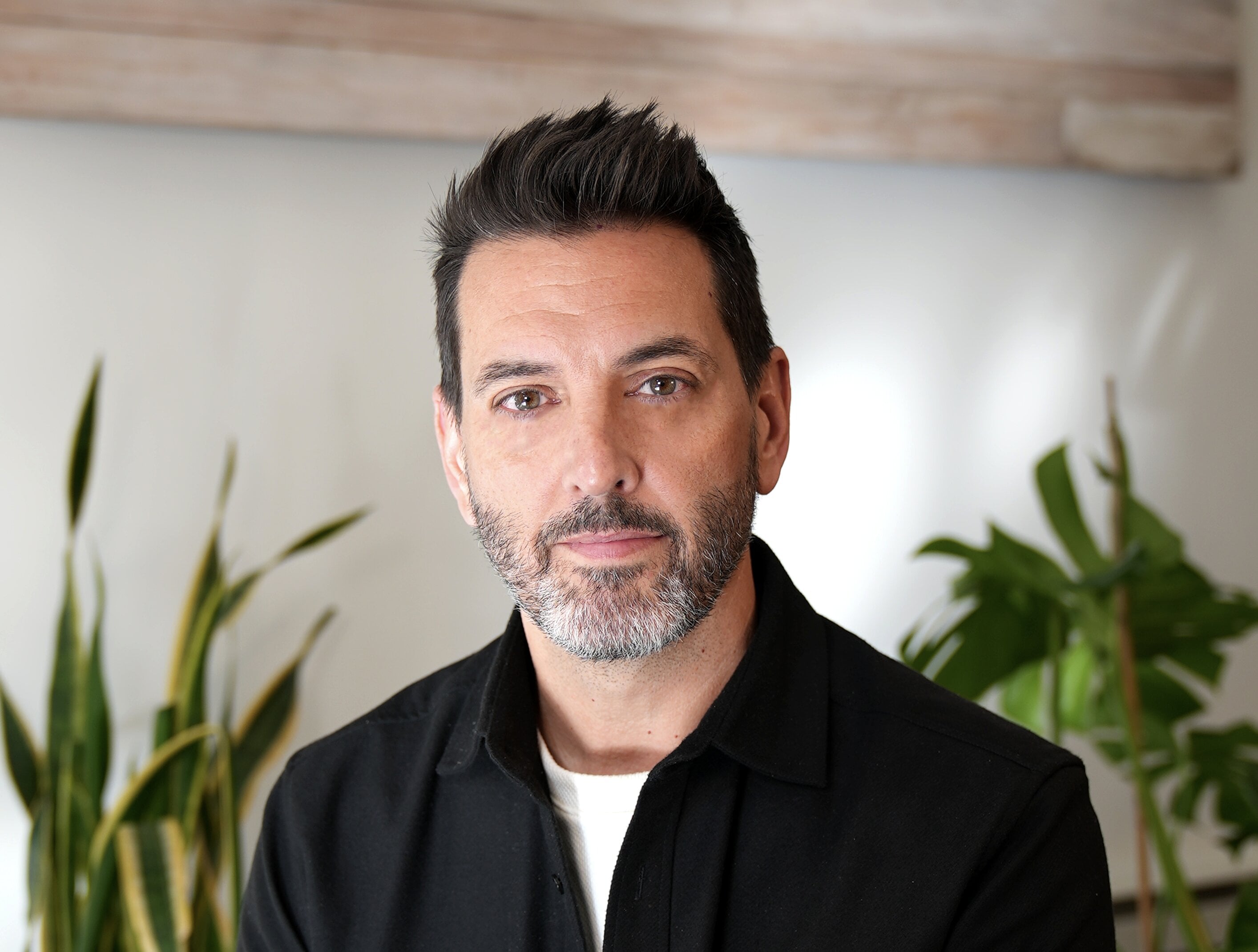
Brad Navin, the New York-based CEO of The Orchard, is a master of deflecting credit for these and many other significant achievements of the Sony Music-owned company he leads.
Navin’s overriding message in his discussion with MBW is one of modesty: we’re just the backbone – the real geniuses run our partner labels and make the music on their records.
But there’s one truth Navin can’t bat away: the power dynamics of today’s music industry have dramatically shifted from just 10 years ago, and The Orchard, more than anyone else, has been responsible for the transformation.
“There was a time where if you wanted to be successful – in the mainstream definition of the word – a major label was your most likely path,” Navin acknowledges. “The landscape has changed. Artists have more choice, and that’s a great thing.”
I’m not sure all of those running major labels would necessarily agree. But it’s certainly been a great thing for artists… and The Orchard itself.
Well-placed sources suggest The Orchard’s turnover is now comfortably north of USD $1 billion a year, making it the largest indie label services company on the planet.
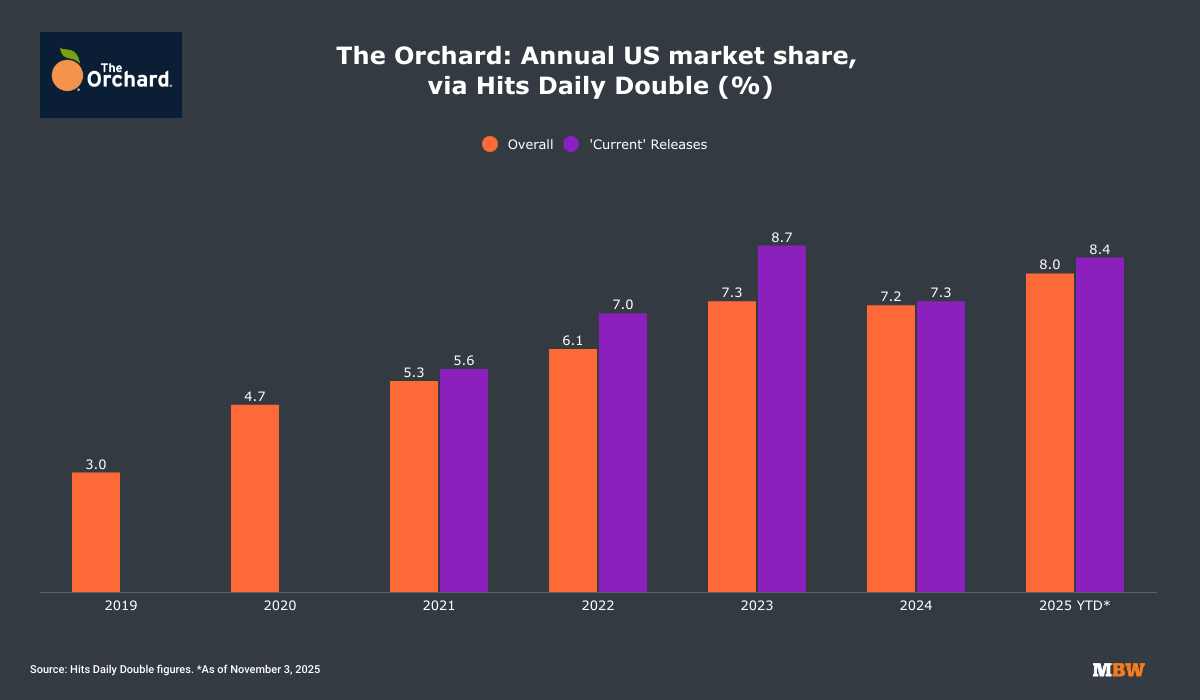
Meanwhile, Hits Daily Double recently pegged the company’s US market share of ‘current’ releases in 2025 YTD at 8.4% – substantially more than the likes of Atlantic Music Group, Columbia, RCA, or Warner Records.
So what! these major labels might say, it’s much easier to run a low-margin business than a ‘high-touch’ record company.
Except, when you look at the facts, that ‘low margin’ accusation RE: The Orchard is worth questioning.
For one thing, Sony Music Group Chairman Rob Stringer confirmed earlier this year that The Orchard/Sony Music has now acquired minority stakes in over half of The Orchard’s 20 biggest clients (believed to include Rimas, plus the likes of Fat Possum, Napalm, and Black 17).
Such deals secure valuable long-term clients for The Orchard, while providing strategic alignment and resources for labels. Yet they also significantly bolster the margin of The Orchard, transforming it from a mere services partner for its 26,000+ clients to an early-stage investor in some of music’s hottest companies.
Indeed, back in May, Stringer was asked by an analyst how The Orchard’s deals might dilute Sony Music’s margin compared to the firm’s major frontline record companies. His response was unequivocal. “The answer is that our margin hasn’t come down [since Sony started investing in The Orchard in 2011]. In fact, it’s got better.”
Stringer, who says The Orchard is “front and center” of Sony Music’s operation globally, also confirmed that the combined gross sales of Sony Music’s two independent services companies (AWAL and The Orchard) doubled between Sony’s FY 2020 and FY 2024.
 Source: Rob Stringer presentation to Sony investors, May ’25
Navin, a veteran of The Orchard for 22 years, is equally bullish about the company’s evolution from scrappy startup to industry kingmaker.
When he joined in 2003, The Orchard was literally flipping CDs over and typing in label copy, trying to convince skeptical indies that digital distribution had a future.
Today, with more than 50 offices worldwide, The Orchard is the ‘indie services’ company to beat – not least in LATAM, where its dominance through labels like Rimas and Double P (Peso Pluma) has given it a peerless status in one of the world’s most exciting territories.
Last month, clients of The Orchard won eight Latin Grammys, led by Bad Bunny with five. And that success is translating globally: The Orchard’s clients recently received 52 nominations for next year’s 68th annual Grammys, led by Bad Bunny with six. (Bunny is the first Spanish-language artist to be Grammy-nominated for Best Album, Best Record, and Best Song in the same year.)
Meanwhile, The Orchard continues to innovate and expand.
Navin reveals that earlier this year, the firm acquired two D2C merch platforms (IndieMerch and Kings Road Merch) – an area of the business he believes can become “very significant” for The Orchard in the years ahead.
In addition, The Orchard now offers clients publishing administration deals via a partnership with Sony Music Publishing, plus neighboring rights services via Kollective Neighbouring Rights (previously Kobalt Neighbouring Rights).
And, of course, tentpole record deals keep getting signed. A few weeks back, The Other Songs, a long-time client, inked an agreement to manage Andrew Lloyd-Webber’s recordings around the globe, distributed via The Orchard.
“I wouldn’t still be here if it wasn’t fun,” Navin tells MBW, with characteristic understatement. Yet behind that modesty lies a more provocative truth, perhaps with an eye on rivals like Universal’s Virgin Music Group: “I like winning. Everybody hates the winner, so I know that we are a target. I would like to keep winning and pull away even further.”
Here, in his first major interview in years, Navin discusses The Orchard’s evolution, the changing face of the music industry – and why he’s having the time of his life watching it all unfold…
Let’s start with your path to The Orchard. You’ve been there 22 years, but what came before?I went through the William Morris mailroom right out of university — pushed a mail cart, paid my dues. Then I tried my hand at artist management. This was around ’97, ’98, when all the big [label] roll-ups started happening, and a lot of bands were getting dropped.
That led me to a captivating opportunity: I joined a startup, Digital Club Network, which ran internet connections into clubs to record concerts, then sold the recordings. The operators who bought Digital Club Network — Dimensional Associates — also had in their portfolio eMusic, some Bluetooth technology, and some publishing and media assets.
Dimensional Associates bought The Orchard from Richard Gottehrer, a legend, songwriter, producer, generally a punk himself, and a disruptor.
[When Navin joined The Orchard], we intentionally visited markets all over the world to sign with independent record labels, digitizing their catalogs. As a relatively small company, we realized that we needed to build our own supply chain and technology.
When did you know you were onto something big?We work for entrepreneurs, and I noticed that they loved the control. For me, that was a big moment.
I say this internally, even today: Our team is fantastic and we’re a really smart group of people, but we also have the added advantage of being client-facing.
“We’re listening to these amazing label entrepreneurs from all over the world discuss their wants and needs.”
We’re listening to these amazing label entrepreneurs from all over the world discuss their wants and needs. That enables [The Orchard] to basically assess in real-time what we need to do to build our business alongside them.
It’s not an echo chamber of what we think has to happen. It’s a virtuous cycle of information in and out.
What was your gut reaction when you were told Sony Music had bought 51% of The Orchard in 2011?We were given a lot of autonomy to operate the business as we saw fit, which ultimately led to Sony Music fully acquiring us a few years later. [Sony Music acquired the remaining 49% in The Orchard in a $200 million deal in 2015.]
As you can imagine, there were spirited debates inside the company when people heard the news [in 2011]. ‘We work for the independent sector; Sony is a major.’
But I remember Richard Gottehrer, the heart and soul of this organization, making a comment in a room full of people back then. He said: ‘Hang on a minute. We can be owned by a bank, or we can be owned by these people – music people. Make sure you understand that.’
He was ultimately right. It’s been great.
Rob Stringer has talked publicly about how central The Orchard is to Sony Music’s own global strategy. How important has that support been, particularly during times when people questioned the logic of a ‘major record company’ investing in an indie services platform?I give Rob tremendous credit for the autonomy we’ve been granted by Sony Music. It’s been game-changing.
April 1st of this year [2025] was the tenth anniversary of The Orchard being a wholly owned subsidiary of Sony Music. In the ten years since, our growth has been astronomical.
That is a testament both to our ability to interoperate [within Sony Music Group] and the support we’ve seen from Rob. It’s been invaluable to how we’ve grown and how we’ve continued to push the envelope.
At some point, The Orchard – your model, at least – kind of became the record industry. People talk about big artists being ‘upstreamed’ to a major label – but Bad Bunny doesn’t need to be ‘upstreamed’ to anyone.Bad Bunny is an incredible artist with unbelievable conviction and belief in who he is and how he’s going to do things.
Our job is to partner with Noah [Assad] and the Rimas team to help bring that vision to market. Creatively? We get the hell out of the way.
“Bad Bunny is a game-changing artist with unbelievable conviction and belief in who he is and how he’s going to do it.”
However, there’s still ample opportunity across the spectrum of music. We all know there are great, talented artists – singers – out there who maybe can’t play an instrument or write a song. They need those traditional elements of [major label A&R] to help bring them to market.
And then there is Bunny, who has that locked down – and everything in between.
Let’s talk about the competitive landscape. Among the major music companies, The Orchard stood alone in terms of investment for a long time. Now you have a more heated competitor over in Santa Monica in Virgin Music Group – it’s less easy than it once was. How has that changed your world?I sincerely mean this: competition is good. It keeps you on your toes — no resting on our laurels.
There is more competition today than ever before, and it comes in many different forms. From fully baked [indie services] companies that are part of a major company, to startups that might be doing one or two things at a really high level. There’s a lot of choice out there for artists and labels of all sizes and calibers.
“There is more competition today than ever before, and it comes in many different forms.”
However, it was never easy for us. There was a time when we were fighting to build technologies, then a time when we were just fighting for respect. And then suddenly, in other people’s words, not mine, music from the fringes started becoming mainstream – and we had to provide great infrastructure, services, and partnership to really interesting, successful labels and artists, while letting them do their thing.
Let’s talk about the Downtown/Universal situation. I’ve written a few times that I think, at least on the basis of market share, blocking it is illogical; if the EC had watched The Orchard’s story, and seen the huge growth of independents in the United States and LATAM in the past decade, for example, maybe they’d understand that better. Still, if the EC does block it… will you laugh yourself to sleep?It’s not my decision to make, but there’ll still be a lot of opportunity and choice for the entire industry, whichever direction it goes.
The independent sector, as you know, is growing more powerful and more interesting year over year. Why is that happening? Because [indies] have so much choice and opportunity.
“The independent sector, as you know, is growing more powerful and more interesting year over year.”
There’s been more competition in [independent distribution] in the last five years than in the prior ten years combined. And new companies continue to launch on both a local and regional level.
There are a whole bunch of great distributors, artist service companies, marketing companies, companies that do pub admin. The Orchard provides all of those services and more at the highest level.
What do you make of the argument – put forward by opponents of the Downtown deal – that a major music company might use its in-house indie distributor to beat indies to artist signings? Has that ever happened?We’ve never seen that happen. I understand why certain sectors of the business have fears. I do think, respectfully, some of those fears are just dated arguments. At this point, people can obtain data wherever they want; It’s literally publicly available on Spotify, for example. Let me put it this way: I don’t think any independent label that we work with wakes up in the morning and compares itself to what Universal, Sony, or Warner is doing. No [indie client] has ever asked me, ‘What would Columbia Records do?’ The most successful ones follow their own instincts.
The Orchard has never entered the DIY distribution world, taking on TuneCore, DistroKid, CD Baby, UnitedMasters etc. Have you ever considered it?Many times. Why did we throw it out? Because I didn’t like it, honestly. I just didn’t like it.
Today, The Orchard is… I wouldn’t say we’re overly selective, but with the advent of all the technological developments, including various forms of fraud and the current state of AI, we have a bit of ‘know your customer’ [threshold] in place. Who do we want to be in business with so that together we can grow – and avoid a multitude of issues down the road?
“Who do we want to be in business with so that together we can grow – and avoid a multitude of issues down the road?”
We’re working hard as a technology-enabled distributor to ensure that we’re doing everything possible to prevent any kind of fraudulent activity and monitor what’s going through the system, in conjunction with the DSPs.
Spotify recently REMOVED 75 million ‘spammy’ tracks; an enormous number. Were any Orchard-specific?I don’t know of any volume that was Orchard-specific, which is pretty amazing. Again, it’s about knowing who your customers are and what kind of labels we want to be in business with.
You’ve bought two D2C merch companies this year: Kings Road Merch and IndieMerch. How important is that opportunity to The Orchard’s future expansion?We’ve always been in businesses adjacent to recorded music distribution, and D2C is a really significant opportunity.
We bought those two companies because we think D2C is going to be a way to help our clients take points of friction out of the [customer sale] process. By having an inventory layer, commerce layer, and even warehouse layer, our clients can still work with their local manufacturers if they want, but we’re providing infrastructure.
“I want our clients to be focused on the creative, not ‘Oh, I need to have an LLC in wherever in order to get money out of a society I’ve never heard of before.'”
We feel like this can be a really significant business for our sector of clients and for Sony Music, quite frankly.
We’re working with our clients across not just recorded [music] but D2C, pub admin [with SMP], and neighboring rights, via Kollective Neighbouring Rights. We’re building infrastructure across all of it, more intentionally than ever.
I want our clients to be focused on the creative, not “Oh, I need to have an LLC in wherever in order to get money out of a society I’ve never heard of before.”
Be honest: how pissed were you in 2021 when Rob Stringer called and said, ‘I’m buying AWAL’?[Laughs] The truth of the matter is that The Orchard actually helped lead that transaction. AWAL is distributed by The Orchard today, through our supply chain.
AWAL operating as a standalone business makes total sense to me, because they [sign artists] and we are really label-centric to a huge degree. When we have the opportunity to work with [individual artist-labels] like Damon Albarn and Gorillaz — those are the exceptions, not the rule.
[AWAL CEO] Lonny [Olinick] and his team are great at what they do. Again, there’s choice within our family of companies, creating opportunities. It’s all good.
When did you realize Latin America was setting the standard for what the independent music industry model was about to become?I was fascinated by this from my earliest days at The Orchard.
My first trips down to Brazil and Argentina were back-to-back, mid-2000s. [The Orchard’s co-head of Latin America,] Laura [Tesoriero], brought us down there — she’s from Buenos Aires and has been in the industry her entire life; her family was in it. She opened my eyes to the entrepreneurship.
These weren’t just labels — they were managers and promoters and publishers as well as labels. There was a reason for that: this was a time when physical goods were being pirated. So [entrepreneurs] had to figure out how to have careers and generate income streams by being part of everything. They found solutions.
Looking forward, where do you see the biggest future opportunities for The Orchard geographically?I have total belief that the same things we experienced in now-mature markets like Korea several years ago — K-pop suddenly taking the world by storm — we’re gonna see that [elsewhere] out of Asia, including India, and also out of Africa. These are massive population bases.
Creative people are everywhere, which makes it an exciting and fascinating experience. If music can be made available to the masses wherever they are, you’re going to hear great music come out of these markets.
I’m also excited about our UK partnerships. Oasis has had a tremendous year, the impact of which is projected to roll into 2026. I’m looking forward to new music from both Gorillaz and RAYE, and to collaborating with the legendary Andrew Lloyd Webber via The Other Songs.
What does it tell us about the modern music business that two of the biggest global stories this year have been Bad Bunny and Oasis, and they both go through The Orchard?It’s been a fun year, I can tell you that!
Oasis went through the major label system and I assume have no regrets because look at where they are today. They’re just at a different point in their career now, and The Orchard is fortunate enough to be able to deliver [for them].
Working with people like Marcus [Russell, Oasis manager], Alec [McKinlay, Oasis co-manager], and Noah [Assad, Bad Bunny’s manager] — I love it. They’re pushing us, we’re pushing each other.
This is why I feel like we have a competitive advantage; working with great entrepreneurs who have all these ideas about how we can keep pushing our service forward, and how we can execute.
You meet a lot of people in a lot of rooms who say, ‘You can’t possibly do that.’ These guys are the opposite of that.
As a participant in the music industry, it’s been quite a depressing year — lots of friends getting laid off at majors all over the world. The Orchard and its growth offers optimism in the middle of all this. How can you cheer us up?I’m very optimistic about The Orchard and the independent sector at large. Companies born out of this cycle are built for speed and have the ability to change in real-time.
Through good times and bad, historically, music always has a place. Music’s an emotion, as Richard Gottehrer likes to say. It’s always going to have value.
What does it tell us about today’s music industry that megastar artists like The Weeknd and Taylor Swift have Orchard-style structures in their deals with major record companies?[Pauses] That’s a good question. You should ask them!Music Business Worldwide