A Magnetic Avalanche on the Sun
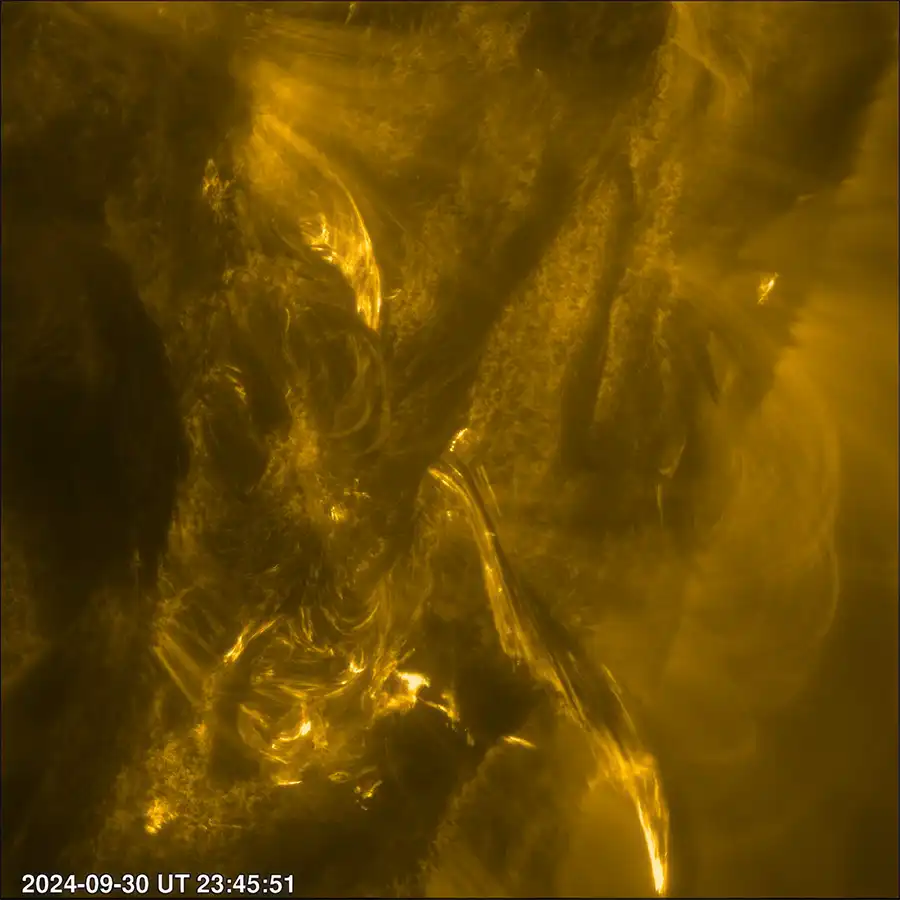
A video taken by the European Space Agency's Solar Orbiter shows the birth of a solar flare — a powerful eruption from the Sun.
The energy for such explosions comes from a sudden reorganization of the magnetic field, known as magnetic reconnection. When stressed to the breaking point, magnetic field lines (and the plasma they carry) snap like rubber bands. And just like a flick of a rubber band imparts kinetic energy, reconnection pours energy into all kinds of solar activity, including flares. But the exact mechanism has eluded scientists, as most magnetic reorgs occur on scales too small to be seen from solar observatories.
That's beginning to change with spacecraft making ever closer approaches to our star. The Solar Orbiter, which aims to study the solar poles, came near the Sun in September 2024, imaging details as fine as 210 kilometers (130 miles) across. While at perihelion, the spacecraft had the good luck to capture a weak flare at extreme ultraviolet wavelengths and X-rays, starting 40 minutes before the event began. It happened in the solar corona, the outermost atmosphere of the Sun, where a giant filament was hanging, suspended by magnetic fields.
Lakshmi Pradeep Chitta (Max Planck Institute for Solar System Research, Germany) calls what happened next a "magnetic avalanche":
Just as a nudge to a sheet of snow may kick off an avalanche, the solar flare began with initially weak disturbances, as little bits of magnetic field reconnected. Solar Orbiter captured those spurts of energy as lightning-like flashes. One by one, the mini-flares build on each other, until the whole region destabilizes and a full-on flare erupts. During and after the flare, energized blobs of plasma rain down to lower regions in the solar atmosphere. Even after the eruption is over, energized loops known as arcades hang suspended over the active region.
Learn more about the solar flare video in ESA's press release and read full details in the January Astronomy & Astrophysics.
Chandra View of the Kepler Supernova Remnant
The Chandra X-ray Observatory has been watching the Kepler supernova remnant for more than 25 years. Now, graduate student Jessye Gassel (George Mason University) has presented the video of this remnant's slow-motion explosion at the 247th meeting of the American Astronomical Society in Phoenix, Arizona. The time-lapse images hold a wealth of information about how supernovae explode into their surroundings, enriching them with fresh elements and molecules.
Johannes Kepler spotted this stella nova in 1604, when a white dwarf drew too much mass from a companion star and exploded in a runaway nuclear detonation. (That supernova is the last one definitively known to have happened in the Milky Way.)
But that initial blast was only the beginning. Now, 400 years later, hot wisps of white dwarf are still blowing outward, pushing their way into the gas of the surrounding interstellar medium.
The time-lapse video is short, just a few seconds long, but it covers a surprising span of time and space. It contains 12.5 days' worth of observations taken between June 2000 and July 2025, revealing wisps of gas expanding at a fraction of the speed of light — in the past two and a half decades, they've already crossed half a light-year.
But the remnant is far away — 17,000 light-years from Earth — and the decades of observations capture only 6% of the time since the white dwarf first exploded. What's more, the gas is so hot, almost 10 million degrees Celsius, that its thermal glow is at X-ray energies. Chandra's sharp X-ray vision is uniquely capable of capturing the remnant blast.
The time-lapse images can tell us about both the exploding star and what it exploded into. Expanding toward the bottom of the video are gases traveling at 14 million mph — 2% the speed of light. Toward the top of the video, gas is expanding at a more sluggish 4 million mph. The velocities tell astronomers that the surrounding medium is lumpy, maybe because the white dwarf shed some layers before it detonated. Denser gas toward the north of the remnant is putting the brakes on its expansion there.
Gassel and colleagues can also learn about the stuff that's between the stars by measuring the outermost rim. "At about 7 o'clock, there's this nice bright filament," Gassel says, "and that is what we are measuring." That's the layer of gas that first blasted into the surrounding medium, and its size and speed tell astronomers about the explosion itself as well as the medium it's expanding into.
Gassel emphasizes that the data is preliminary — there's still much work to be done to analyze what's happening in and around this supernova. Read more in the Chandra X-ray Observatory press release and video information page.

Comments (0)