
Remember me

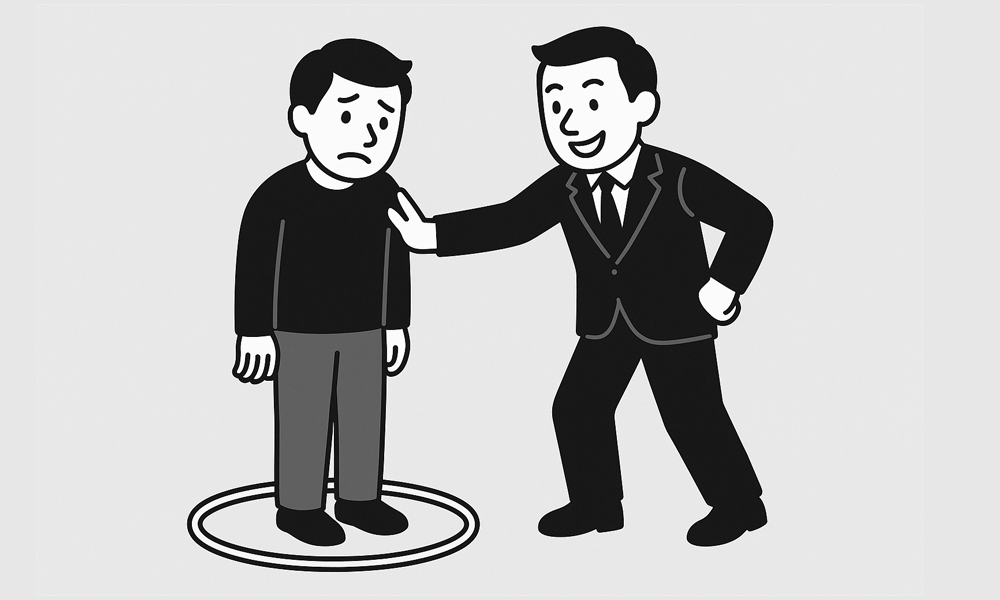
Imagine being asked to step into a hula hoop laid on the floor.
Most people hesitate. The circle is small, the boundary obvious. You feel the constraint the moment you imagine standing inside it.
Now imagine a different setup.
You’re brought onto a field, and the facilitator draws a huge circle on the ground – a “field-sized hoop”. You’re told: “Stand anywhere inside this.”
No problem. You stroll in comfortably. There’s so much space that it doesn’t feel like a restriction at all.
Then, without asking you to move, the facilitator redraws the circle smaller. Each time they do, they ask a simple question:
“Are you still comfortable? Can we continue?”
The circle tightens regardless if you have not given permission. You’re already inside it anyway. Each change seems minor compared to the last, and it feels easier to say “yes, still okay” than to step out and object.
Eventually, the circle shrinks to the size of the original hula hoop — the one you would never have stepped into if it had been drawn that small at the start.
Nothing “dramatic” happened. No one shouted, “Now we take away your freedom!” There were only small adjustments that you accepted one by one… until you ended up exactly where you’d have refused to stand at the beginning.
That is how rights can disappear in countries that still call themselves democratic.

Most citizens would resist if a government openly announced, all at once:
We will track most of your digital life. We will make it extremely hard for you to protest. We will treat certain speech as a crime, on broad and shifting grounds.As a single package, the “hoop” is clearly too small.
So instead, rights are trimmed in slices:
Just one law for “fake news”. Just another for “foreign interference”. Just a permit requirement here, a correction order there. Just this one case where stronger powers are needed “to protect society”.Each change is presented as targeted, technocratic, proportionate, “for your own good”. Each one hits a specific group first – activists, foreign media, opposition voices, “troublemakers”, people unlike you.
If you’re not the target this time, the circle doesn’t feel smaller. So you stay where you are. And because you stay, it becomes easier for the next line to be redrawn closer in.
Singapore and the comfort of the shrinking circleSingapore is not unique in this, but it is a very efficient example.
On paper, the country has elections, Parliament, courts, a written Constitution. It is easy to point at these and say, “See? We are not that kind of state.”
But look at how the hoop has moved over time:
Already strict laws on speech and assembly have been refined and extended. Online spaces now sit under multiple overlapping controls: “falsehoods”, “foreign interference”, “hostile information campaigns”. Defamation, contempt and other offences remain powerful tools against individuals and independent outlets. Physical protest is so tightly regulated that most people would never even consider organising one.None of this arrived overnight. Every tightening was framed as necessary and sensible: to protect harmony, to defend against foreign manipulation, to safeguard public order. Each time, many citizens shrugged and stayed where they were.
And each time, the circle shrank a little more.
Daily life still feels “normal”: you can shop, travel, watch Netflix, scroll your feeds. But the space in which you can meaningfully criticise power, organise collectively, or build independent structures has been compressed. You are still in a field — but the boundaries are now much closer than they were a generation ago.
The most unsettling part is not just that it has happened, but how easy it has been for people to adapt to it.
No bargain, no safety netWhat makes this shrinking of space even more insidious is that it isn’t even part of an honest bargain.
There is no explicit social compact that says:
“Surrender these rights and, in return, we guarantee your economic security, social dignity, and protection from hardship.”
Instead, people quietly give up rights while still living in a system where:
losing your job can mean falling through the cracks, being bullied, abused or discriminated against often leaves you to navigate hostile structures alone, support is conditional, bureaucratic, and uneven.When you’re jobless, isolated, harassed or struggling, you face those problems inside the same tightened circle — with fewer tools to push back, organise or demand better.
So you don’t just have less freedom; you also have no guarantee that the state will catch you when you fall. Rights are eroded without a clear promise of wellbeing in return, and often without people fully realising what they have quietly surrendered or condoned.
The role of media: who tells you the hoop is shrinking?In theory, this is where independent media should step in and say:
“Here is how much space citizens used to have. Here is how much is left. Do you agree with what has been taken away?”
But as media becomes more dependent on state funding, state-linked advertisers or tight regulatory control, its incentives shift. Instead of warning that the circle is closing, it often:
treats new laws as neutral technical fixes, frames critics as “foreign-linked”, “fringe” or “discredited”, reports the enforcement but not the pattern, and rarely asks whether the cumulative effect is a fundamental change in the relationship between citizen and state.When the watchdog becomes part of the furniture, the shrinking hoop continues largely unreported. People are not even “asked” for consent, as in the experiment. The redrawing just happens in policy papers, court judgments and tightly framed news stories that most will never read in full.
The democratic world is not exemptIt would be a mistake to see this as a uniquely Singaporean or “small authoritarian state” problem.
Across the democratic world, you see the same logic at work:
“Temporary” emergency powers that quietly become permanent. Broad surveillance measures justified by terrorism, then normalised for routine enforcement. Anti–fake news laws that start with obvious lies, then drift into policing opinions and inconvenient truths. Protest restrictions passed “for safety” that end up used against students, unions and climate activists.Everywhere, the story is similar: the circle shrinks one rationalised step at a time, while voters are reassured that their rights are intact because elections still happen, courts still sit, and the shopping malls are still open.
The question for citizensThe shrinking hoop experiment ends with one uncomfortable question:
“If this small circle had been drawn at the start, would you ever have stepped into it?”
Translated into politics, it becomes:
“If you had been told 20 or 30 years ago that this would be the level of surveillance, the limits on speech, the controls on media and protest – would you have accepted it then?”
If the honest answer is no, then the real issue is not just how far the circle has moved, but how easy it has been for people to move with it.
That is the danger of gradualism: there is no single moment when the red line is dramatically crossed. Only a series of small lines that quietly disappear behind you.
At that point, the warning from history stops feeling abstract. As the English version of Martin Niemöller’s poem reminds us:
When the Nazis came for the communists,
I kept quiet; I wasn’t a communist.
When they came for the trade unionists, I kept quiet;
I wasn’t a trade unionist.
When they locked up the social democrats, I kept quiet;
I wasn’t a social democrat.
When they locked up the Jews, I kept quiet;
I wasn’t a Jew.
When they came for me, there was no one left to protest.
The point is brutally simple: if you only worry about the circle when it finally closes around you, it will already be too late.
Notice: We now publish our news at Heidoh. Follow us on WhatsApp Follow us on Telegram

Comments (0)