
Remember me


When X (formerly Twitter) rolled out its new “About this account” label in November, the stated aim sounded simple enough: give users more information about where an account is based, when it was created, and how often it has changed usernames – so people can better judge whether they are dealing with bots, trolls or bad-faith operators.
The feature also displays the country or region an account is “based in”, using a mix of signals like IP address and app-store region, and may flag possible VPN/proxy use.
Unsurprisingly, it triggered a wave of stories about “foreign interference”. Internationally, coverage focused on how multiple high-profile pro-Trump “MAGA” accounts, branding themselves with American flags and patriotism, turned out to be operated from countries such as India, Nigeria, Russia and parts of South-east Asia.
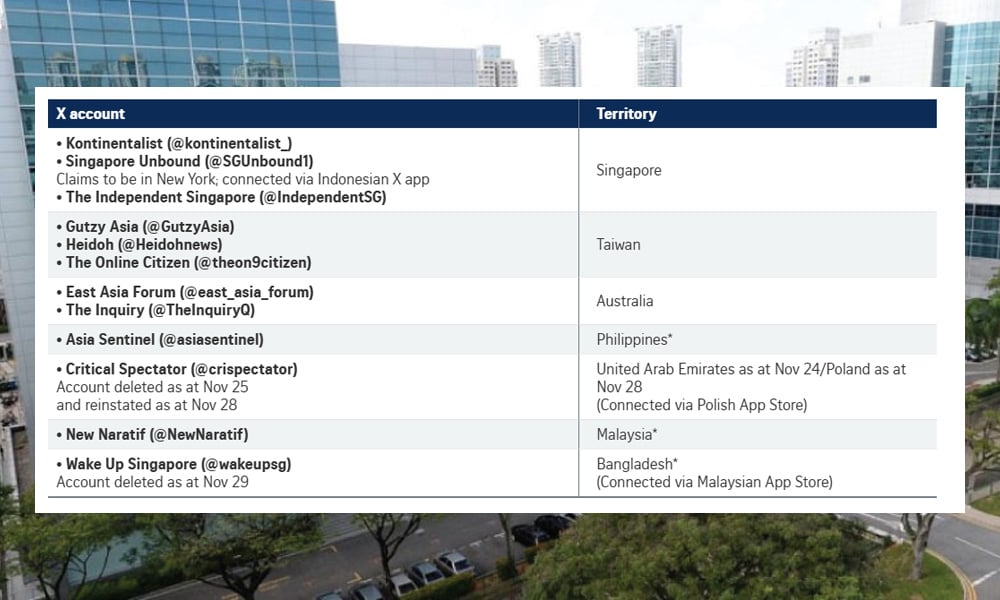
On 28 November, The Straits Times (ST) joined this conversation with a piece that began with those US examples – then pivoted to a curated list of 12 X accounts that “frequently comment on Singapore’s policies and politics”.
Among them: The Online Citizen (TOC), Gutzy Asia and Heidoh.
The way the story is framed matters, because it quietly blurs a crucial distinction: the difference between foreign-run operations, and Singaporean-run outlets whose editor simply lives overseas.
From US astroturf to “12 Singapore commentators”The ST article opens with the global controversy: X’s new label exposed supposedly American political accounts that were actually operating from India, Nigeria and elsewhere, prompting fears about foreign interference in US domestic politics.
It then announces that ST “examined 12 X accounts” that comment heavily on Singapore, including some that have previously received POFMA directions. Most of these, readers are told, “appeared to be based elsewhere.”
Within this small, hand-picked universe, ST highlights:
The Inquiry, run by former Singaporean Zulfikar Shariff, now an Australian citizen, located in Australia; anonymous Lee Kuan Yew quote/fan accounts based in Australia and India; Critical Spectator, operated by a Polish national, initially shown as based in the UAE via the Polish app store, then later in Poland after the account was deactivated and reactivated; and the X accounts tied to TOC editor Terry Xu – TOC, Gutzy Asia and Heidoh – shown as based in Taiwan, “where he lives.”On the surface, all of this is technically accurate. But context and omissions are doing heavy lifting.
Citizenship vs GPS pin – what ST chose to emphasiseLook at how ST describes different players:
For The Inquiry, the article stresses that it is run by a “former Singaporean” who is now an Australian citizen – a clear signal that the operator is no longer Singaporean. For the accounts linked to TOC’s editor, ST says simply that they are “based out of Taiwan, where he lives” – with no mention at all that he remains a Singaporean.Placed inside a story framed around “foreign interference”, “bad actors” and accounts “operating overseas”, this omission is not trivial. It subtly nudges readers towards seeing:
former Singaporean in Australia →
Singapore-focused accounts “based out of Taiwan” →
Polish commentator in UAE/Poland
all as variations of the same “foreign-linked” category.
A more neutral, fully factual wording was available:
“Accounts tied to The Online Citizen (TOC) editor Terry Xu, a Singaporean journalist currently based in Taiwan, comprising TOC, Gutzy Asia and Heidoh, showed Taiwan as their location.”
ST did not choose that.
Instead, nationality is highlighted only when it supports a narrative of someone being “ex-Singaporean” or foreign, and downplayed when it would clarify that an outlet is still Singapore-run, even if its editor resides elsewhere.
Heidoh is not a Singapore-centric commentary outlet – and Gutzy Asia is effectively dormantThere is also a basic factual problem in the way Heidoh and Gutzy Asia are implicitly framed.
ST groups both together with 10 other accounts that supposedly “commented frequently on Singapore’s policies and politics”. In reality:
Heidoh is primarily an Asia news site, focusing on regional issues across East, South-east and South Asia. Singapore is only one part of its coverage. Commentary on Singapore politics is carried through TOC’s platforms, not via Heidoh’s X account. Heidoh’s feed is dominated by wider Asian developments, not Singapore-centric political takes. Gutzy Asia has effectively ceased publishing since it was hit with a POFMA Declaration of Online Location in 2024. It is not an active, day-to-day commentator on Singapore policy, and has not been for some time.Yet ST provides no data, no content analysis, no numbers to justify the impression that Heidoh “frequently” comments on Singapore policy in the way that TOC does, or that Gutzy Asia is currently playing any meaningful role in shaping the Singapore conversation.
Simply placing all three – TOC, Gutzy and Heidoh – in a tiny group of 12 “Singapore commentators” without that nuance is misleading.
If the stated purpose is to help readers understand which overseas-based accounts are talking about Singapore politics, then:
conflating a Singapore-focused commentary outlet (TOC) with a regional Asia news brand (Heidoh), and a largely dormant site (Gutzy Asia)collapses important distinctions and inflates the impression of “foreign-based” Singapore commentators far beyond what the present reality supports.
A small, curated sample – and a former ST editor’s doubtsFormer Straits Times senior journalist Bertha Henson has publicly questioned how the paper even chose these 12 accounts.
She notes that:
there are many X accounts that comment on Singapore; yet ST picked a familiar set of “usual suspects”, then used a strap suggesting that “most” of these commentators are based overseas – when, strictly speaking, it is only “most of the 12 we chose”.She also points to the Critical Spectator paragraph and asks, quite pointedly, whether the account’s recent Oxley Road commentary is the real reason it was chosen for scrutiny.
Her concern goes beyond personalities. It highlights a structural issue: when you choose a very narrow sample and then generalise from it, you are constructing a narrative, not merely reporting a neutral reality.
Missing from ST’s sample, for instance, are:
Mainstream foreign newsrooms like the South China Morning Post, Bloomberg, Reuters or AP, which routinely cover Singapore from foreign bureaus – all “foreign-based” in the literal sense, but not treated as suspicious or fringe.By leaving such outlets out of the frame, the article’s curated universe of “Singapore commentators” ends up heavy with:
ex-Singaporeans now based abroad, a Polish commentator whose account behaviour looks erratic, alternative sites that have clashed with the authorities, anonymous LKY fan accounts, and Singaporean-run independent outlets based in Taiwan.And then it points to their foreign locations as the salient fact.
Regional outlets in the crosshairs tooThe way Heidoh is framed also sits within a broader pattern of how Singapore authorities treat regional publications which are not Singapore-centric but occasionally publish analysis on Singapore.
Publications like New Naratif, Asia Sentinel and East Asia Forum are not built around Singapore alone. Their focus is on the wider Asian region – South-east Asia, East Asia, and questions of democracy, governance and geopolitics across multiple countries. Singapore is just one of many subjects they cover.
Yet these outlets have repeatedly found themselves in the crosshairs of the Singapore authorities when their pieces on Singapore run counter to the official narrative. They have been singled out, POFMA-ed or otherwise challenged, not because their entire publication is Singapore-focused, but because specific articles about Singapore were deemed problematic.
That’s what makes ST’s treatment of Heidoh so troubling:
Heidoh’s editorial scope is regional, not Singapore-centric. Its Singapore pieces are part of a broader Asia news mix, similar in spirit to how New Naratif or East Asia Forum approach the region. But by lumping Heidoh into a tiny list of “accounts that frequently comment on Singapore’s policies and politics”, ST effectively rebrands a regional outlet as a Singapore-political actor in the eyes of readers.Seen alongside the experience of New Naratif, Asia Sentinel and East Asia Forum, this looks less like an innocent oversight and more like a familiar move: treat any regional platform that challenges official narratives on Singapore as if it were fundamentally about Singapore politics, even when its actual editorial mandate is much wider.
Even ST’s own expert says overseas commentary is not inherently wrongTo its credit, ST does quote Singapore Management University law academic Benjamin Joshua Ong, who makes an important point: being based overseas and commenting on Singapore politics is “not necessarily wrong.”
According to the article, he draws the line at:
accounts that pretend to be Singaporean when they are not; those who spread false or deliberately misleading statements, especially at the behest of others; and attempts to exert control over governmental affairs, rather than simply trying to persuade Singaporean readers.Those are reasonable concerns, and they echo the logic behind Singapore’s Foreign Interference (Countermeasures) Act (FICA), which explicitly targets foreign influence operations and “hostile information campaigns”, including via social networks.
But the article’s overall structure means Professor Ong’s carefully hedged comments arrive after readers have already been walked through:
the global story of foreign-run MAGA accounts; a curated list where most “Singapore commentators” appear to be abroad; a Polish commentator whose account hops between UAE and Poland; ex-Singaporean activists overseas; “alternative” news sites; and Singaporean-run outlets listed as simply “based in Taiwan”.The nuance does not erase the association already planted: that overseas-based accounts are somehow inherently suspect and adjacent to foreign interference.
What X shows – and what ST chose to do with itIn the end, X’s “About this account” label is just that: a label. It guesses a country from IPs, app stores and other technical traces. It doesn’t tell you who holds the passport, who owns the outlet, who calls the editorial shots, or whether the work is done in good faith.
Those judgements are made not by algorithms, but by editors.
So when The Straits Times takes this rough location tag and builds a story that:
highlights ex-Singaporeans and foreign nationals, drags in Gutzy Asia even though it has been effectively dormant since being DOL-ed in 2024, recasts Heidoh – a regional Asia news brand – as if it were a frequent Singapore political commentator, and describes TOC, Gutzy and Heidoh only as “based out of Taiwan”, without mentioning that they are still Singapore-run,that is not the neutral work of “just reporting what X shows”. It is an editorial choice.
If the concern is really foreign interference, why erase the fact that TOC is run by a Singaporean? Why lump a dormant site and a regional Asia outlet into a tiny sample of “Singapore commentators”, without a single number to back up the claim that they “frequently” comment on Singapore? Why leave out big regional and international publications that also cover Singapore from overseas, and focus instead on a familiar cast of “usual suspects”?
X’s data may be imperfect, but at least it is honest about its limits. The more important question now is whether The Straits Times can say the same about the narrative it has chosen to build around that data.
Notice: We now publish our news at Heidoh. Follow us on WhatsApp Follow us on Telegram

Comments (0)