
Remember me









Astronomers sensed something extraordinary when a mysterious comet called 3I/ATLAS first appeared in mid-2025. This icy traveler didn’t follow a normal orbit; instead, it zipped through the solar system on a hyperbolic path. That meant 3I/ATLAS did something no typical comet could: it came from interstellar space. For years, such visitors were pure speculation. Now, for the third time ever, scientists were watching one in real time.
What followed was a rare chain of events. As 3I/ATLAS approached the Sun, it became active: ice sublimated, dust and gas streamed off, forming a glowing coma and tails. Then, a spacecraft already bound for Jupiter turned its cameras toward the comet. The result: a stunning, up-close image from deep space, and a detailed view of an interstellar comet in full motion.
A visitor from far away3I/ATLAS was first spotted on 1 July 2025 by the ground-based survey telescope ATLAS in Chile. The moment astronomers calculated its orbit, the verdict came fast: this comet was not from our Solar System. Its path was hyperbolic, meaning the Sun’s gravity could not hold it. That categorization placed 3I/ATLAS in a tiny club; only a handful of objects, including the famous 1I/ʻOumuamua and 2I/Borisov, have ever borne the “interstellar” label. As 3I/ATLAS fell toward the Sun, it carried with it a promise: a rare chance to examine material formed around another star.
By late 2025, Earth-based telescopes grew unable to follow it as the comet passed behind the Sun from our perspective. But space-faring observatories picked up the slack. Both NASA and ESA mobilized assets to track 3I/ATLAS from new vantage points. With the comet heading inward toward its perihelion (closest approach to the Sun) around October, every opportunity to observe became crucial. Its journey through the inner system would be brief. That made every observation precious.
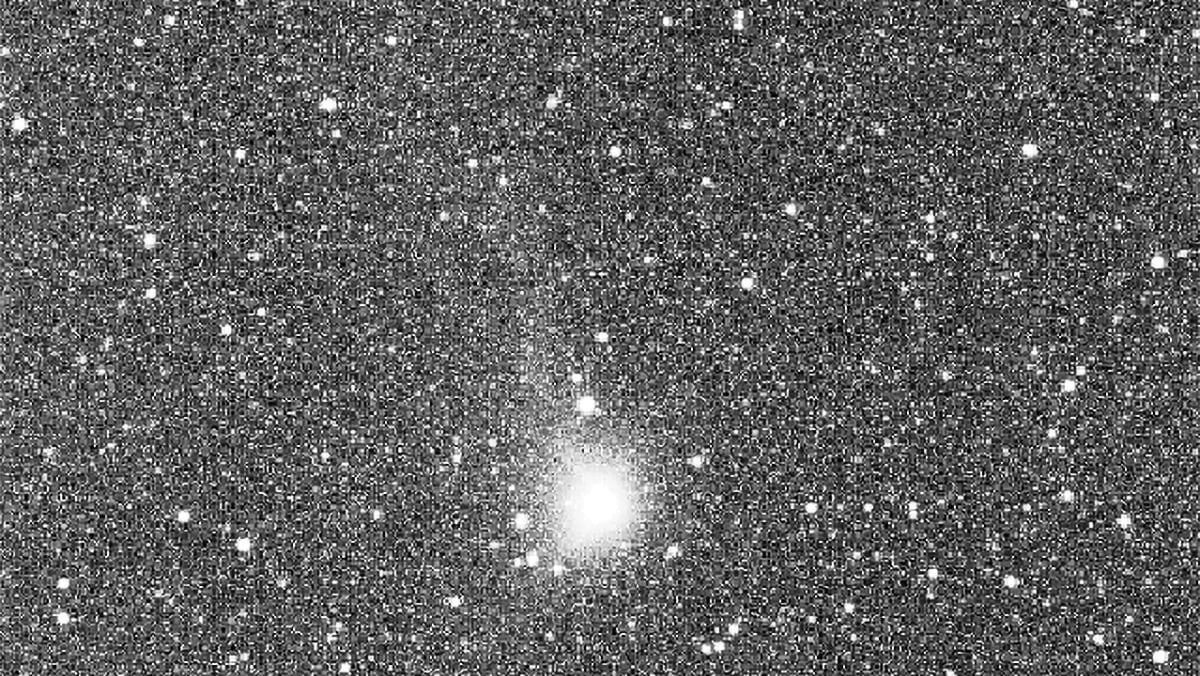
 This image shows the observation of comet 3I/ATLAS when it was discovered on July 1, 2025. Credit: ATLAS/University of Hawaii/NASA
JUICE: An Unexpected Glimpse
This image shows the observation of comet 3I/ATLAS when it was discovered on July 1, 2025. Credit: ATLAS/University of Hawaii/NASA
JUICE: An Unexpected Glimpse
Enter JUICE, the European Space Agency’s spacecraft destined for Jupiter‘s icy moons. JUICE was never designed to chase comets. Yet when 3I/ATLAS drifted nearby in November 2025, mission controllers saw an opportunity they couldn’t ignore. Between 2 and 25 November, JUICE turned its instruments toward the comet.
On 2 November, JUICE’s basic Navigation Camera (NavCam), usually used to steer the spacecraft, snapped a photo of 3I/ATLAS. The team didn’t grab the full image. They downloaded a small portion. Even so, what they saw amazed them. A bright, glowing coma glowed around the nucleus. And there were signs of not one, but two tails, a plasma tail of ionized gas, and a fainter dust tail made of solid particles.
 JUICE’s image of interstellar comet 3I/ATLAS. Credit: ESA/Juice/NavCam
Coma and tails: Classic comet behavior
JUICE’s image of interstellar comet 3I/ATLAS. Credit: ESA/Juice/NavCam
Coma and tails: Classic comet behavior
The features in the NavCam image look like those of a familiar comet. There’s a glowing coma, the cloud of gas and dust surrounding the nucleus, formed when sunlight warms the comet and ices turn directly into vapor. Around that, dust and gas drift away into space, producing the characteristic twin tails. The plasma tail, made of ionised gas carried by the solar wind, streams straight out from the comet, while the dust tail drifts more slowly, bending gently under the influence of solar radiation.
What makes the image even more compelling is its timing. JUICE took this shot just days after the comet passed its closest point to the Sun. That means 3I/ATLAS was at or near peak activity, shedding gas and dust at high rates. It is rare to capture a comet at such a moment, let alone an interstellar one.
 JUICE’s image of interstellar comet 3I/ATLAS shows the coma, plasma tail, and a potential dust tail of the comet. Credit: ESA/Juice/NavCam
What lies beneath: Questions scientists hope to answer
JUICE’s image of interstellar comet 3I/ATLAS shows the coma, plasma tail, and a potential dust tail of the comet. Credit: ESA/Juice/NavCam
What lies beneath: Questions scientists hope to answer
The NavCam image is not the end of it. JUICE’s other instruments, including a high-res optical camera (JANUS), spectrometers (MAJIS, UVS), and particle detectors (SWI, PEP), were all pointed at the comet during the same period. But because JUICE had to shield its main antenna from the Sun, the data transmission will be slow. The full dataset, including detailed views of the coma, tail, and maybe even surface structures, is expected to reach Earth in February 2026.
Once available, this data could answer some big questions. What ice does 3I/ATLAS carry? Is its composition similar to comets that formed in our solar system, mostly water ice mixed with dust and organic compounds? Or does it have a different mix, reflecting formation in another star’s disk? Early ground-based observations give hints. Spectroscopy from the James Webb Space Telescope (JWST) suggests 3I/ATLAS may be unusually rich in carbon dioxide (CO₂), compared to many Solar System comets. That could imply it formed under cooler or different chemical conditions than our native comets.
There are other surprising clues, too. Observations using ultraviolet instruments detected OH emission, a sign of water vapor, even when the comet was still fairly far from the Sun, at about 3.5 astronomical units. That activity so far out is unusual. It may mean water-ice sublimation begins earlier, or there are icy grains in the coma releasing water as they heat up. Taken together, these details hint that 3I/ATLAS might not just repeat what Solar System comets do. It might reveal entirely new comet archetypes formed under alien conditions.
 Detection of CO2 with JWST’s image. Credit: NASA/James Webb Space Telescope
Comet 3I/ATLAS: A breakthrough
Detection of CO2 with JWST’s image. Credit: NASA/James Webb Space Telescope
Comet 3I/ATLAS: A breakthrough
In decades of comet science, we have observed many comets. But nearly all originated within our Solar System. Interstellar comets have always been rare. Before 2025, only two had ever been confirmed. For 3I/ATLAS, astronomers had only a narrow window. The fact that a spacecraft like JUICE, millions of kilometers from Earth, managed to capture a clean image is remarkable. It pushes the boundary of what we can learn from fast-moving, unpredictable interstellar visitors.
And because JUICE used multiple instruments, scientists now have the potential to study 3I/ATLAS in depth: not just how it looks, but what it’s made of. That may give us a direct sample of material formed around another star. It could offer insights into how planetary systems across the galaxy build comets, asteroids, and perhaps even planets.
If 3I/ATLAS turns out to have a cometary composition like ours, water ices, dust, and organics, it suggests such building blocks are common in many star systems. If its makeup is different, carbon dioxide-rich, water-poor, or with unusual dust, it might hint at greater diversity in how matter condenses around young stars. Either way, this visit won’t be repeatable. Once 3I/ATLAS leaves, it might never return. That makes these observations irreplaceable.
 ESA’s Jupiter Icy Moons Explorer (Juice) spacecraft. Credit: ESA
Further reading
ESA’s Jupiter Icy Moons Explorer (Juice) spacecraft. Credit: ESA
Further reading
Right from the discovery of the interstellar comet 3I/ATLAS, DIYP has published several articles on its photographs and features. Here is the list of articles:
Clear skies!
Comments (0)