
Remember me








/https://tf-cmsv2-smithsonianmag-media.s3.amazonaws.com/accounts/headshot/SarahKuta.png)
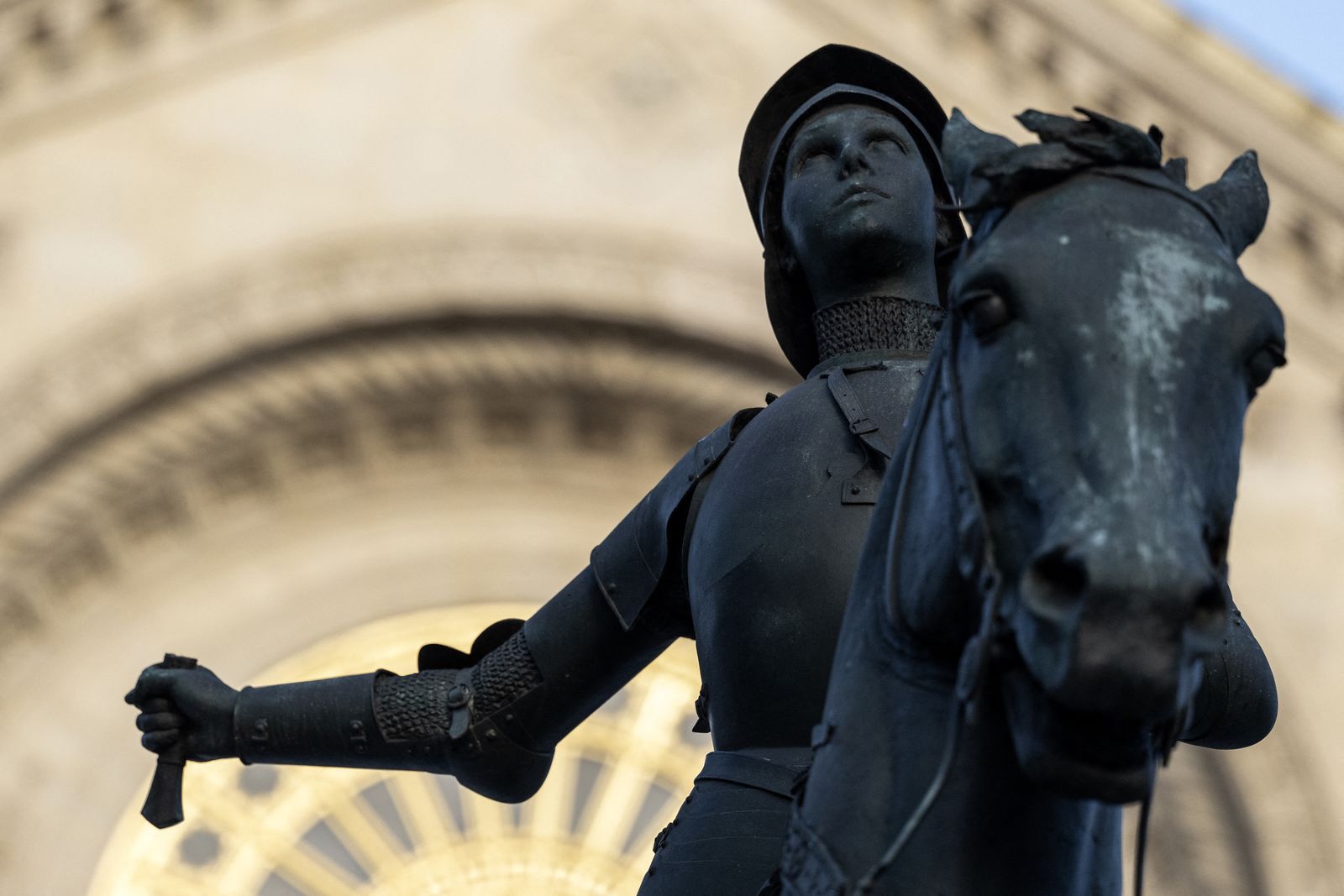
:focal(2601x1759:2602x1760)/https://tf-cmsv2-smithsonianmag-media.s3.amazonaws.com/filer_public/f2/51/f25127ca-8ae0-46d7-b0af-64d3500a8829/gettyimages-2253854810.jpg) Created by French sculptor Paul Dubois, the statue is located in a public square in front of the Église Saint-Augustin.
Blanca Cruz / AFP via Getty Images
Created by French sculptor Paul Dubois, the statue is located in a public square in front of the Église Saint-Augustin.
Blanca Cruz / AFP via Getty Images
A man has been taken into custody on charges of stealing a sword from a Joan of Arc statue in Paris.
According to Le Parisien’s Thomas Diquattro and Julien Constant, the theft took place around 10 a.m. on January 2.
Security camera footage reviewed by Karen Taïeb, the deputy mayor of Paris overseeing the city’s heritage and history, showed an unidentified man approaching the bronze statue, which depicts Joan of Arc riding a horse atop a stone pedestal. The man violently shook the horse before scaling the statue, per Le Parisien. He wrenched off the sword, which was pointed upright in Joan of Arc’s right hand. The weapon then broke into a few pieces.
The suspect walked off with the sword, but he didn’t get far. Police stopped him a few minutes later and recovered the damaged weapon. So far, police have not shared many details about the crime, including the man’s possible motive. A waiter at a nearby bistro was mystified by the theft, telling Le Parisien he wondered what the man had planned to do with the stolen sword.
City leaders vowed to repair—or, if necessary, reproduce—the statue, which was created by French sculptor Paul Dubois in the late 19th century. It belongs to the Musée d’Orsay but is on loan to the city of Paris.
Last restored in 2021, the artwork is in the eighth arrondissement of Paris, a centrally located area on the bank of the Seine River that’s also home to landmarks like the Champs-Élysées. It’s situated in a public square in front of the Église Saint-Augustin, a Catholic church built in the late 19th century by French architect Victor Baltard.
Quick fact: Other casts of Paul Dubois’ statueThere are several versions of the sculpture on display elsewhere, including a cast in front of the Cathedral of Notre-Dame of Reims and another version in Meridian Hill Park in Washington, D.C.
Joan of Arc, also known as the Maid of Orléans, is a national symbol in France. Born around 1412, she grew up as a peasant girl in the French countryside. Around age 13, she started hearing voices that told her God had given her a mission: to fight the English occupation of France during the Hundred Years’ War, and to help Charles VII secure the French throne.
In 1429, she convinced Charles—then the French dauphin—to let her lead French troops into battle in Orléans, which had been under siege by the English for several months. She helped free the city, then kept on fighting against the English. That summer, Charles was crowned king of France at the cathedral in Reims.
In May 1430, Joan of Arc was captured. She was convicted of heresy, then burned to death in Rouen, France, a year later. Pope Benedict XV formally canonized her as a Catholic saint in 1920, nearly 500 years after her death.
Parisians love Joan of Arc. In the summer of 2019, they became outraged when a statue in the Place des Pyramides appeared to have been vandalized. In reality, the statue’s flag had been removed for repairs.
Get the latest stories in your inbox every weekday.
Comments (0)