
Remember me


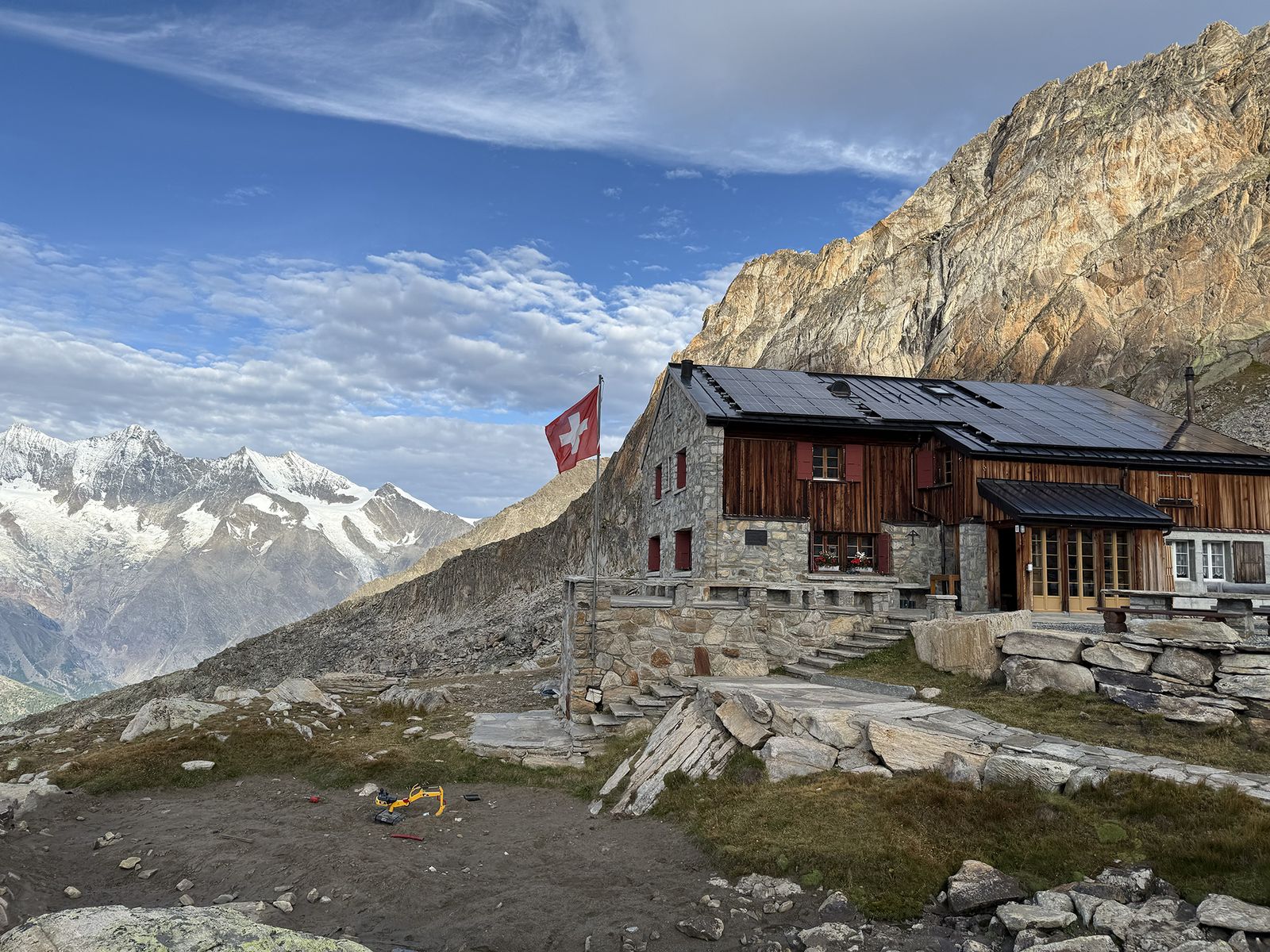


:focal(1000x752:1001x753)/https://tf-cmsv2-smithsonianmag-media.s3.amazonaws.com/filer_public/fe/1b/fe1b36e5-06ae-4b51-9ac9-b228b6ca8cc5/img_1946.jpg) The Swiss Alpine Club (SAC) owns about half of Switzerland’s 320 huts, including the Almageller Hut on the southern side of Weissmies Mountain above the village of Saas-Almagell.
Anna Fiorentino
The Swiss Alpine Club (SAC) owns about half of Switzerland’s 320 huts, including the Almageller Hut on the southern side of Weissmies Mountain above the village of Saas-Almagell.
Anna Fiorentino
In 1779, Englishman Charles Blair built the first primitive shelter for hikers to view France’s Mer de Glace glacier, in the shadow of the Alps' tallest peak, Mont Blanc. The simple stone hut, rebuilt 16 years later as the Temple of Nature, inspired the construction of many after it. As alpine clubs sprung up in Europe and climbers claimed first ascents of major peaks in the Alps in the 1850s and 1860s, the Golden Age of Alpinism gave rise to a network of huts to support a new type of adventure tourism.
Some 3,000 hiking huts, around 1,300 of which are staffed by Europe’s alpine clubs to provide food and safety above the treeline, are still standing in the Alps—for now.
As the region warms twice as fast as the rest of the globe, the ground under these huts and the trails that support them is becoming more unstable. These temperature shifts and extreme weather patterns are turning permafrost—the “glue” that holds entire rock formations together above 7,500 feet—from ice to mud, dismantling sections of mountains. In spring, summer and early winter when water percolates after cycles of freezing and thawing at even higher elevations in fractured bedrock, the Alps are seeing steeper, faster rockfalls and avalanches along with glacier retreat. This has required local municipalities to reroute and even close some of the area’s historic trails. And in the face of aging infrastructure, the foundations of huts are crumbling.
These local leaders, along with alpine clubs and hut guardians, work around the clock to keep the huts and trails safe. In Austria alone, 272 of 429 mountain huts and 31,000 miles of trails are in dire need of repair. Clubs across the Alps are sounding the alarm in hopes of financial assistance as maintenance costs mount.
/https://tf-cmsv2-smithsonianmag-media.s3.amazonaws.com/filer_public/e2/78/e2789c2a-fb18-455b-a5dd-708f9101b693/the_temple_de_la_nature_in_chamonix_is_one_of_europes_earliest_mountain_huts_built_in_1795_to.jpg) The Temple of Nature in Chamonix, France, is one of Europe's oldest mountain huts, built in 1795 to view the Mer de Glace glacier.
Anna Fiorentino
Bearing witness to climate change’s impact on the Alps
The Temple of Nature in Chamonix, France, is one of Europe's oldest mountain huts, built in 1795 to view the Mer de Glace glacier.
Anna Fiorentino
Bearing witness to climate change’s impact on the Alps
In August, on the first day of my high-alpine hike through the French, Italian and Swiss Alps, I stood in front of the Temple of Nature looking down at the bare valley floor, where the Mer de Glace is no longer visible from the hut that was built to view it.
What Blair didn’t know at the time was that more than a century later, in 1909, the Mer de Glace would be the subject of the first photographs documenting climate change in the Alps. The aerial shots, taken from a hot-air balloon by photographer Eduard Spelterini, became the baseline for scientists to measure the effects of global warming caused by humans. In 2017, they were featured in a well-documented time-lapse photo series.
The Mer de Glace is retreating at a rate of 15 feet per year. It has moved over a mile and a half since Spelterini took his photos—I saw for myself, standing there in spikes on the ice and snow under the shrinking meltline on my high-alpine introduction to the Alps. By 2100, 90 percent of the glacier will be gone, while glaciers worldwide are expected to shed another 366 billion tons in the next decade.
Not all huts in the Alps will be as lucky as the Temple of Nature, still standing as if it was built yesterday, after all these years.
“What is striking is that in recent years several huts have been directly affected by permafrost degradation and glacier retreat, requiring concrete measures,” explains Marion Herren, a hut specialist for the Swiss Alpine Club (SAC), which owns about half of Switzerland’s 320 huts. “Access to certain huts has become more difficult and, in some cases even impossible, as retreating glaciers leave behind deep valleys with steep rock walls.”
/https://tf-cmsv2-smithsonianmag-media.s3.amazonaws.com/filer_public/81/5a/815a1d85-4ba9-4420-9398-7e5a64deadcb/blatten_in_the_lotschental_valley.jpg) Last May, a massive boulder broke loose from thawing permafrost and fell on the Birch Glacier, sending more than 300 million cubic feet of ice and rock onto the Swiss village of Blatten.
Anna Fiorentino
Last May, a massive boulder broke loose from thawing permafrost and fell on the Birch Glacier, sending more than 300 million cubic feet of ice and rock onto the Swiss village of Blatten.
Anna Fiorentino
Valais is one of the highest regions of Switzerland with the most areas flagged for rockfall. Last May, a massive boulder broke loose from thawing permafrost and fell on the Birch Glacier, sending more than 300 million cubic feet of ice and rock onto the Swiss village of Blatten. Just two months before my hike, I stood 7,500 feet up at a ski resort in neighboring Wiler, Switzerland, with a former Blatten resident. We looked down the valley in disbelief at the landslide scarp left from a mix of ice, mud and rock covering her village below us. She pointed to a photo on her phone where, just out of our view, the historic church, 600-year-old homes and her now half-sunken apartment building had stood two weeks earlier. Now, unsurprisingly, hikers are strongly advised to avoid the Hollandia Hut and the trails in the Lötschental Valley in the rocky Valais canton (or state), where the Blatten disaster occurred.
No one knows when major rockslides, avalanches or landslides will happen, just that they’re more frequent as a result of man-made climate change, as greenhouse gas emissions increase temperatures at an unprecedented rate, far beyond the planet’s natural warming and cooling cycles. The best monitoring systems in the world are found in the Alps, and thanks to their use of high-tech lasers, radar, GPS, fiber optics and motion sensing, along with catch fences, tools to detect changes in rock acceleration, and drones and satellites, there is enough warning before big events for evacuation. But hikers and mountaineers can expect more closures and rerouting, and they should be more vigilant on the trails.
“Hiking is gaining in popularity, especially during heatwaves,” says Herren. “People seek the cooler air of the mountains, which is increasingly reflected in hut visitor numbers.”
This past summer, after the warmest year yet in 2024, the trails saw a record number of tourists. A scenic spot in Italy’s Dolomites saw 8,000 visitors on just one August day. But with more people comes more hiking accidents from rockfalls and unstable ground. In the Dolomites, the number of search-and-rescue operations increased by 20 percent over the previous summer.
“It’s the acceleration of the melting—the pace by which glaciers melt—that is truly extreme, especially in recent years,” says Daniel Farinotti, a glaciologist based in Switzerland. A new study he co-authored shows the rate of Alps glacier loss could peak as early as 2033, with only 3 percent of central Europe’s glaciers remaining by 2100. But he adds, “The mountains have been dangerous forever and they will remain dangerous as long as they exist.”
Hiking in the high-alpine comes with detours/https://tf-cmsv2-smithsonianmag-media.s3.amazonaws.com/filer_public/25/9f/259fed98-f21c-46ed-b0cd-308e09677364/ready_for_rosti_at_britannia_hut2.jpg) The Britannia Hut, the most visited Swiss hut, was built by British members of the Swiss Alpine Club in 1912 at an elevation of 12,000 feet.
Anna Fiorentino
The Britannia Hut, the most visited Swiss hut, was built by British members of the Swiss Alpine Club in 1912 at an elevation of 12,000 feet.
Anna Fiorentino
As I trekked from Chamonix in France to Italy’s Courmayeur, I took in one classic storybook vista after another while witnessing the effects of climate change. On a rainy day, my leg of the famous Tour du Mont Blanc, a 105-mile route around the 15,766-foot peak, was canceled and moved to a safer route after authorities closed roads and pedestrian access to the valley due to risk of avalanches, mudslides, rockfall and flooding rivers. By the second week, I was roughing it in Valais’ alpine huts with a SAC guide, hiking through fog and snow flurries up to the Britannia Hut—the most visited Swiss hut, built by British members of the SAC in 1912 at an elevation of 12,000 feet. Hearing a loud crackle and boom, I stopped cold in my tracks and turned around to see a massive boulder pummeling down the rocky scree. It’s why no hiker should embark without checking Switzerland’s map that flags trail closures and potential rockfall. I learned to always look out for freshly fallen sharp rocks from boulders (that aren’t covered in lichen) and craters marking where rocks recently bounced down the slope.
“That transition from Felskinn to Egginerjoch [in Switzerland] is getting very problematic because of the glacier retreat,” says Herren of that section of the hike. Needless to say, the guide took my friend and me on a detour on the way back down.
Across Switzerland's high-alpine terrain, the traditional routes to 22 SAC huts still cross glaciers. “But by 2050 [as glaciers melt] this will only be the case for six SAC huts, and by the end of the century for only three,” Herren says. “Certain [more technical mountaineering or climbing] alpine tours are also becoming more difficult due to unstable rock or glacier retreat—a trend that is expected to increase in the future.” Among the 152 SAC huts, 42 are potentially threatened by rockfalls, and over a third could become unstable, all from thawing permafrost, according to SAC’s huts report. By the end of the century, glaciers will no longer be visible from any of the huts.
Quick facts: Climate change in the Alps According to the Research Center for Alpine Ecosystems (CREA Mont-Blanc), temperatures in the Alps have risen by 3.6 degrees Fahrenheit in the past century. The effects of climate change are more pronounced in alpine regions because higher temperatures melt snowy and icy areas; these spots that were reflective of the sun are then replaced by dark, rocky areas that absorb heat.As of now, several Swiss huts are closed. The 1864 Trift Hut isn’t permitting visitors because, Herren says, “glacier retreat above the hut created a hollow area where snow could accumulate more heavily.” Meanwhile, the 1914 Mutthorn Hut is being rebuilt, and the octagonal wooden Refuge du Bouquetins is undergoing construction yet again to prevent tilting with a new adjustable foundation. While many of the original huts were built with wood and stone brought up on foot or mule (and later cable car), the modern durable replacement materials used today for structural stability, like fiber-reinforced concrete and aluminum, are dropped in by helicopter. Meanwhile, trails to huts including Konkordia, Oberaletsch and Sciora (in addition to the Hollandia Hut outside Blatten) are either closed or receiving maintenance.
The costs of maintaining huts and trailsMarkus Stoffel, an expert on climate impacts and risks at the University of Geneva, has documented increasing rockfall activity for 25 years in the Zermatt Valley of Valais. That work helps municipalities, which are constructing rockfall dams to protect the houses and roads on the valley floor.
“Whenever a rockfall event occurs and you have people injured or even killed, there will be an investigation, and if the court comes to the conclusion that the municipality didn’t do whatever is in their hands to prevent it, they can be liable,” Stoffel says. So, naturally, they are trying to ensure a safe experience.
/https://tf-cmsv2-smithsonianmag-media.s3.amazonaws.com/filer_public/45/eb/45eb2cd4-6e8d-4cdc-b399-2198e1fe402f/hiking_almageller_hohenweg.jpg) Trekking in the Alps offers one classic storybook vista after another.
Anna Fiorentino
Trekking in the Alps offers one classic storybook vista after another.
Anna Fiorentino
/https://tf-cmsv2-smithsonianmag-media.s3.amazonaws.com/filer_public/d5/40/d54048c6-f906-4130-bbb9-8caad1baa530/almageller_hohenweg_high_trail_to.jpg) By the end of the century, glaciers will no longer be visible from any of the huts.
Anna Fiorentino
By the end of the century, glaciers will no longer be visible from any of the huts.
Anna Fiorentino
The problem is that the pockets of municipalities are only so deep. After millions were spent to build the 25-mile-long Europaweg trail from Grächen to Zermatt in the 1990s—widely considered one of the Alps’ most beautiful hikes, with panoramic views of the Matterhorn—the main scenic section had to be closed permanently in 2018. To keep hikers safe from debris flow and rockfall, they had no choice but to build a less-scenic, much longer detour.
“Climate change is forcing us to rethink our concepts,” the SAC Huts 2050 report reads. “Our huts need to be adapted so that they remain safe and attractive in the future. This is not just about structural safety, but also about continuing to make mountain sports possible under changing conditions.”
Local municipalities, public authorities and alpine clubs, through membership fees, have been footing the bills for structural adjustments, relocations and trail maintenance, but improvements are getting more costly and time-consuming. Updating, rebuilding and moving huts, and repairing cracking foundations, creating new access, and installing safety measures after avalanches and rockfall costs the SAC up to $8.8 million annually. And while the SAC can’t avoid this high investment from members and donors to make the trails safe in coming years, “the funds will not be enough to finance the construction projects alone,” says the huts report. So the SAC is calling for urgent action and a new financial model for hut construction.
The same goes for other clubs in countries across the Alps. For example, the Austrian Alpine Association collected 90,000 signatures on a petition in 2024, asking the Austrian government for $100 million to repair the trails and the many volunteer-maintained historic huts that are damaged; they were given just $3 million in response. Last year, University of Lausanne researchers identified the many impacts of climate change on 45 huts in the French-Swiss Alps: degrading road access and hiking routes, damage to buildings, depletion of water resources and deteriorating conditions for activities around the huts. “Almost all the huts are experiencing at least one of these impacts, and the majority are affected by at least two types,” the study reads.
The guardians of the AlpsBy my second day in Switzerland, already winded at 9,000 feet over the village of Saas-Almagell, I was ready to quit. Altitude sickness was rearing its ugly head along the steepest terrain of the trip. But Valais' heavenly views were worth every painful switchback. Feeling as small as edelweiss on the endless ridgeline, I gazed out at Weissmies Mountain and other 13,000-footers from Almageller Hut, where a bottomless supply of drinkable water was on tap. After the hut’s water supply dried out of glacier melt, the hut’s guardian renewed it from a nearby spring and was making homemade minestrone soup.
/https://tf-cmsv2-smithsonianmag-media.s3.amazonaws.com/filer_public/b9/65/b965c219-382a-49ad-a4c7-058e4a204a37/sleeping_at_9500_feet_in_almageller_hut.jpg) The author slept at 9,500 feet in Almageller Hut.
Anna Fiorentino
The author slept at 9,500 feet in Almageller Hut.
Anna Fiorentino
/https://tf-cmsv2-smithsonianmag-media.s3.amazonaws.com/filer_public/ea/6d/ea6d2e0b-7689-49bf-8c08-4014233dc7b2/img_1699.jpg) Altitude sickness was rearing its ugly head along the steepest terrain of the trip.
Anna Fiorentino
Altitude sickness was rearing its ugly head along the steepest terrain of the trip.
Anna Fiorentino
“Very often, the water supply is an issue where you once had snow and ice. If there is nothing left to melt, there won’t be any water unless it rains,” says Farinotti, the glaciologist from ETH Zurich. Since the majority of SAC huts are not connected to the power grid, most depend on water, solar and wind for energy.
By now, with the SAC and local municipalities so cash-strapped from repairs, maintenance has fallen more on those living in and managing the huts—their guardians. To ensure our safety, they manage structural hut issues and scree-covered access routes, in addition to cooking mountain rosti and spätzle.
“If I have a day off, in my free time, I work on the trails or make new hiking or climbing routes. Maybe a friend or an employee comes to help,” says Roberto Arnold, guardian of Weissmies Hut, first built in 1894, where I sat down after dinner on my final overnight under low beams by cubbies full of hiking boots, ropes and helmets. He’d been working since 3 a.m.
Arnold remembers being on a rope a few years back, attached to other mountaineers on a bad weather day on a trail section that has since closed permanently. “We were quite high up and could hear the rock start to fall in this spot near the glacier,” he says. “All of a sudden we were running. Two people in our group were still behind us—a man who was maybe 75 years old fell down, and while we were still running, we were pulling him on the rope maybe 10 meters until we were out of danger. We were so lucky, because no one got hurt.”
It was Arnold’s dream to look after the hut, and by now, his kids are better climbers than he is. Up here, he has weathered many storms, and rockfall has been a fact of life since long before the Temple of Nature was built in the 1700s in Chamonix. Only now, he’s learning to navigate the Alps trails and maintain his hut in a new era of tourism with even more danger from nature. Arnold soldiers on, removing fallen rock between his hut and classic alpine routes, rebuilds sections of trail that have washed away in storms and as glaciers melted, and lets his guests know when the trails change course.
“You always have rockfalls, but we try to make it better to make sure that people who are visiting can get here,” he says. “We try to make it as safe as possible, but we cannot change everything.”
Planning Your Next Trip?Explore great travel deals
A Note to our Readers Smithsonian magazine participates in affiliate link advertising programs. If you purchase an item through these links, we receive a commission.
Comments (0)