
Remember me









/https://tf-cmsv2-smithsonianmag-media.s3.amazonaws.com/accounts/headshot/SarahKuta.png)
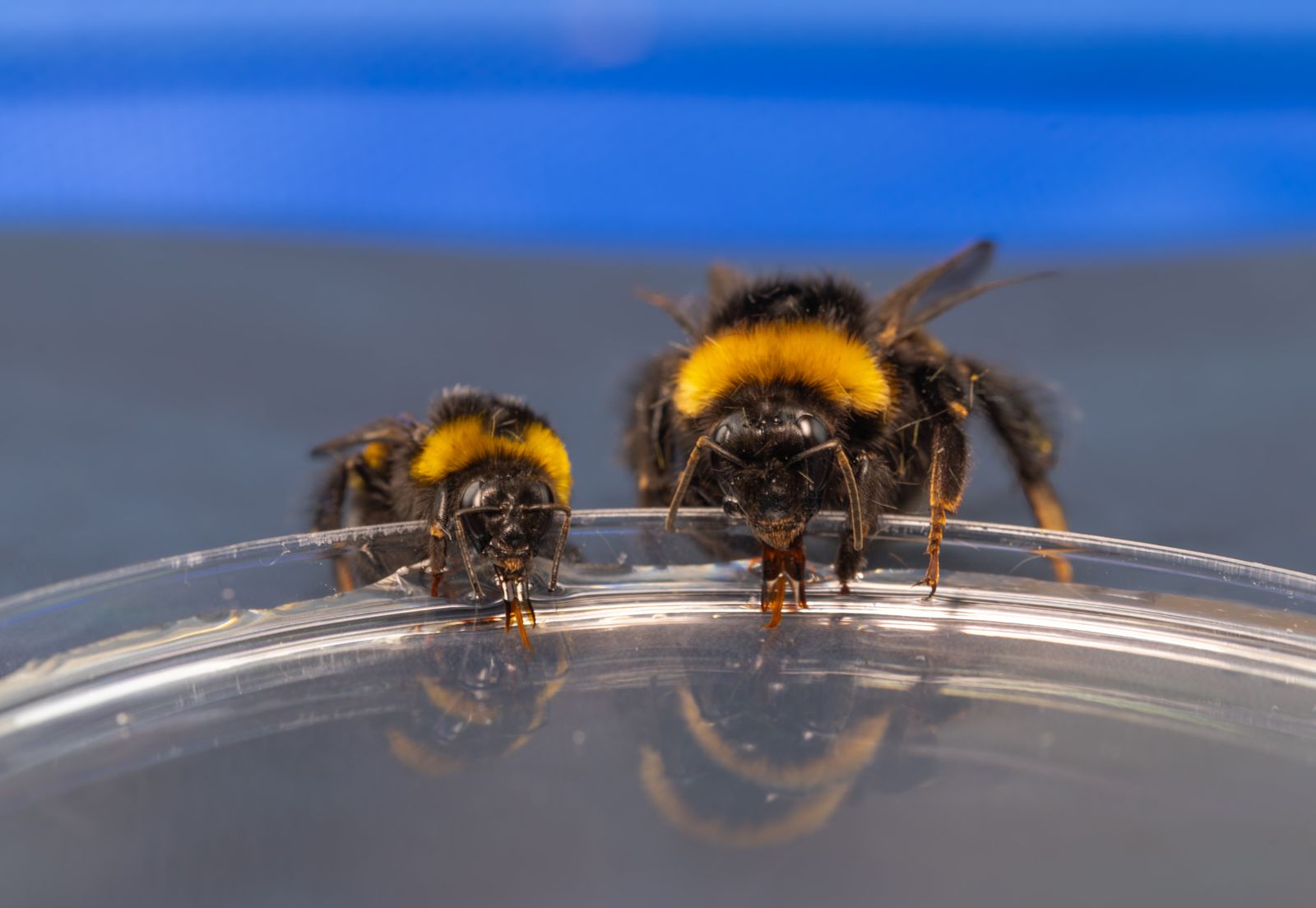
:focal(2523x1742:2524x1743)/https://tf-cmsv2-smithsonianmag-media.s3.amazonaws.com/filer_public/7f/1a/7f1a93f4-6d96-4239-a28e-250318bc6a8b/25-27391-1.jpg) A worker bee (left) and a queen bee (right) slurp up artificial nectar during laboratory experiments.
Zexiang Huang, Shumeng Wu, Qinglin Wu
A worker bee (left) and a queen bee (right) slurp up artificial nectar during laboratory experiments.
Zexiang Huang, Shumeng Wu, Qinglin Wu
Every spring, enterprising queen bumblebees emerge from hibernation and set to work starting new colonies from scratch. They fuel themselves by seeking out flowers and slurping up nectar.
But once these large, solitary females have established nesting sites, laid eggs and cared for the first hatchlings, they start delegating. Worker bees, for instance, take over all foraging duties, bringing nectar, pollen, water and other resources back to the hive.
But why? New research hints at a potential physical reason for this behavioral shift. Queen bumblebees have sparser hair on their tongues than worker bees, which makes the royals less efficient at lapping up nectar, according to a new study published January 12 in the journal Proceedings of the National Academy of Sciences.
Scientists have long wondered why queens stop foraging once the first worker bees are old enough to buzz out into the world and search for food. Past research suggests that queens remain in their nests because of hormonal changes or differences in metabolism. Another possibility: Since queens are the only fully reproductive females in each hive, it may be more advantageous for the colony if they dedicate all their energy to egg-laying—a phenomenon known as task specialization.
But recently, a team of researchers wondered if physical differences might help explain the shift. To test that hunch, they took a closer look at the mouthparts of 99 buff-tailed bumblebees—32 queens and 67 workers—using a special, high-powered microscope. Their investigation revealed that the bees’ tongues ranged in length from around four millimeters to ten millimeters, and that they were covered in tiny hairs. The queens’ tongues, however, tended to be longer and less hairy than those of the worker bees, they found.
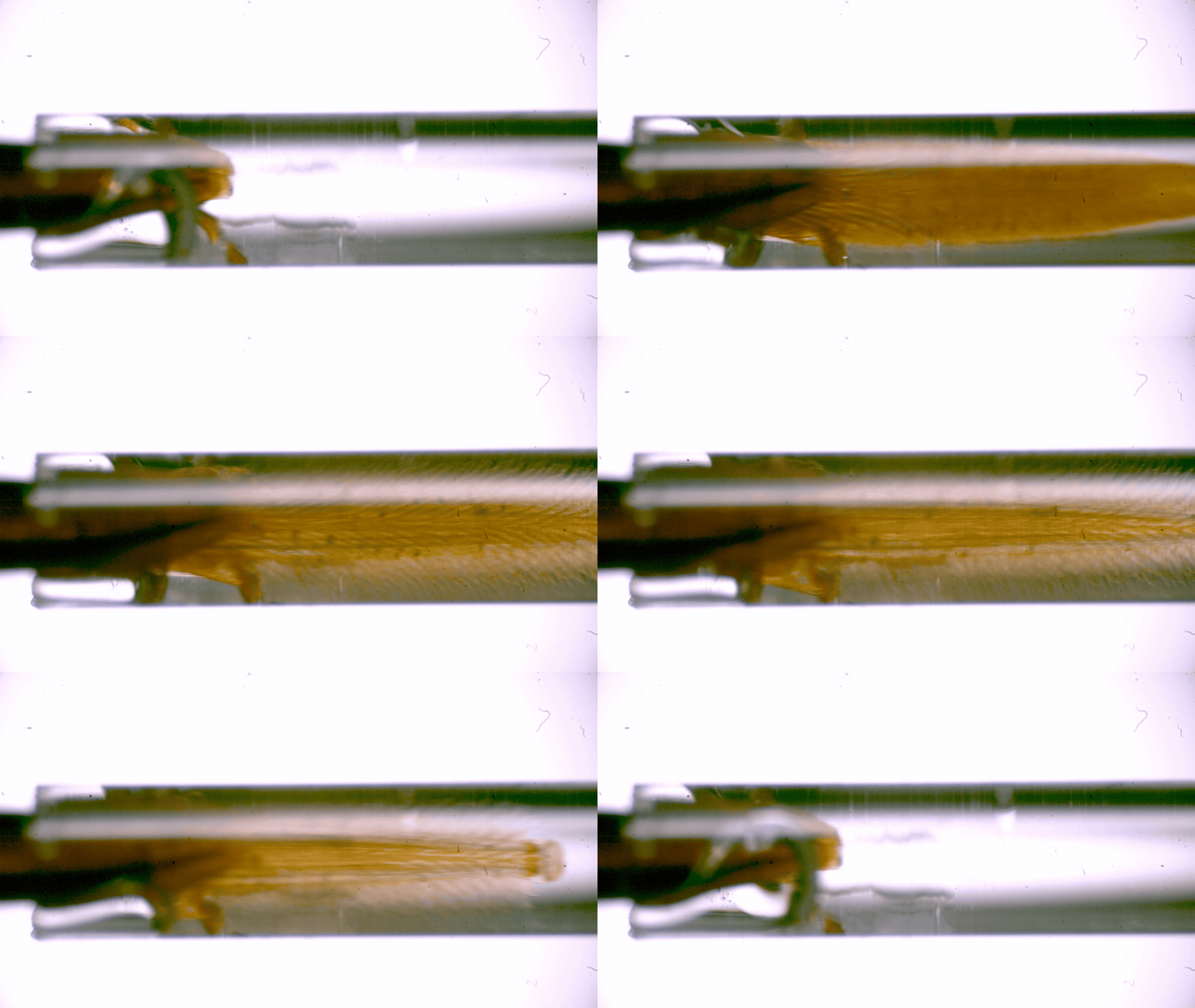 The scientists recorded high-speed video footage of the bees' tongues slurping up nectar.
Z. Huang et al., PNAS, 2026 under CC BY 4.0
The scientists recorded high-speed video footage of the bees' tongues slurping up nectar.
Z. Huang et al., PNAS, 2026 under CC BY 4.0
When the scientists recorded high-speed videos of the bees feasting on artificial nectar, they also learned the queens were less efficient at feeding—largely because of the sparser hair on their tongues. In worker bees, the denser hair creates small, tightly packed gaps that suck in nectar.
“That space between the hair is able to pull fluid in” thanks to capillary action, Patrick Spicer, a fluidics engineer at the University of New South Wales in Australia, told New Scientist’s Ruby Prosser Scully in 2019.
Need to know: What is capillary action?Capillary action takes place when molecules in a liquid are more attracted to the walls of a vessel, like the bees’ tongue hairs, than to the other molecules in the liquid. That forces the liquid to move upward.
To further confirm these differences, the researchers fed the bees several artificial nectars with different proportions of water and sugar. Workers easily slurped up all kinds of nectar—thick, thin and in-between—while the queens performed best when they lapped up thicker, less watery syrups.
Overall, the analysis reveals a “scaling mismatch” between tongue length and hair spacing in queens, which ultimately limits their ability to capture nectar, the researchers write in the paper. It points to subtle deviations that can influence how labor gets divvied up among insects within a community.
In addition to solving a long-standing bee mystery, the findings could have practical implications for bee breeders and apiaries, as well as growers who rely on insect pollination for the success of their crops, reports Science News’ Emily Conover. A better understanding of the bees’ tiny tongue hairs might help people predict how well the insects can harvest different kinds of nectar, Saad Bhamla, a biophysicist at Georgia Tech who was not involved with the research, tells the outlet.
Get the latest stories in your inbox every weekday.
Comments (0)