
Remember me







/https://tf-cmsv2-smithsonianmag-media.s3.amazonaws.com/accounts/headshot/SarahKuta.png)
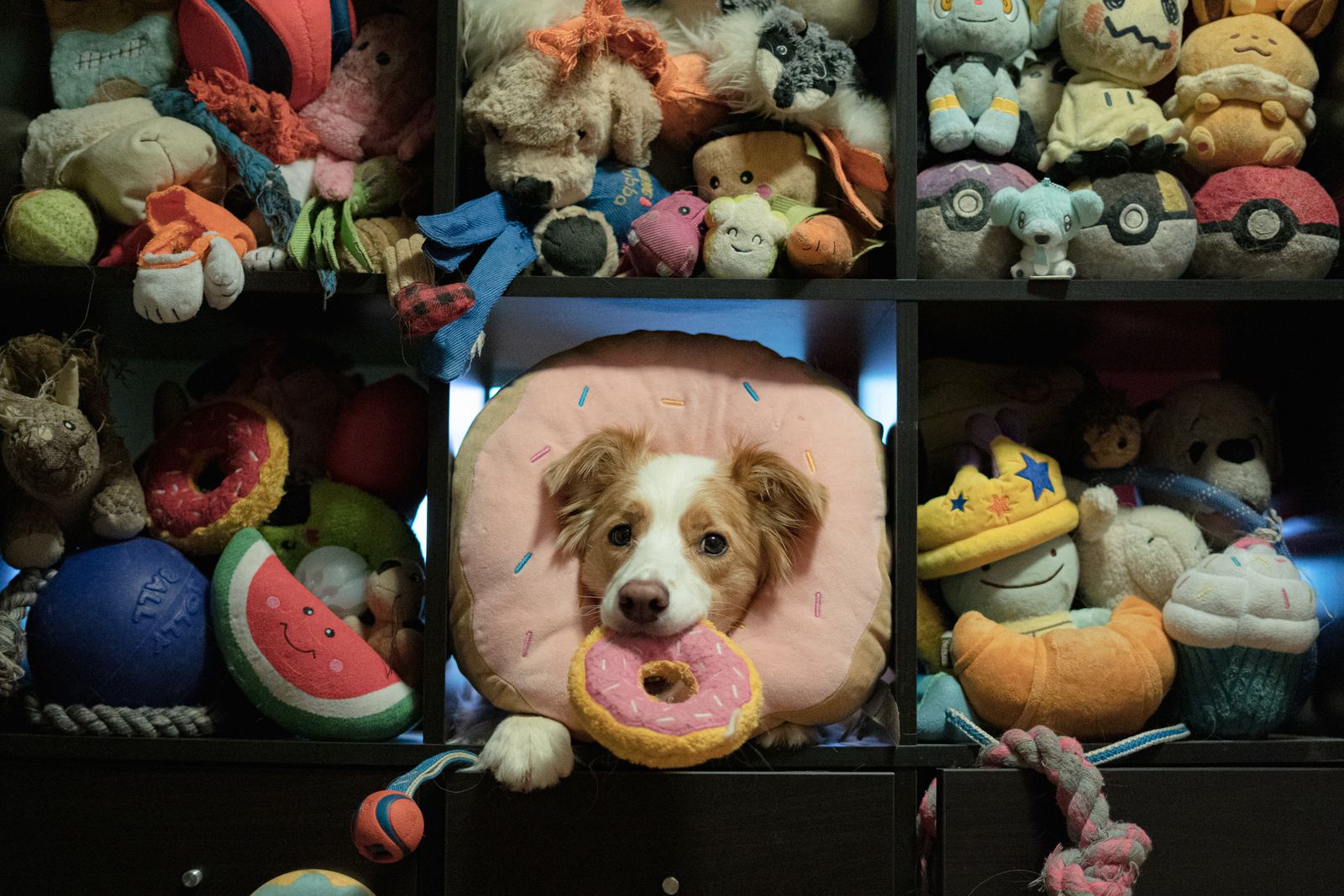
:focal(2669x1779:2670x1780)/https://tf-cmsv2-smithsonianmag-media.s3.amazonaws.com/filer_public/70/61/70619168-58b3-4c75-88b7-5d43de4b8476/dror_adq5474_image_1.jpg) The study involved pups like Miso, a 6-year-old male border collie from Canada who knows the names of about 200 toys.
Veronica Suen
The study involved pups like Miso, a 6-year-old male border collie from Canada who knows the names of about 200 toys.
Veronica Suen
Eavesdropping on their owners seems to help some highly gifted dogs learn new words, a complex cognitive and social ability that may put them on par with human toddlers.
New research published this month in the journal Science suggests some canines are even smarter than previously thought. The findings also add to the growing body of work that suggests language may not be entirely unique to humans.
Scientists—and pet parents—already know dogs can learn words like “sit” and “stay,” as well as their own names. But some special pups can also remember the names of specific objects, amassing large vocabularies for all the toys in their households. These pups, called “gifted word learners,” are relatively rare and seem to be able to remember labels for years.
Most of the time, these gifted word learners seem to pick up the names of their toys through direct interactions with their owners, such as playing or training. But researchers wondered whether these prodigious pups might also be able to learn new labels in indirect ways, such as by listening in on human conversations.
To investigate, they recruited ten gifted word learners for laboratory experiments: seven Border collies, one Labrador retriever, one miniature Australian shepherd and one Australian shepherd/blue heeler mix.
/https://tf-cmsv2-smithsonianmag-media.s3.amazonaws.com/filer_public/90/e2/90e27b97-3839-4a66-8305-433a4353c794/low-res_bryn.jpg) Bryn, an 11-year-old male Border collie who knows the names of about 100 toys.
Helen Morgan
Bryn, an 11-year-old male Border collie who knows the names of about 100 toys.
Helen Morgan
In one experiment, the scientists asked the pups’ human family members to discuss and handle a new toy, taking care not to interact directly with the pooch, which was watching nearby. The humans used the toy’s name while passing it back and forth amongst themselves, saying things like, “This is your armadillo. It has armadillo ears, little armadillo feet. It has a tail, like an armadillo tail,” per NPR’s Nell Greenfieldboyce. The researchers repeated these interactions over the course of several days, ultimately introducing each dog to two new toys.
For comparison, in another experiment, the researchers had the family members introduce new toys to the dogs directly. The owners repeated the names of the toys and allowed the canines to play with them.
Later, the scientists placed the new toys—along with nine other objects the pups were already familiar with—in a room. They then had the owners ask the dogs to retrieve particular toys by name.
The pooches that had been introduced to the new toys directly performed slightly better than those who had only heard its name while eavesdropping, picking the right toy 90 percent of the time compared with 80 percent of the time. But the researchers say that, statistically, this difference is negligible. Additionally, seven of the dogs did better than chance at picking the correct toy in both experiments.
“With some of the dogs, it’s like they had no doubt about what they were supposed to be doing,” says lead author Shany Dror, a cognitive researcher and animal trainer now at the University for Veterinary Medicine in Vienna who conducted the research while at Eötvös Loránd University in Hungary, to Scientific American’s Jackie Flynn Mogensen. “They would just go into the room, straight to the toy that they knew [was] the new toy and [then brought] it immediately.”
When the researchers conducted similar experiments with typical family dogs that did not have robust vocabularies, none of those pups performed better than chance, which suggests the ability may be unique to gifted word learners.
Overall, however, the researchers argue the study provides convincing evidence that some dogs can learn words from overheard speech, a skill that had previously been found in bonobos and, possibly, African grey parrots, reports the Guardian’s Nicola Davis.
The behavior is also similar to how some 18-month-old children pick up new words—as any parent who has uttered a curse word when they thought their toddler was out of earshot, only to hear it repeated back to them later, can attest. This means the dogs have “sociocognitive skills” that are “functionally parallel” to human 18-month-olds, the researchers write in the paper.
“The fact that [the dogs] can hear and overhear people passing an item back and forth and labeling it—and then pick up on that word—means that they are attending to that conversation,” says Heidi Lyn, a comparative psychologist at the University of South Alabama who was not involved with the research, to Scientific American. “That’s a pretty sophisticated attentional and cognitive leap that they’re making.”
The findings make sense within the context of domestication: Historically, the dogs that were good at understanding and communicating with humans were the ones that had the best chances of surviving and passing along their genes to their offspring, per CNN’s Amarachi Orie.
The study’s results may also hint at the evolutionary origins of language learning. “The fact that this skill also exists in a species that does not have language suggests that the skill itself predates language,” Dror tells the Guardian. “So humans first evolved an ability to understand complex social interactions and only later used this complex understanding to develop language.”
Overall, outside experts were impressed with the study, but they also cautioned against making direct comparisons between dog and human language learning abilities. “The interpretation in terms of ‘word learning’ in the linguistic sense seems a little too strong for me,” Juliane Kaminski, a comparative psychologist at the University of Portsmouth in England who was not involved with the project, tells the Washington Post’s Dino Grandoni.
Others noted potential limitations of the experimental setup. For instance, the pups who participated have been influenced by the laboratory environment, Federico Rossano, a comparative cognition researcher at the University of California, San Diego, who was not involved in the research, tells the New York Times’ Emily Anthes.
“I am looking forward to seeing it replicated in maybe a little more controlled way,” he says, adding that future studies could instead be conducted in the dogs’ home environments.
Still, Dror hopes the findings might encourage all pet parents to respect their pooches’ social and cognitive abilities a little bit more. “This can really give us more appreciation to how exceptional dogs can be,” she tells the Washington Post.
Get the latest stories in your inbox every weekday.
Comments (0)