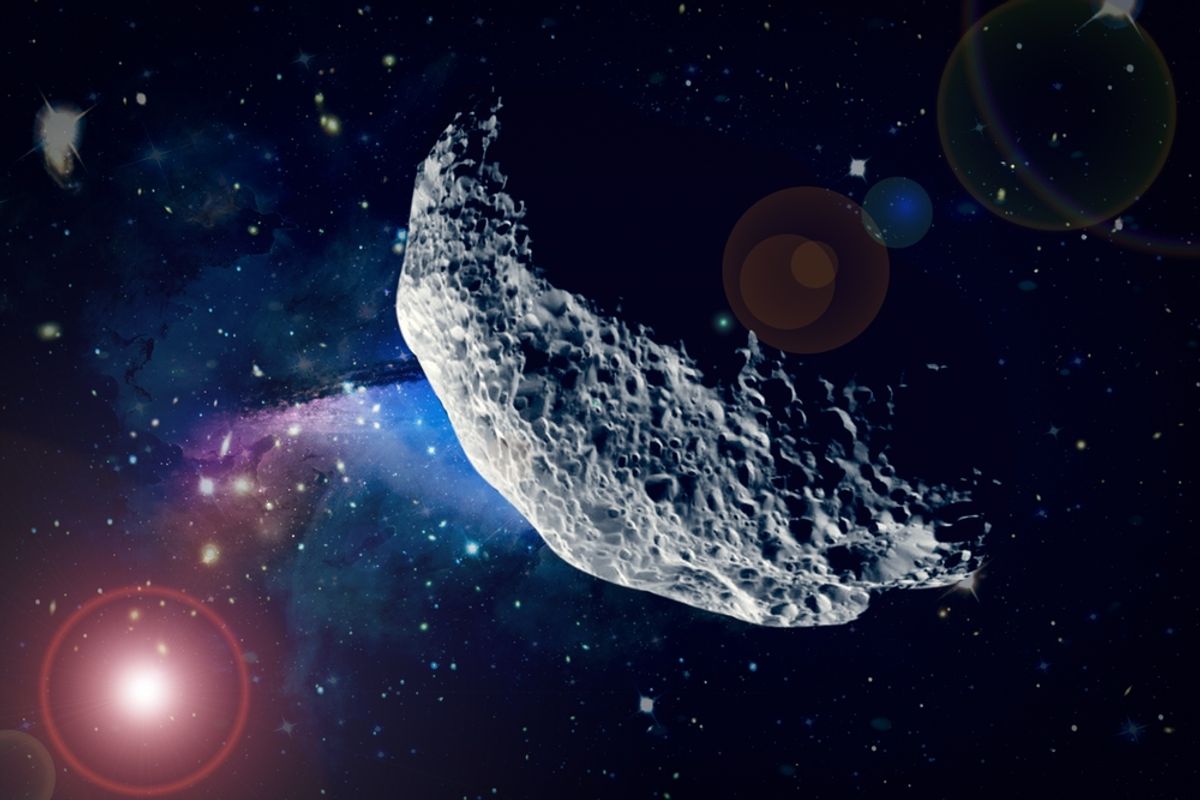
2025 MN45 might not sound particularly catchy or noteworthy, but it has piqued astronomers’ interest for one very specific reason: it is the fastest mini-planet of its size detected to date.
At 710 meters (2,297 feet), the asteroid is more than twice the length of the Eiffel Tower and spins on its axis once every 1.88 minutes.
2025 MN45 is one of thousands of asteroids recently identified by scientists at the NSF-DOE Vera C. Rubin Observatory using the Legacy Survey of Space and Time (LSST) Camera — the largest digital camera ever built.
Nineteen were categorized as being either super or ultra-fast-rotating. That means a spin time of less than 2.2 hours or 5 minutes, respectively. The findings have now been reported in The Astrophysical Journal Letters.
2025 Mn45: A Record-Breaking Asteroid
Asteroids are small chunks of rock that have been floating through the Solar System since its formation some 4.6 billion years ago. There are approximately 1.45 million of these objects known to science, the majority of which are thought to be composed of smaller rocks essentially glued together by gravity. These are known as “rubble pile” asteroids.
This rickety structure makes them particularly vulnerable to fragmentation. It is thought that the fastest rubble piles in the main asteroid belt can spin without falling apart is one rotation every 2.2 hours.
To spin faster than 2.2 hours and avoid fragmentation, the asteroid must be structurally sound. To spin at speeds of 2 minutes or less, it must be exceptionally strong. With a spin time of 1.88 minutes, 2025 MN45 is the fastest known asteroid with a diameter of 500 meters or more.
“We calculate that it would need a cohesive strength similar to that of solid rock,” lead author Sarah Greenstreet, NSF NOIRLab assistant astronomer and lead of Rubin Observatory’s Solar System Science Collaboration’s Near-Earth Objects and Interstellar Objects working group, explained in a statement.
Despite this exceptional feat, main-belt asteroid 2025 MN45 only just made it to the top spot. It narrowly beat 2025 MJ71 — a Near Earth Object (NEO) with a spin time of 1.9 minutes. Other runners-up possessed spin speeds of 3.8 minutes (2025 MK41), 13 minutes (2025 MV71), and 16 minutes (2025 MG56).
Discovering Thousands Of New Asteroids
The findings are based on observations taken at the end of April and the beginning of May 2025 using the LSST Camera, which detected approximately 2,000 asteroids never before seen. From these observations, astronomers at the observatory were able to calculate the shape and rotation period of the asteroids by studying how their brightness fluctuates over time.
The team was able to collect reliable data on 76 asteroids with a rotation speed under 21.3 hours — an assemblage that included one NEO, 73 main-belt asteroids, and a further two on the outskirts of the main asteroid belt. This contrasts with previous discoveries of fast-rotating objects, which have mostly been classified as NEOs.
Rubin Observatory: “A Discovery Machine”
This is just the start, with the Rubin Observatory due to begin its 10-year LSST mission — a project that will involve imaging the entirety of the southern sky every 3 days. It is expected to capture light from up to 5 million asteroids, meteoroids, and other small bodies. These findings could lead to new discoveries that improve our understanding of the Solar System's history.
“We have known for years that Rubin would act as a discovery machine for the universe,” Aaron Roodman, Deputy Head of LSST and professor of Particle Physics and Astrophysics at SLAC, said in a statement. “The ability to find thousands of new asteroids in such a short period of time, and learn so much about them, is a window into what will be uncovered during the 10-year survey.”
Read More: Vera C. Rubin Observatory Captured This Cotton Candy Nebula, Here's What it Will Capture Next
Article Sources
Our writers at Discovermagazine.com use peer-reviewed studies and high-quality sources for our articles, and our editors review for scientific accuracy and editorial standards. Review the sources used below for this article: